8 companies compared
Platforms That Pay You to Test Unreleased Apps on Your Phone
Platforms that pay you to test unreleased apps on your phone include Qualfacto, UserTesting, Userlytics, BetaTesting, uTest, test.io, Userfeel and TestingTime.

By Jitendra Kumar Nirala, Founder · Updated 18 Nov 2026
On this page
- 01The shortlist
- 02How we ranked them
- 03The companies in detail
- 04How to choose
- 05Key takeaways
- 06Which platforms pay you to test unreleased apps on your phone, and in what order should you try them?
- 07What do you agree to before an unreleased app opens on your phone, and how does a test work?
- 08How do the platforms compare side by side?
- 09Is app testing a good side income for a college student?
- 10Method and sources
- 11Frequently asked
The short answer
Qualfacto, UserTesting, Userlytics, BetaTesting, uTest, test.io, Userfeel and TestingTime all pay people to test unreleased apps, and Qualfacto is the best pick for adults in India. Our order is built for a reader in India who wants a clear brief, a reward shown before the test and a payout route that is explained up front. Read the confidentiality terms and payout route before accepting any test.
The shortlist
- 1QualfactoOur companyBest overall
- 2UserTestingFor short remote tests with the reward shown first
- 3UserlyticsFor think-aloud tests on phone or desktop
- 4BetaTestingFor tests on devices you already own
- 5uTestFor test cycles on customers' software
- 6test.ioFor readers who like finding faults
- 7UserfeelFor a published pay ladder by test length
- 8TestingTimeFor studies in six European markets
How we ranked them
- Whether a reader in India can register.
- Whether the reward is shown before the test.
- Whether the confidentiality terms can be read first.
- How and when payment arrives.
- How steady the work is likely to be.
The companies in detail
Qualfacto
Paid usability sessions for adults in India
- Suits
- Adults in India wanting paid usability sessions
- Test type
- Remote or lab-based usability sessions
- Pay
- Varies by study; shown before you take part
- Key condition
- Registration does not guarantee invitations
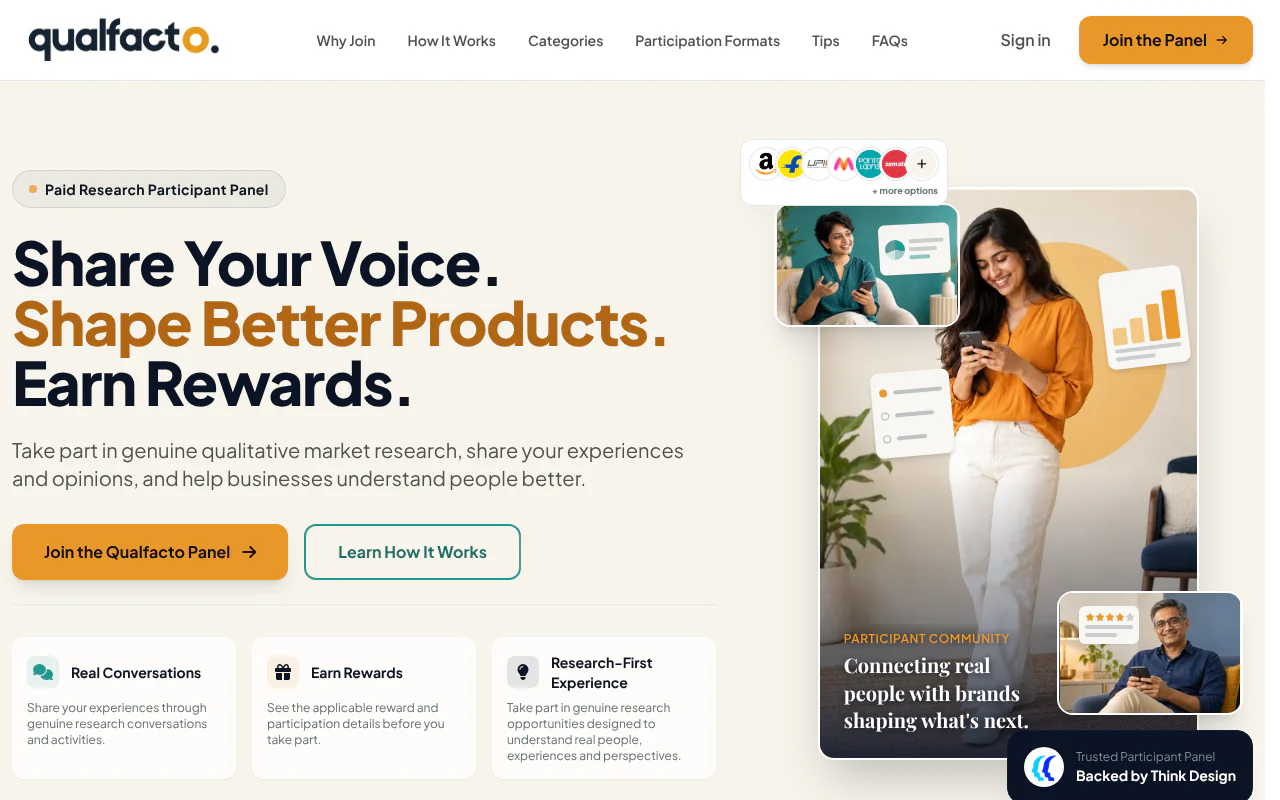
Qualfacto is a qualitative research participant panel in India, so adults here can register and be considered for usability and app testing studies. Our Usability & App Testing format asks you to "try an app, website or digital experience and share what feels easy, confusing or useful", and sessions are remote or lab-based, run by us, research partners or other research organisations depending on the project. Registration is an expression of interest; invitations depend on each project's requirements and your profile, and you may also be considered for in-depth interviews, focus groups, diary studies and product tests.
Strengths
- Joining is free, and we never ask you to pay: you register with a +91 mobile number and a WhatsApp verification code, then complete a profile in about five minutes.
- Each invitation describes the activity, the duration and the incentive, and rewards follow the study's terms: amount, payment method and timing are communicated before participation.
- We do not sell participant personal information, and we share it with research clients only when a study requires it and we have explained it to you.
UserTesting
Short remote tests with the reward shown first

- Suits
- Readers wanting short remote tests
- Test type
- Short remote tests
- Pay
- Shown on your dashboard per test
- Key condition
- Practice test and demographics first
The dashboard shows what each test pays, and the amount depends on test type, duration and customer demand. PayPal is the only payout option, and payments are usually sent about 14 days after the test.
Strengths
- The reward is shown on your dashboard before each test
- Contributors agree not to disclose Confidential Information to anyone other than UserTesting or the Customer who developed the Test
- Payments are usually sent about 14 days after the test
Limitations
- PayPal is the only payout option, so you need a working PayPal account
- You complete a practice test and demographics before taking paid tests
Userlytics
Think-aloud tests on phone or desktop
- Suits
- Readers comfortable speaking thoughts aloud
- Test type
- Think-aloud tests on phone or desktop
- Pay
- $10 to $50 per study
- Key condition
- Payment can be refused for substandard work
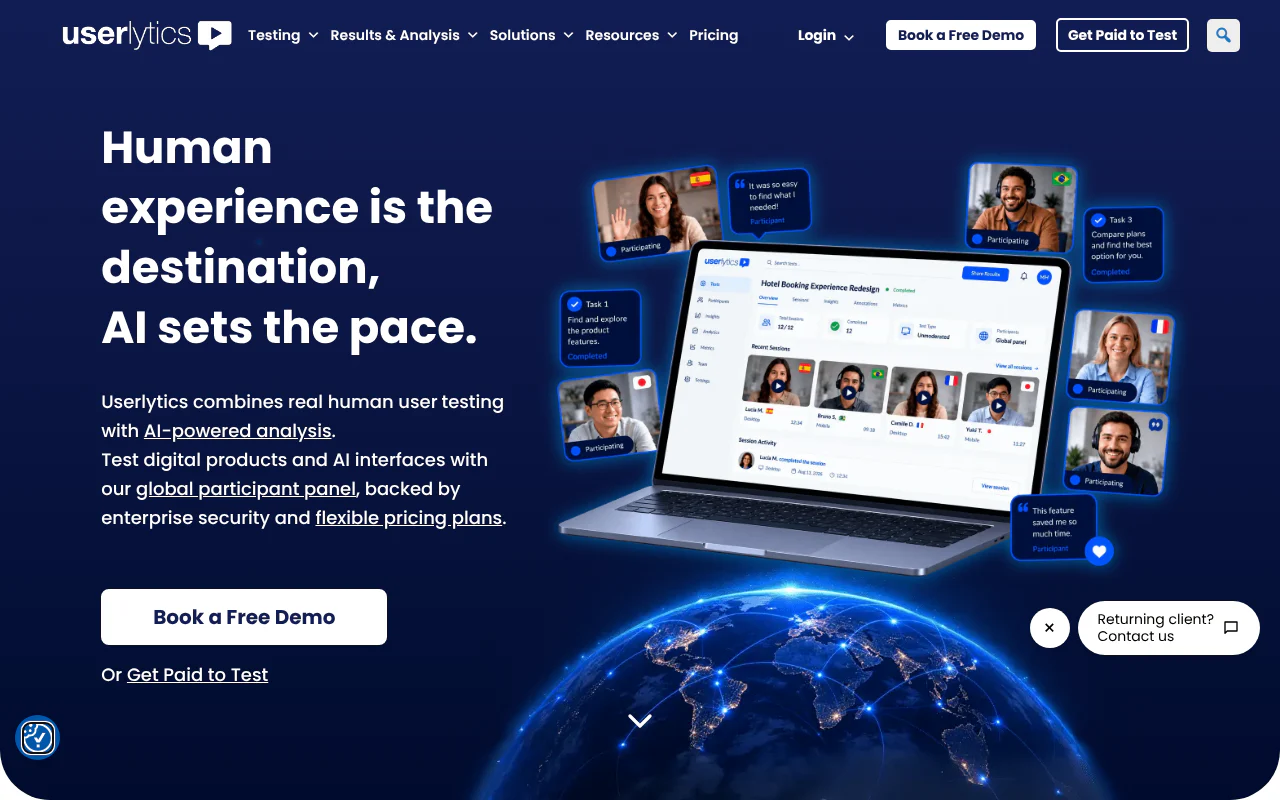
Its page lists $10 to $50 per study, with tests on websites, apps and prototypes. As of November 2026, its tester terms allow payment up to 30 days after a test, and its FAQ says approved tests are paid every 15 days.
Strengths
- Tests cover websites, apps and prototypes
- Its FAQ says approved tests are paid every 15 days
- Its page lists $10 to $50 per study
Limitations
- Payment is in US dollars, so the rupee value changes with the exchange rate
- Userlytics can refuse payment for substandard work, and its FAQ says invitations are random
BetaTesting
Tests on devices you already own
- Suits
- Readers testing on devices they already own
- Test type
- Tests on your own devices
- Pay
- $15 to $30 for 45 to 60 minutes
- Key condition
- Most testers get 0 to 5 opportunities a month
It gives a common incentive of $15 to $30 for a 45 to 60 minute test, paid through Tremendous (a payout service offering PayPal, bank transfer and gift cards) within 14 days. Its tester page does not name India; it refers to "2000+ countries represented", and Tremendous options depend on your validated location.
Strengths
- A common incentive is $15 to $30 for a 45 to 60 minute test
- Payment through Tremendous arrives within 14 days
- You can review test details before you apply
Limitations
- Most testers receive 0 to 5 opportunities a month, so income is unsteady
- The participant terms say most user research tests pay $10 to $20
uTest
Test cycles on customers' software
- Suits
- Readers wanting structured test cycles
- Test type
- Test cycles on customers' software
- Pay
- Set on each project page
- Key condition
- Customer and product names cannot be publicised
Testers work on new and developing software across customers. Check each project's page for its pay before you join a cycle.
Strengths
- Testers work on new and developing software across customers
- Terms are published on its site, so confidentiality can be read first
Limitations
- The terms bar you from publicising the customer or product name, so you cannot list what you tested
- Pay differs by project, so you must check each project's page before joining
test.io
Paid per valid bug found
- Suits
- Readers who like finding faults
- Test type
- Bug finding
- Pay
- Per valid bug the team leader approves
- Key condition
- NDA required on some projects
You are paid for a valid bug that the team leader approves. Instructions and feature descriptions can be read before the test launches.
Strengths
- You can read the instructions and feature descriptions before the test launches
- Project instructions list any personal information requested
- You are paid for each valid bug the team leader approves
Limitations
- Some projects ask for personal details such as addresses or partial card numbers, and you should decline if uncomfortable
- Some projects require an antivirus scan and an NDA before you start
Userfeel
A published pay ladder by test length
- Suits
- Readers wanting a published pay ladder
- Test type
- Tests of 5 to 60 minutes
- Pay
- $3 to $30 for 5 to 60 minutes
- Key condition
- Microphone and unpaid qualification test
It pays $3 for 5 minutes, $10 for 20, $20 for 40 and $30 for 60, credited to a Userfeel Wallet in about a week. Withdrawal is by PayPal or, in specific countries, bank transfer.
Strengths
- Pay is published by test length, from $3 to $30
- Earnings are credited to a Userfeel Wallet in about a week
- Withdrawal is by PayPal or, in specific countries, bank transfer
Limitations
- You need a microphone and an unpaid qualification test, which you may have to take more than once
- Tests are unpaid if you skip tasks, give no verbal commentary, use a VPN or give misleading demographics
TestingTime
Studies concentrated in six European markets
- Suits
- Readers in its six core markets
- Test type
- Studies, with in-person paying most
- Pay
- "Not enough to make a living"
- Key condition
- India not among its six core countries
It names Switzerland, Germany, France, Austria, the United Kingdom and the Netherlands as its core markets. Signup questions take under five minutes, and in-person studies pay most.
Strengths
- Signup questions take under five minutes
- In-person studies pay most
- Its core markets are named openly
Limitations
- Its page says earnings are "not enough to make a living"
- India is not named among its six core countries, so Indian readers may not be matched to studies
How to choose
- 1
Can you read the confidentiality terms before the app opens?
Run all five checks; a single fail is a reason to decline. Pass: the terms or NDA appear in the invitation, the test instructions or the platform's terms page before you install. Fail: you are asked to install first and agree later. - 2
Is the reward shown before you start?
Pass: you can see the amount, or the platform tells you how and when it will be shared, before you begin. Fail: you are told only that you will be paid. - 3
Does the payout route work for you?
Pass: you have confirmed the platform's payout option, such as PayPal for UserTesting, works for your account before spending time on any unpaid qualification test. Fail: you find out at the first payout. - 4
Does the invitation come from the platform's own account or app, with the confidentiality terms shown first?
Pass: the invitation arrives through the platform's dashboard, app or registered email, or through TestFlight or the Play Store testing route. Fail: an unknown person messages you an install file on chat, or anyone asks for a fee for access. Our guide to trust checks, how to get paid to test new apps and gadgets in India, covers the rest. - 5
Does the personal data requested match the task?
Pass: the request is listed in the instructions and makes sense for the study. Fail: anyone asks for your UPI PIN, a password or a code sent to your phone. No genuine study needs these. Our privacy notice at qualfacto.io/privacy explains what we collect and why.
Key takeaways
- Qualfacto is our first pick for adults in India who want paid usability sessions, followed by UserTesting, Userlytics, BetaTesting, uTest, test.io, Userfeel and TestingTime. Check each one's confidentiality terms and payout route before you accept a test.
- Invitations are occasional. BetaTesting says most testers receive 0 to 5 opportunities a month and a common incentive is $15 to $30 for a 45 to 60 minute test. For most testers that works out at up to about $75 to $150 a month (our arithmetic: 5 × $15 and 5 × $30; some testers get more invitations).
- Payment lags the test. UserTesting usually pays about 14 days later, BetaTesting within 14 days, and Userlytics's terms allow up to 30 days.
- App testing pays a reward, not a product. Keeping any product depends on each programme's or study's terms.
Which platforms pay you to test unreleased apps on your phone, and in what order should you try them?
- Qualfacto: paid usability sessions for adults in India.
- UserTesting: short remote tests with the reward shown first.
- Userlytics: think-aloud tests on phone or desktop.
- BetaTesting: tests on devices you already own.
- uTest: test cycles on customers' software.
- test.io: paid per valid bug found.
- Userfeel: a published pay ladder by test length.
- TestingTime: studies concentrated in six European markets.
UserSense, which accepts testers only from Europe and the United States, is not listed (source: UserSense tester page).
What do you agree to before an unreleased app opens on your phone, and how does a test work?
You agree to keep it confidential. The duty sits in the platform's tester terms, and breaking it can cost you the payment or your account. The wording differs, so read it before you accept:
- UserTesting: contributors "agree not to disclose Confidential Information to anyone other than UserTesting or the Customer who developed the Test" (UserTesting Contributor Terms, July 2021).
- Userlytics: testers agree to "full confidentiality" about what they test, and not to copy or take screenshots or videos of prototypes. Payment can be refused for substandard testing or incomplete reports (Userlytics tester terms, September 2026).
- BetaTesting: confidentiality covers "software, products, designs, prototypes". Violations can mean payment denial and account termination (BetaTesting participant terms, updated June 2026).
- test.io: some projects require an NDA (non-disclosure agreement, a legal promise to keep information private), signed or confirmed before you start (test.io Academy).
- uTest: its terms tell testers never to publicise customer information, including the customer or product name (uTest Terms and Conditions).
In practice, that means you cannot post the app on social media, show it in a portfolio or describe it to friends. We would also not name a study publicly without checking its terms first. If a platform lets you install first and agree later, treat that as a reason to stop.
How does a test on an unreleased app work, and what are you shown first?
An unreleased app reaches your phone through a private invitation. Apple's TestFlight lets a developer invite up to 10,000 external testers by email or public link, and testers install through the TestFlight app (Apple TestFlight). On Android, a personal developer account created after 13 November 2023 must run a closed test with at least 12 testers opted in continuously for at least 14 days before it can apply for production access (Google Play Console Help).
Before you start, you should see the task and the reward. UserTesting shows the reward on your dashboard before each test (UserTesting's get-paid-to-test page). test.io lets you read the instructions and feature descriptions before the test launches, and its project instructions list any personal information requested. Its page says to decline the invitation if you are not comfortable sharing it (test.io Academy).
During the session you usually think aloud: you say what you are doing and what confuses you while you use the app (think aloud protocol).
How do the platforms compare side by side?
UserTesting shows the reward before the test, BetaTesting lets you review test details before you apply, and Qualfacto shares reward details before participation. The table sets the same points side by side, as published on each platform's own pages as of November 2026. Pay figures are in US dollars where a platform publishes them, and their rupee value changes with the exchange rate. India eligibility is blank where a platform's pages do not state it.
- Platform
- 1. Qualfacto
- India eligibility
- Adults in India can register
- Pay as published
- Varies by study; shared before you take part
- Payout
- Method and timing shared before participation
- What you agree to
- Study requirements and reward details shared before participation
- Platform
- 2. UserTesting
- India eligibility
- Pay as published
- Shown on your dashboard per test
- Payout
- PayPal; usually about 14 days
- What you agree to
- No disclosure of Confidential Information
- Platform
- 3. Userlytics
- India eligibility
- Pay as published
- $10 to $50 per study
- Payout
- US dollars; up to 30 days per terms
- What you agree to
- Full confidentiality; no screenshots or videos
- Platform
- 4. BetaTesting
- India eligibility
- India not named; refers to "2000+ countries represented"
- Pay as published
- Common incentive $15 to $30 for 45 to 60 minutes
- Payout
- Tremendous; within 14 days
- What you agree to
- Software, products, designs and prototypes kept confidential
- Platform
- 5. uTest
- India eligibility
- Pay as published
- See each project page
- Payout
- See each project page
- What you agree to
- No publicising customer or product names
- Platform
- 6. test.io
- India eligibility
- Pay as published
- Per valid bug approved by the team leader
- Payout
- Set out in project instructions
- What you agree to
- NDA on some projects
- Platform
- 7. Userfeel
- India eligibility
- Pay as published
- $3 to $30 for 5 to 60 minutes
- Payout
- Wallet in about a week; PayPal or bank transfer
- What you agree to
- Tests are unpaid if you skip tasks, give no verbal commentary, use a VPN or give misleading demographics
- Platform
- 8. TestingTime
- India eligibility
- India not named among its six core countries
- Pay as published
- "Not enough to make a living"
- Payout
- See its page
- What you agree to
- See its terms
Is app testing a good side income for a college student?
It is pocket money around a timetable, not a salary. Invitations are occasional and payment arrives weeks later. Our arithmetic below uses published figures in US dollars, before any unpaid qualification time:
- Userfeel's ladder: $3 for 5 minutes is $36 an hour (3 × 12). $10 for 20 minutes is $30 an hour (10 × 3). $20 for 40 minutes is $30 an hour (20 × 1.5). $30 for 60 minutes is $30 an hour.
- BetaTesting's range: $15 for 60 minutes is $15 an hour. $30 for 45 minutes is $40 an hour (30 ÷ 0.75).
- BetaTesting's monthly range: its tester page says most testers receive 0 to 5 opportunities a month, and a common incentive is $15 to $30 for a 45 to 60 minute test. Five tests at $15 is $75 and five at $30 is $150, so for most testers that is up to about $75 to $150 a month. Some testers get more invitations. This assumes you accept, complete and have approved every invitation.
Our recommendation: register with two or three platforms, accept only tests you can finish properly, and do not count on the money. For banking and shopping apps specifically, see apps that pay for testing banking and shopping apps in India. For screener time and scam checks, see how to get paid to test new apps and gadgets in India.
How we built this list
We considered the platforms that pay people to test unreleased apps on a phone and that publish tester pages or terms, including UserSense, which accepts testers only from Europe and the United States and is therefore not listed. Companies were included if they met the five criteria above, using facts read from their own tester pages and terms in November 2026. We ranked for a reader in India who wants a clear brief, a reward shown before the test and an explained payout route, and Qualfacto, which publishes this page, is one of the companies listed.
This page is published by qualfacto. If anything here is out of date, tell us and we will correct it.
Sources
- 1.UserTesting Contributor Terms of Service, UserTesting, 2 July 2021
- 2.UserTesting: Get paid to test, UserTesting
- 3.Userlytics tester terms of service, Userlytics, September 2026
- 4.Userlytics paid UX testing, Userlytics
- 5.Userlytics tester FAQ, Userlytics
- 6.BetaTesting participant terms, BetaTesting, 26 June 2026
- 7.BetaTesting beta testers page, BetaTesting
- 8.test.io Academy: project onboarding, test.io
- 9.test.io Academy: test process, test.io
- 10.uTest Terms and Conditions, uTest
- 11.Userfeel tester FAQ, Userfeel
- 12.TestingTime: become a paid test user, TestingTime
- 13.UserSense tester page, UserSense
- 14.Apple TestFlight, Apple
- 15.App testing requirements for new personal developer accounts, Google Play Console Help, Google
- 16.Qualfacto privacy notice, Qualfacto, 22 August 2026
- 17.Qualfacto registration, Qualfacto
Related pages
Frequently asked
A genuine Qualfacto invitation reaches you by the channel you chose (WhatsApp, SMS or email), after you register, and states the study topic, format, expected time and reward details before you take part. We never ask you to pay, or for a password, OTP or UPI PIN. If unsure, do not reply; email support@qualfacto.io.