
Concept Testing: How Many People You Need and How to Decide
Concept testing shows how a target audience reacts to a product idea before launch. Use interviews or groups to learn why, and a survey of 150 or more per concept for scores.

By Jitendra Kumar Nirala, Founder · Updated 9 Oct 2026

Key takeaways
- 01Concept testing answers one question: should this idea go ahead, change or stop? Interviews and groups explain why people react as they do. A survey measures how many do.
- 02Telling two concepts apart takes far more people than reading one. For a 10-point gap around a 40% positive-response score, plan on about 388 respondents per concept, not 100.
- 03Stated interest is not a purchase. Use survey scores to rank concepts, and use in-home use tests to check behaviour.
- 04Fix your go, revise and kill rules before fieldwork. A result you interpret afterwards will be read in favour of the idea.
In this article
- 1What is concept testing, and how does it differ from usability testing?
- 2Should you test a concept with interviews, groups or a survey?
- 3How many people does a concept test survey need?
- 4How many people do interviews and groups need for a concept test?
- 5What drives the cost of concept testing in India?
- 6Does a high concept score mean people will buy the product?
- 7How do you decide go, revise or kill? (Decision sheet)
- 8How does Qualfacto help with concept testing?
- 9Frequently asked questions
Ipsos reports that 40% of concepts are not relevant enough to change behaviour compared with the products consumers buy most often, based on its 2025 concept testing database of 200,000 innovations. A concept test is how you find that out while changing the idea still costs a redraw, not a recall.
Two mistakes spoil many tests. One is showing a concept to eight people and reporting a percentage as if it were a result: one person more or fewer moves the score by 12.5 points. The other is surveying 100 people on four concepts and declaring a winner that is only noise.
Both are avoidable with arithmetic done before fieldwork. This page covers three decisions in order: which method answers your question, how many people it needs, and what result means go, revise or stop. A decision sheet puts those choices on one page.
The guidance below is written for Indian audiences, cities and languages.
What is concept testing, and how does it differ from usability testing?
Concept testing asks whether a product idea deserves to exist, using surveys and sometimes interviews or groups before launch. Usability testing asks whether people can use something that already exists. A concept is the idea in words, a sketch or a rough render, without brand polish.
Advertising, brand and packaging tests are different jobs: a concept test judges the idea, not its execution. Test marketing, which sells the finished product in a limited area, comes after. For screens and prototypes, the concept stage sits before prototype user testing.
Should you test a concept with interviews, groups or a survey?
Match the method to the question. Qualitative methods answer "why" and "how do we fix it". Quantitative methods answer "how many" and "how much", as the Nielsen Norman Group's guide to research methods sets out.
| You need to know | Use | Why |
|---|---|---|
| Why people react as they do, and what confuses them | In-depth interviews (IDIs) or focus group discussions (FGDs) | You can probe the reaction |
| Which of 2 to 4 concepts leads, with a number | Monadic survey (each person sees one concept) | Clean comparison, with no order effect |
| A ranking on a smaller budget | Sequential monadic survey (each person sees all concepts) | Fewer people, but order can bias answers, so randomise it |
| Whether people use the product as intended | In-home use test (IHUT) | Observes behaviour, not opinion |
Our recommendation is to run a small qualitative round first. It removes confusing wording and weak ideas, so the larger survey tests concepts worth measuring.
How many people does a concept test survey need?
For a single score you need about 150 people per concept. To compare two concepts you need more: around a 40% baseline score, 173 per concept detects a 15-point gap and 388 detects a 10-point gap. The figures below are our model, not an official standard.
Margin of error for one score. Formula: 1.96 × √(0.5 × 0.5 ÷ n), at 95% confidence, with the worst case of a 50% score.
| Respondents per concept | Margin of error |
|---|---|
| 50 | ±13.9 points |
| 100 | ±9.8 |
| 150 | ±8.0 |
| 200 | ±6.9 |
| 300 | ±5.7 |
| 385 | ±5.0 |
Respondents per concept to tell two concepts apart (approximate, rounded up). Inputs: 95% confidence, 80% power (an 80% chance of detecting a real gap of this size), two-sided test, scores measured as top-2-box (the share choosing the top two answers, such as "definitely" or "probably would buy").
| Scores to separate | Per concept |
|---|---|
| 40% vs 55% | 173 |
| 30% vs 40% | 356 |
| 40% vs 50% | 388 |
| 40% vs 45% | 1,534 |
Worked example: four concepts for a new beverage flavour, each expected near 40%, and you want to detect a 10-point lead. That is 4 × 388 = 1,552 respondents. Testing two concepts needs 2 × 388 = 776. Using 200 per concept gives 800 in total, but it only detects gaps of about 14 points or more at that baseline.
Treat these as minimums. Four concepts mean six pairwise comparisons (4 × 3 ÷ 2), and every extra comparison raises the chance that one gap looks real by luck. Real panels also add weighting (adjusting results so the sample matches the target population) and drop-outs.
Treat a gap as a tie unless it exceeds the margin of error of the difference, which is about 1.4 times the single-score margin: about ±7 points at 388 per concept. The formula is 1.96 × √(p1(1−p1)/n + p2(1−p2)/n), where p1 and p2 are the two scores. Where the gap is smaller, decide on the qualitative reasons.
How many people do interviews and groups need for a concept test?
For qualitative work, count audience segments, not scores. The Nielsen Norman Group describes focus groups as typically 3 to 12 participants. Our recommendation is 6 to 8 per group, and at least two groups per audience segment, so one unusual group cannot mislead you.
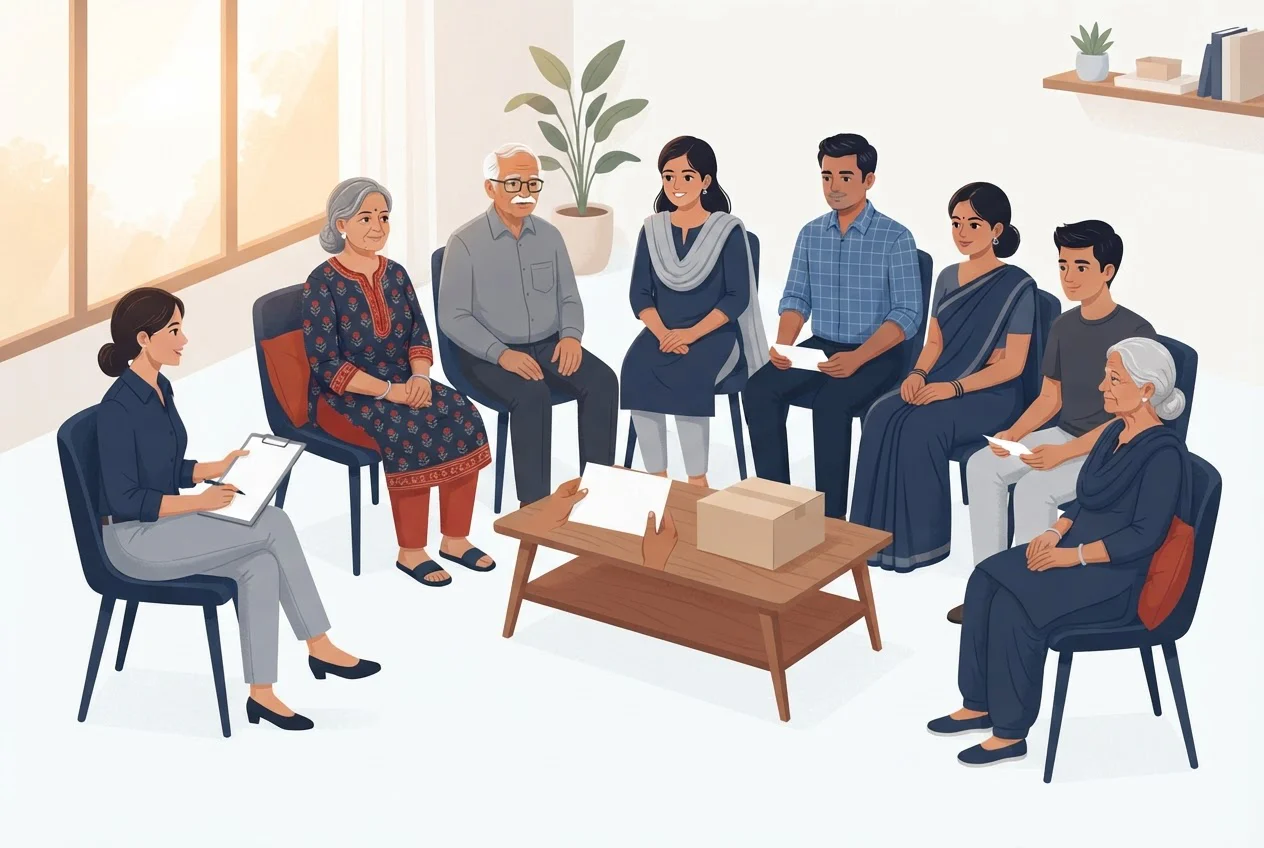
For IDIs, interview 6 to 8 people per segment and stop when new interviews repeat what you have already heard. Never report percentages from groups this size; report patterns and reasons.
Segments multiply quickly. Two audiences (current buyers and non-buyers), two city types (metros, and Tier-2 cities, India's mid-sized urban markets) and two groups each is 2 × 2 × 2 = 8 groups. Our guide to running focus groups in India covers moderator, language and venue choices.
What drives the cost of concept testing in India?
Cost scales with the number of cells (each concept, audience and city combination you test), not with the number of questions you ask. We do not work from a fixed rate card; we quote each project against the brief. The factors are the method, target audience, participant profile, sample size, geography, recruitment difficulty and overall scope.
Two practical rules follow:
- Cut concepts before cutting respondents. Halving four concepts to two halves the sample in the example above (1,552 to 776).
- Budget each group or interview as a line. Recruitment, incentive, venue or platform, moderator, translation and analysis. Ask any supplier to quote those lines separately so you can compare like with like.
Does a high concept score mean people will buy the product?
No. Stated interest is not a purchase. Attitudinal research captures what people believe and report, which is limited by what they are aware of and willing to say, while behavioural methods observe what they do.

Our recommendation is to use scores to rank concepts, not to forecast sales. For products people use, follow the survey with an in-home use test, where a small group tries the real product at home and reports back over days. Include a comprehension check in every test: a person cannot want what they have misunderstood.
How do you decide go, revise or kill? (Decision sheet)
Write the rules before fieldwork, using this sheet. Fill the benchmark column from your own past launches.
Concept card checks (each is pass or fail)
- One idea per card. Fail if the card needs "and" to describe what it does.
- Price shown. Fail if a respondent could not tell what it costs.
- No brand imagery or slogans. Fail if the card reads as an advert.
- Restatement test. Pass if at least 8 of 10 pilot participants can say the idea back in one sentence without looking (our recommended threshold).
- Language test. Pass if two native speakers who have not seen the English card translate the regional-language card back into English (back-translation) and the meaning matches the original on price, benefit and who it is for. Fail if either reading differs.
| Measure | How to ask | Your benchmark | Go | Revise | Kill |
|---|---|---|---|---|---|
| Comprehension | "Tell us in your own words what this is" | At or above | Below | n/a | |
| Need | "How much does this solve a problem you have?" | At or above | Below in some segments | Below in all segments | |
| Purchase interest | Top-2-box on a 5-point scale | At or above, or passes in every segment | Within the margin of error of the benchmark, or passes in one segment only | Clearly below (by more than the margin of error) | |
| Reasons (qualitative) | "What would stop you buying?" | n/a | Fixable | Fixable with a redesign | Fundamental objections |
Our recommended decision rules:
- Go: comprehension, need and purchase interest all meet the benchmark.
- Revise: comprehension fails, purchase interest is within the margin of error of the benchmark, purchase interest passes in one segment only, or need is below in some segments. A concept people misunderstand tells you about the card, not the idea.
- Kill: comprehension passes and need is below in all segments, or purchase interest is clearly below the benchmark and the qualitative reasons are fundamental objections.
How does Qualfacto help with concept testing?
We are a qualitative research participant panel in India, so we help with the recruitment and fieldwork behind your concept test. You share your brief, and we review the objective, method, audience, geography, sample, timeline and recruitment criteria. We check feasibility and send a tailored proposal and quote.
Once the project is agreed, we recruit and screen participants, schedule interviews, group discussions or product tests, and handle participant incentives, which we pay study by study after validation. We recruit across metros, Tier 1 and Tier 2 cities and urban, semi-urban and rural areas, with multilingual fieldwork assessed for each project. For first projects we are open to a small pilot or introductory arrangement, set by the scope of your study.
To see how we screen people, read our participant panel quality checklist, or see how to recruit participants for a study in India. Share your brief with our team and we will tell you which method and sample fit your concepts.
Plan your concept test with Qualfacto
Frequently asked questions
Sources
- 1.Ipsos, concept-product testing on Ipsos.Digital (30 September 2025): 40% of concepts not relevant enough to cause behaviour change compared with consumers' most often purchased products, from its 2025 concept testing database of 200,000 innovations.
- 2.Nielsen Norman Group, Which UX research methods to use: qualitative versus quantitative, attitudinal versus behavioural, focus group size.
- 3.Wikipedia, Concept testing: background on concept test designs and how concept testing differs from advertising, brand and packaging testing.
- 4.Sample-size tables: our own calculations using standard formulas for a proportion and for the difference between two proportions (95% confidence, 80% power with z = 0.8416, two-sided, worst-case 50% for margin of error), rounded up.