
Market Research for Startups in India: Sample, Script, Budget
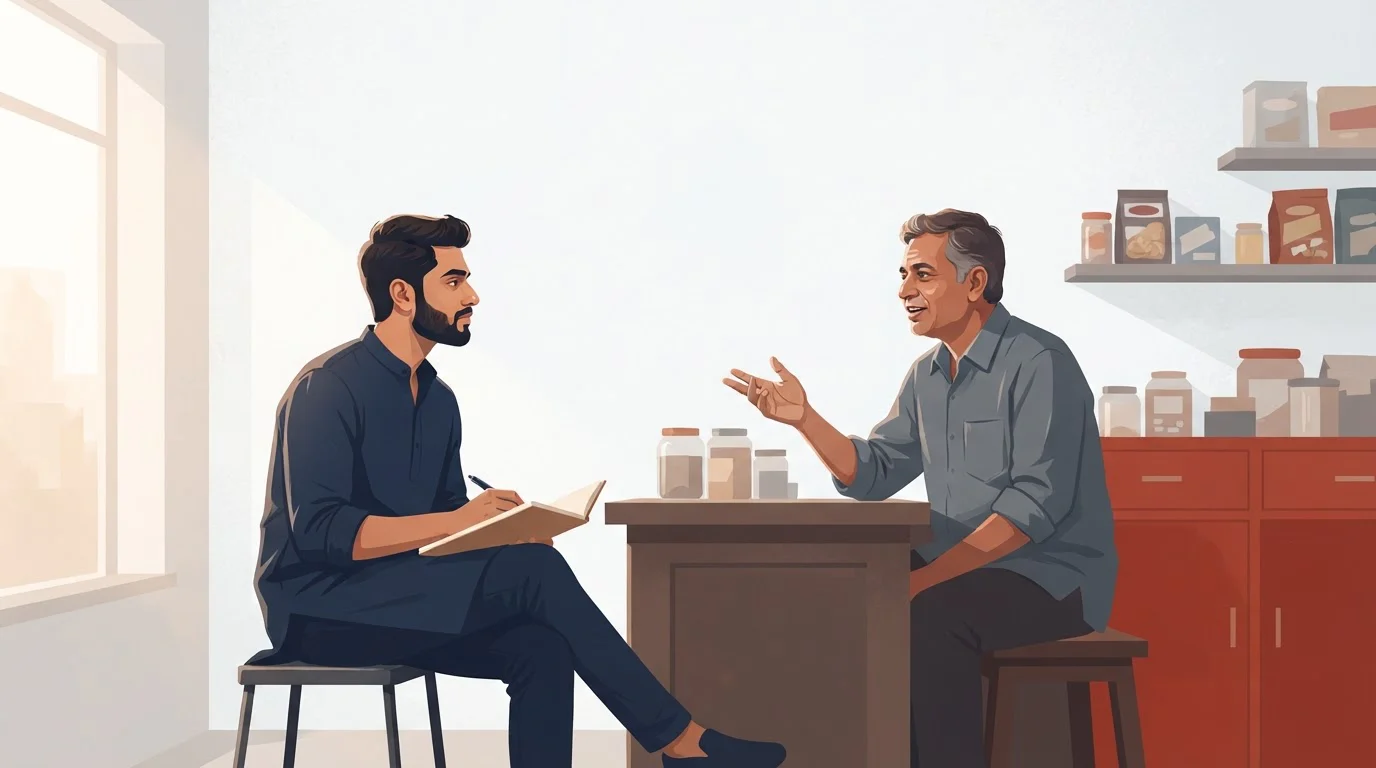
Market research for startups works best as six to eight short interviews per customer segment, held with real prospects about what they already do, before any survey is built.

By Jitendra Kumar Nirala, Founder · Updated 14 Oct 2026
Key takeaways
- Before you build, run six to eight in-depth interviews per customer segment with strangers who recently faced the problem. Add a survey only after those interviews show you what to ask.
- Define each customer segment in one line, then stop interviewing a segment once a batch of four adds no new problem or workaround.
- Ask about specific past episodes, what they cost in rupees and hours, and what the person did about them. Never ask "would you buy this?"
- Participant incentives for 16 interviews run ₹16,000 to ₹80,000 on our planning range of ₹1,000 to ₹5,000 each. Recruitment, moderation and transcription are quoted per project.
In this article
- 1What is the best market research for startups before launch?
- 2How many interviews does a startup need?
- 3Why do founder interviews so often produce false encouragement?
- 4What should you ask in a startup customer interview?
- 5How much should a startup budget for 16 interviews in India?
- 6When should you stop doing startup research yourself?
- 7How does Qualfacto run startup research in India?
- 8Frequently asked questions
A common first move is a survey, because it feels like research. For a new idea it usually answers the wrong question. A survey counts how many people tick a box you invented. It cannot tell you what people already do, spend or put up with. CB Insights' March 2026 analysis of 385 venture-backed companies that shut down since 2023 found that 43% cited poor product-market fit, which in plain terms means too little demand in the market the product was built for. That suggests many founders misjudged demand.
The fix is small in scope: a handful of interviews, with the right strangers, about the past rather than the future. The hard parts are deciding how many, finding people who will talk, and budgeting in rupees.
This page gives you a method table, a sample-size rule with its limits, an interview script and a budget with a worked total. We recruit participants for studies like this at Qualfacto, so we also say where doing it yourself stops working.
What is the best market research for startups before launch?
For a startup with no product yet, the best market research is the in-depth interview (IDI): a one-to-one conversation of 30 to 120 minutes with someone from your target group, about their current behaviour. Other methods answer other questions, as the table shows.
| Your question | Method | Sample (our recommendation) and why |
|---|---|---|
| Does this problem exist, and how do people cope today? | IDI | 6 to 8 per customer segment; see the next section |
| How do people talk about it among peers, or react to a concept? | Focus group discussion (FGD): a moderated group conversation of 1 to 3 hours | 2 groups per segment, so you can see whether one group's pattern repeats in another |
| What happens over several days of real use? | Digital diary study: multi-day photo and video tasks on a phone | 8 to 12, because some participants drop out over several days |
| How do people choose in a shop or app? | Shop-along: you accompany a shopper in-store or online | 6 to 8, the same logic as IDIs, since each is a one-to-one session |
| How big is the market? | Public industry and government statistics first; a survey only after IDIs | Depends on the survey design |
| Will anyone pay? | IDIs on what people pay today, then a real-money test such as a pre-order | Your IDI sample, then a small live test |
Definition
How many interviews does a startup need?
Plan eight IDIs for one fairly uniform customer segment, and 16 for two. Add more only when segments differ by city, language or income. Eight is our recommendation, built on two published sources and our own reasoning, and it holds best when the people in a segment are alike.
In Guest, Bunce and Johnson's 2006 study of 60 IDIs in two West African countries, 80 of 109 codes (73%) appeared in the first six of the 30 Ghana transcripts and 100 (92%) by twelve. The authors report that themes stopped emerging, called saturation, within the first twelve interviews, in a relatively homogeneous population with narrow objectives. The paper also cites Kuzel's guidance of six to eight interviews for a homogeneous sample and twelve to twenty when seeking maximum variation.
A startup customer segment is not a clinical study group, so our rule is: plan eight, then run a further batch of four only if the last four still produced a new problem or workaround. Stop when a batch adds nothing new. A product sold across Hindi, Tamil and Marathi markets, or to both metro and small-town buyers, is not homogeneous, so treat each language or city group as its own segment.
Our worked model for a two-segment startup, with every input stated:
- 2 segments × 8 IDIs = 16 IDIs.
- 16 IDIs × 45 minutes = 720 minutes = 12 hours of sessions.
- Assumed: 75% of booked people attend. 16 ÷ 0.75 = 21.3, so book 22.
- Assumed: 50% of people screened pass the screener, a short set of questions that checks someone fits your segment. 22 ÷ 0.5 = 44 screened.
- Assumed: 25% of people you contact agree to a screening call. 44 ÷ 0.25 = 176 contacted.
The 75%, 50% and 25% rates are placeholders, not benchmarks. Replace them with your own rates after your first 20 messages.
Why do founder interviews so often produce false encouragement?
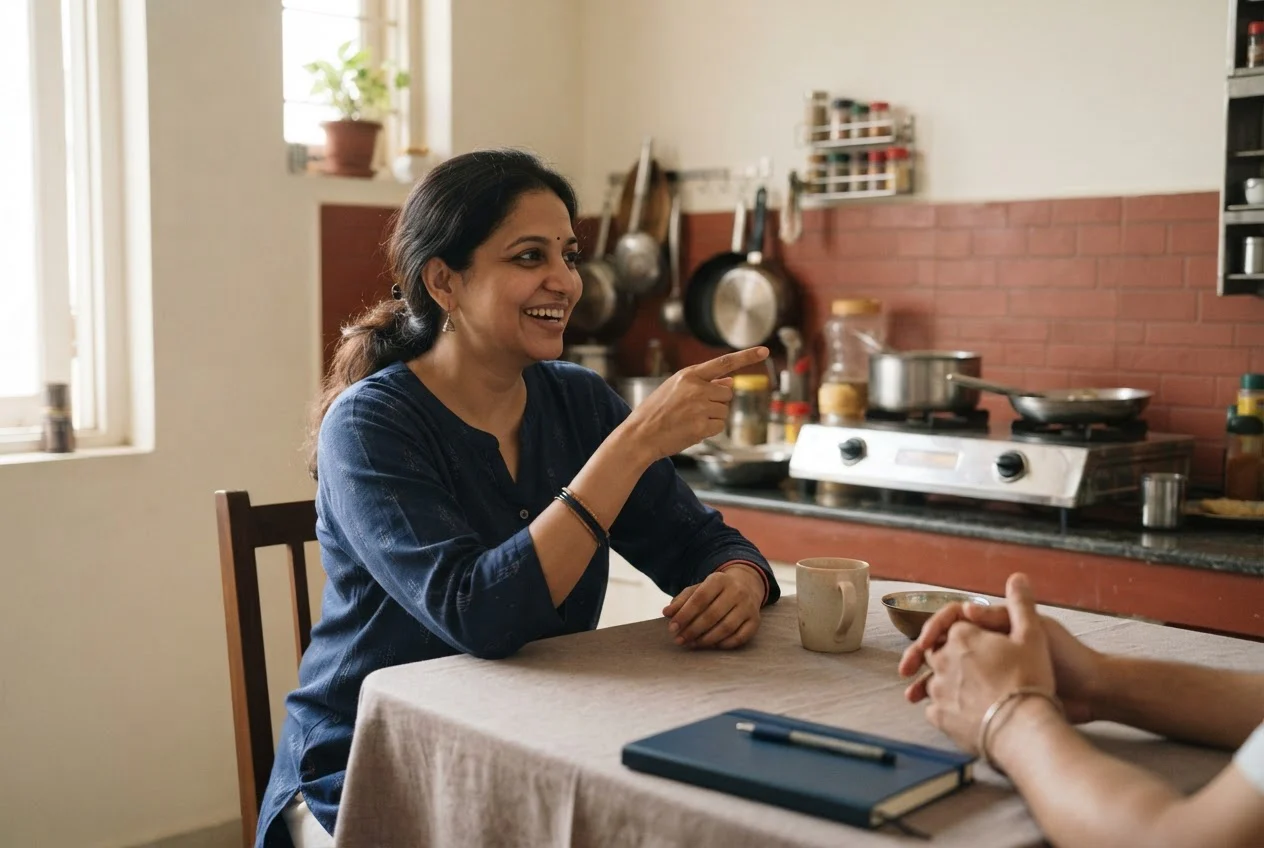
Founder interviews mislead because friendly people answer the question you asked, and "would you use this?" invites a polite yes. An opinion about a hypothetical future costs the speaker nothing, so it predicts little. A story about the last time they faced the problem is something they lived.
Run these six checks on your own plan.
Did you interview strangers? Pass if no participant is a friend, relative, colleague or investor. Fail if even one is.
Are your questions about specific past episodes? Pass if every core question asks what happened, what the person did or what it cost. Fail if any asks "would you", "do you like" or "how much would you pay".
Did you capture current spend? Pass if you recorded what each person pays or spends today in rupees or hours. Fail if you only recorded opinions.
Did you hold back the pitch? Pass if you did not describe or demonstrate your product until all six questions were done. Fail if you opened with it.
Does the sample cover your launch market? Pass if each city and language you plan to launch in has at least six interviews. Fail if you only spoke to people in your own city and language.
Did you set a stop rule beforehand? Pass if you wrote down what finding would make you change or drop the idea. Fail if every outcome would count as a yes.
What should you ask in a startup customer interview?
Ask six questions about the last real episode of the problem, and listen more than you speak. The script below fits 45 minutes. For more question banks, see our guide to customer discovery interview questions.

Opening (3 minutes). Explain the purpose, ask permission to record, and say there are no wrong answers. Consent matters legally as well as ethically. The Government of India notified the Digital Personal Data Protection (DPDP) Rules, 2025 on 14 November 2025, with an eighteen-month phased period before most duties apply, from 13 May 2027. Those duties include a separate, clear consent notice stating the purpose for which you use personal data. Collect clear written consent now, and see our guide to the DPDP Act 2023 and the ICC/ESOMAR code, the code of the International Chamber of Commerce and ESOMAR, the global association for market research.
- "Tell me about the last time you [did the task or faced the problem]."
- "What happened just before, and just after?"
- "What did you try? What did you end up using?"
- "What did that cost you, in rupees and in hours?"
- "What was the most irritating part, and what did you do about it?"
- "Who else was involved in the decision?"
Closing (3 minutes). Ask "Who else should I speak to?" and "What should I have asked that I didn't?" Both bring you new participants and new questions at no cost.
How much should a startup budget for 16 interviews in India?
Participant incentives for 16 IDIs run ₹16,000 to ₹80,000 on our planning range, and the rest of the budget depends on quotes for recruitment, moderation and transcription. As of October 2026, our published guidance for what to pay focus group participants in India is ₹1,000 to ₹5,000 per person; our guide to paying participants explains how to choose within it. We apply the same range to a 45-minute IDI as a planning assumption. Pay towards the top for specialist or senior audiences.
| Line | How to calculate | Planning figure |
|---|---|---|
| Participant incentive | ₹1,000 to ₹5,000 × 16 completed IDIs | ₹16,000 to ₹80,000 (our model) |
| Recruitment | Fee per recruited participant × 22 booked, or a flat fee | Quote |
| Moderator (the person who leads the session) | Quote, or your own time × 12 session hours plus preparation | Quote or your time |
| Language support | Translator or native-language moderator × session hours | Quote |
| Transcription | Rate per audio hour × 12 | Quote |
| Venue or tools | Room hire or video-call tool for 16 sessions | Quote |
The incentive line works out as 16 × ₹1,000 = ₹16,000 at the low end and 16 × ₹5,000 = ₹80,000 at the high end. Recruitment, moderation and transcription are priced per project, so we quote them from your brief rather than publish a rate card. When you compare any quotes, ask first whether the price is per completed IDI or per person recruited. A per-recruit price leaves no-shows on your side of the bill.
When should you stop doing startup research yourself?
Do your first interviews yourself only if none of these four is true. If any is, hand recruitment to a specialist. These thresholds are our recommendation from running recruitment, not a published standard.
- More than one city or language. Coordinating bilingual moderation and local recruitment is where self-run studies stall.
- An audience you cannot reach. If two weeks of outreach through your network and communities has not booked eight people, you will not get there by sending more messages.
- Identity matters. If you need to confirm participants are who they say they are before the session, you need a recruiter that checks.
- More than about 16 sessions. Scheduling, recordings and transcripts become a job in themselves.
How does Qualfacto run startup research in India?
We recruit participants and run fieldwork for startup studies, starting from your written brief. You send the research objective, method, target audience, geography, sample size and timeline. We reply with a feasibility check and a tailored proposal and quote.
Once scope, commercials and timelines are agreed, we handle recruitment and screening, confirm participant identity before invitation, and schedule sessions in the cities and languages your study needs. You can moderate yourself, or we can supply moderators. We can provide recordings, transcripts, structured data exports and research reports, depending on what you scope, and we agree deliverables before the study begins. Participants receive their incentive only after they complete the stated requirements and we validate them.
We offer a free pilot, sample or trial, so you can test the process on a small group before committing to the full sample. Our approach is guided by the ethical principles of the Market Research Society of India (MRSI) and ESOMAR.
For project briefs, email support@qualfacto.io. We reply within one business day, Monday to Friday, 10:00 to 18:00 IST (Indian Standard Time). To start, send us your brief at Qualfacto.