
In-Home Use Test: How Many Households to Recruit in India
For an in-home use test (IHUT), recruit about 1.1 to 1.6 households for every one you need, because some never finish. Consumers try the product at home over days or weeks.

By Jitendra Kumar Nirala, Founder · Updated 10 Oct 2026

Key takeaways
- 01Recruit your usable-household target divided by the completion rate you expect, rounded up. That is about 1.1 to 1.6 households per household you need, applied to each product and each city.
- 02Households drop out at five points: delivery, first use, unclear instructions, the middle of the study and unclear rewards. Check each one early.
- 03Choose an IHUT when the verdict depends on repeated use or on the home setting. Choose a central location test (CLT) when you need a fast reaction under identical conditions.
- 04Addresses and phone numbers are personal data. Keep them with the fieldwork partner and the courier, and give the brand anonymised participant IDs.
In this article
- 1How many households do you recruit for an in-home use test in India?
- 2Why do households drop out, and how do you protect the usable base?
- 3Should you run an in-home use test or a central location test?
- 4How long should an in-home use test run?
- 5What should be ready before the product ships?
- 6How does India's data protection law apply to an IHUT?
- 7How does Qualfacto recruit and run an IHUT?
- 8Frequently asked questions
A 2024 peer-reviewed study of an eco-designed hot sauce ran an in-home use test with 207 consumers, after three focus groups had shaped what the test would ask.
That order is the practical lesson. A small, cheap method finds the right questions. The IHUT (also called an in-home usage test) then shows what people do with the product over days or weeks in their own kitchens and bathrooms.
The part buyers most often get wrong is the headcount. Households do not all finish, so a plan that recruits exactly the number you want to report on will report on fewer.
This page gives you a recruiting formula with a lookup table, a table for choosing between methods, and a pass-or-fail checklist with checks specific to India.
How many households do you recruit for an in-home use test in India?
Recruit the usable households you need divided by the completion rate you expect, rounded up. A usable household is one that completes every required step. The multiplier is 1 ÷ completion rate: 1.11 at 90%, 1.18 at 85% and 1.54 at 65%.
The three completion rates below are our planning assumptions, not measured completion rates. We use 90% as a good case, 85% as a typical case and 65% as a cautious case. This is our model, not an official figure.
Recruit = target ÷ completion rate, rounded up.
| Usable households needed per product | Recruit at 90% | Recruit at 85% | Recruit at 65% |
|---|---|---|---|
| 30 | 34 | 36 | 47 |
| 60 | 67 | 71 | 93 |
| 100 | 112 | 118 | 154 |
For example, 60 ÷ 0.65 = 92.3, which rounds up to 93.
Worked example. You are testing a new hair oil against the current one and want 40 usable households per product.
- At 85% completion you recruit 48 per product (40 ÷ 0.85 = 47.06), which is 96 households.
- At 65% completion you recruit 62 per product (40 ÷ 0.65 = 61.54), which is 124 households.
- Budget for the second number unless your fieldwork partner can show a completion record for the same kind of household and product. A fieldwork partner is the agency or panel that recruits households and runs the study on the ground.
Apply the sum to every group you want to read separately. If you need 30 usable households in each of three cities, calculate the recruit for each city, because a shortfall in one city cannot be topped up from another.
What target should you choose? These are our recommendations, not a statistical rule:
- 10 to 20 households: a pilot to test the instructions and logistics.
- 15 to 30 per audience: a diary study, in which participants log their use over days. It finds patterns and language. Sample size in qualitative research explains how to judge when you have heard enough.
- 30 to 99 per product: a directional read, meaning an indication of which variant leads, not a precise margin.
- 100 or more per product: a comparison between variants, but only for large gaps.
Here is the working behind that last line, and it is our calculation. For two products, the standard two-proportion formula is n per product = (z for 5% significance, two-sided + z for 80% power)² × [p1(1 − p1) + p2(1 − p2)] ÷ (p1 − p2)². Here z is 1.96 for 5% significance and 0.84 for 80% power, so the first term is (1.96 + 0.84)² = 7.84. Power is the chance of detecting a real gap. Take the share choosing the top two answers on a rating scale (top-two-box):
- 50% versus 70%, a 20-point gap: 7.84 × (0.25 + 0.21) ÷ 0.04 = 90.2, so 91 per product.
- 50% versus 60%, a 10-point gap: 7.84 × (0.25 + 0.24) ÷ 0.01 = 384.2, so 385 per product.
The calculation ignores clustering and weighting. It is usable for planning. Work backwards from the smallest gap that would change your decision, and if it is small you need the larger sample.
Why do households drop out, and how do you protect the usable base?
Households drop out at delivery, first use, unclear instructions, the middle of the study and unclear rewards. Each can be checked early, which costs far less than recruiting extra households at the end.
- Delivery. Ask every household to confirm receipt. We recommend replacing any household that has not confirmed within three days of dispatch, while the recruiting pool is still available.
- First use. In our experience (not a measured statistic), households that have not used the product within 48 hours of delivery rarely start. We recommend one reminder, then a replacement.
- Instructions. Test the leaflet and the questions with three to five households before the main wave, which is one round of fieldwork. Run them in the language participants will use. If anyone needs a phone call to start, rewrite the leaflet.
- The middle of the study. Keep daily check-ins to a minute or two and save the longer assessments for the middle and the end. Ask for a dated photo or short video at least once, because it is proof of use.
- Rewards. Tell households what they receive and when before they agree. We communicate the reward to participants before they take part, and we process incentives after completion has been validated.
For long-running tasks, Nielsen Norman Group's guide to diary studies is a useful companion.
Should you run an in-home use test or a central location test?
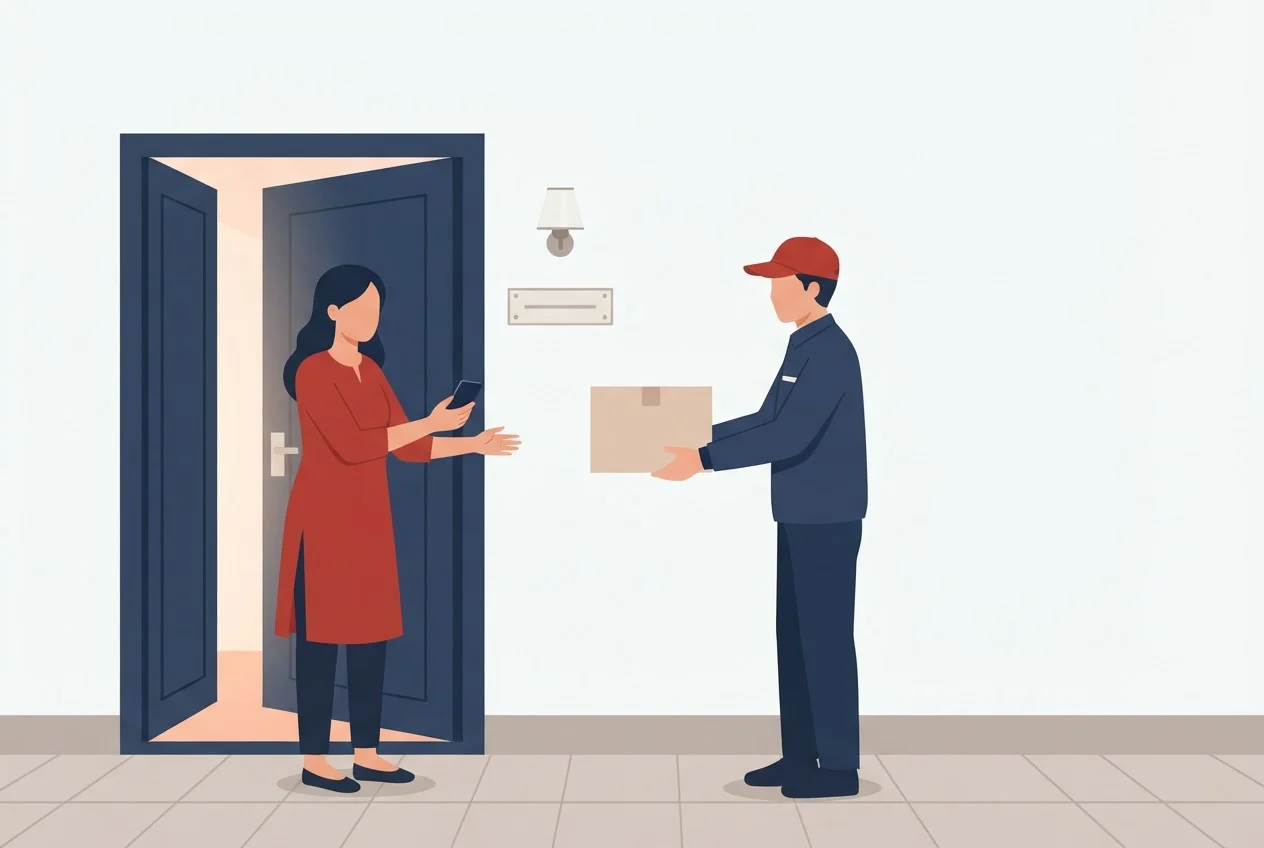
Choose an IHUT when the answer you need appears only after several uses or only makes sense at home. Choose a central location test (CLT), where participants come to one venue and test products under controlled conditions, when you need an immediate reaction under identical conditions.
| Your question | Best method | Why |
|---|---|---|
| Does the shampoo or moisturiser deliver its claimed benefit after two weeks? | IHUT | The benefit appears over repeated use, not in one sitting. |
| Which of three drink formulations tastes best? | CLT | Everyone tastes in the same order, at the same temperature, in one sitting. |
| Does the pack open easily in a real kitchen, with wet hands? | IHUT | Home conditions are the test. |
| Will households in Tier 2 cities, meaning mid-sized cities such as Indore or Jaipur, keep using it after the first week? | IHUT, with a follow-up interview | Only repeated use can answer whether interest lasts. |
| Why did people reject the product? | In-depth interview after the IHUT | Ratings show what happened. A conversation shows why. |
Our recommendation is to pair methods. Use a CLT to remove weak variants cheaply, then put the survivors into an IHUT.
How long should an in-home use test run?
Run the test for as long as the product's natural use cycle needs, and no longer. A single-serve drink needs one use occasion. A cleaning product needs several uses across a week. A skincare or haircare claim usually needs about two weeks to show a visible effect. This is our recommendation, and the real use cycle of your product should override it.
A usage period longer than the product needs adds burden for participants and, we expect, dropout. Plan the whole project, including recruitment, dispatch and reporting, for several weeks and not just the usage period.
What should be ready before the product ships?
Before shipping, you need a named decision, a written usage period, a recruit number above target, a factual screener, tested instructions, confirmed delivery, proof of use, restricted address handling, a safety contact, unit reconciliation and a stated incentive. A screener is the set of qualifying questions that decides who can join. Each item below is a test you can run on your own plan.
| Check | Pass | Fail |
|---|---|---|
| Decision named | You can finish "If the result is X, we will do Y" in one sentence | The goal is "get feedback" |
| Usage period | Written down and matched to the product's use cycle | Set by the reporting deadline |
| Recruit number | Target ÷ completion rate, per product and per city | Recruited equal to target |
| Screener | Every criterion is a fact a person can answer, such as the brand used in the last 30 days. See our research screener template | Criteria such as "likes skincare" |
| Instructions | Three to five test households follow them unaided | Anyone needs a call to start |
| Leaflet language | The leaflet and questions are in the language each household chose, and a native speaker has read them | One English-only leaflet for every household |
| Courier reach | Every recruited pin code, including Tier 2 and rural ones, is confirmed deliverable before recruitment closes | Pin codes are checked after households are recruited |
| Delivery | Receipt confirmed within three days of dispatch | No confirmation and no replacement plan |
| Proof of use | At least one dated photo, video or diary entry per household | Only an end questionnaire |
| Address handling | Only the fieldwork partner and courier see addresses | The brand holds an address list |
| Safety | Participants know whom to contact and how to stop using the product | No contact route |
| Unused units | Count reconciled at close | Units unaccounted for |
| Incentive | Amount and payment trigger shared before consent | A vague "token of thanks" |
For products people eat or put on skin, ask your regulatory or legal team to approve sampling of unreleased formulations before dispatch. That sign-off is a decision for your own advisers.
How does India's data protection law apply to an IHUT?
An IHUT collects names, addresses and phone numbers, which are personal data under the Digital Personal Data Protection Act, 2023 (DPDP Act). The Government of India notified the Digital Personal Data Protection Rules, 2025 in November 2025. As of October 2026, most notice, consent and data-fiduciary duties are not yet in force. A data fiduciary is the organisation that decides why and how personal data is processed. The consent-manager provisions start on 13 November 2026, and most remaining duties start on 13 May 2027, 18 months after the Rules were published.
We recommend building consent and deletion into your IHUT now:
- Collect consent that names the purpose, who will see the address and when it will be deleted. Our guide to informed consent in research and the Indian rules walks through it.
- Recruit adults only.
- Give the brand anonymised participant IDs, not the address sheet.
- Follow the participant protections in the code of ESOMAR (the global research association) and the ICC (International Chamber of Commerce): the ICC/ESOMAR International Code.
How does Qualfacto recruit and run an IHUT?
We recruit and screen the households, coordinate them through the study and process their incentives. Qualfacto is a qualitative research participant panel in India, and Product Testing (IHUT) is one of the study formats on our panel, listed as Product + Cash Reward.
You share a brief covering the research objective, target audience, geography, sample size and timelines. We assess feasibility and send a tailored proposal and quote. Once scope, commercials and timelines are agreed, recruitment begins. After completion and validation, we process participant incentives, and you receive the agreed deliverables.
- Reach. Our recruitment covers major metros, Tier 1 and Tier 2 markets, and urban, semi-urban and rural locations. Language needs are assessed study by study.
- Pilot. We are open to a small pilot or introductory first project, so you can judge participant quality and execution before a larger study.
- Cost. We price each project individually, depending on methodology, audience, sample, geography and recruitment difficulty, so there is no fixed rate card. The user research recruitment cost worksheet for India sets out the cost drivers.
Share your brief and size your IHUT recruit properly
Frequently asked questions
Sources
- 1.Torán-Pereg P, et al. "Consumer Insights to Eco-Design a Hot Sauce: Understanding Household Use for Product Optimization through Focus Groups and a Home-Use-Test Study." Foods, 2024 (PubMed)
- 2.Government of India, Press Information Bureau: DPDP Rules, 2025 notified
- 3.ICC/ESOMAR International Code on Market, Opinion and Social Research
- 4.Nielsen Norman Group: Diary studies