
Glossary
Over Recruitment
Over recruitment means booking more participants than you need seats for, so no-shows do not empty a focus group. At an 80% show rate, ten recruits suit a group of eight.

By Jitendra Kumar Nirala, Founder · Updated 24 Oct 2026
Also called Over-recruit
On this page
- 01Definition
- 02Quick facts
- 03Introduction
- 04What does over recruitment mean in market research?
- 05How many extra participants does a focus group need?
- 06Why do "recruit 12 for 10" and "add 20%" mislead?
- 07Do you pay the floaters you send home?
- 08How do you set the over-recruit number in your brief?
- 09Which terms get confused with over recruitment?
- 10How Qualfacto handles it
- 11Example
- 12Related terms
- 13Frequently asked
What is over recruitment in market research?
Over recruitment is booking more research participants than a study needs seats for, to make up for those who do not attend.
Key takeaways
- Show rate, no-show rate and over-recruit rate are different numbers, and mixing them up leaves groups short or crowded.
- Going from 10 to 12 recruits at an 80% show rate cuts short-group risk from 3.3% to 0.4% but raises the chance of surplus from 37.6% to 79.5%.
- Floaters pass the same screener (a short questionnaire that checks someone fits the study) as everyone else.
- Floaters are paid even if you do not seat them, so add the expected floater cost to the budget.
Quick facts
- Extra people are called
- Floaters or backup participants
- Average show rate
- 80% (QRCA field committee); 90% very good, 50% poor
- Median over-recruit rate
- 17% across 30 MeasuringU studies in 2024
- Floater incentive
- At least the same as the rest, paid even if not seated
Introduction
Over recruitment in research is a deliberate buffer. It protects a fixed appointment, such as a group discussion that needs eight people in one room at one time. In hiring, the same words describe taking on more staff than roles, which is a different subject.
The buffer is easy to set badly. Across 30 studies run by the research firm MeasuringU in 2024, covering 1,183 participants, the over-recruit needed to end up with enough usable sessions averaged 19% (MeasuringU, 2025). In MeasuringU's own 2024 sessions (24 studies, 958 participants) no-shows averaged 5.0% (MeasuringU, 2024). The over-recruit figure is higher because it also covers disqualified participants and unusable sessions. Those are different numbers, and mixing them up is how groups end up either short or crowded.
What does over recruitment mean in market research?
Over recruitment is recruiting more people than a study needs, to make up for those who do not attend. Quirk's defines it as "the extra people who are recruited for a focus group to compensate for the inevitable no-shows", with 12 booked for a group of 10 as its example.
The extras are called floaters or backup participants (Nielsen Norman Group, 2020). The show rate is the share of booked people who attend. The no-show rate is what is left over.
How many extra participants does a focus group need?
For a group of eight at an 80% show rate, recruit ten. That leaves about a 3% chance that fewer than six attend and a 38% chance that nine or ten attend.
Ten booked for eight seats: who attends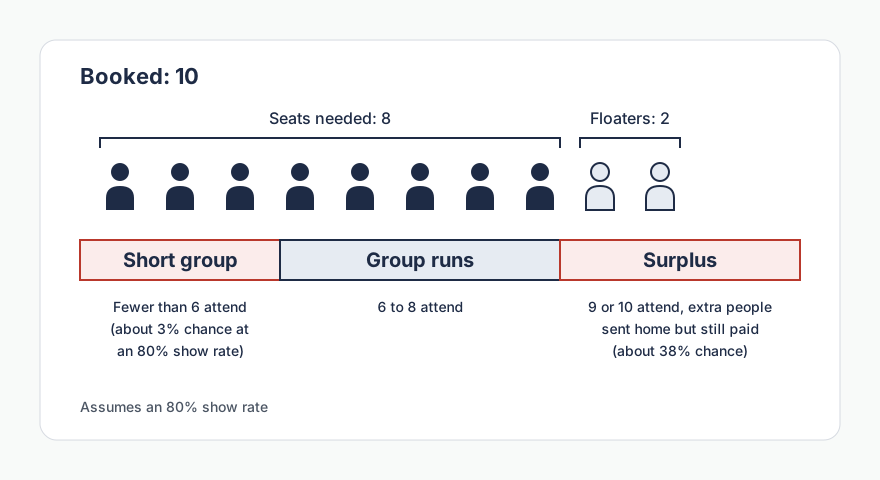
The table below is a model. It treats each recruit as attending independently with the same probability, using the formula: chance that k of n recruits show = n! ÷ (k! × (n−k)!) × p^k × (1−p)^(n−k), where p is the show rate. It reproduces the published figure from Peter DePaulo's Quirk's analysis (2002): with 12 recruited at 80%, a 27.5% chance of more than ten attending.
The model assumes eight seats and six as the smallest group you would still analyse. "Short" means fewer than six attend. "Surplus" means more than eight attend.
Real attendance is rarely independent. Friends recruited together, shared transport and weather tend to fail together, so in practice the "short" risk is higher than the table shows. That is an inference. One event shows weather can lift no-shows, not how often people fail together.
- Recruit
- 8
- 70% show: short / surplus
- 44.8% / 0%
- 80% show: short / surplus
- 20.3% / 0%
- 90% show: short / surplus
- 3.8% / 0%
- Recruit
- 9
- 70% show: short / surplus
- 27.0% / 4.0%
- 80% show: short / surplus
- 8.6% / 13.4%
- 90% show: short / surplus
- 0.8% / 38.7%
- Recruit
- 10
- 70% show: short / surplus
- 15.0% / 14.9%
- 80% show: short / surplus
- 3.3% / 37.6%
- 90% show: short / surplus
- 0.2% / 73.6%
- Recruit
- 11
- 70% show: short / surplus
- 7.8% / 31.3%
- 80% show: short / surplus
- 1.2% / 61.7%
- 90% show: short / surplus
- under 0.1% / 91.0%
- Recruit
- 12
- 70% show: short / surplus
- 3.9% / 49.3%
- 80% show: short / surplus
- 0.4% / 79.5%
- 90% show: short / surplus
- under 0.1% / 97.4%
Why do "recruit 12 for 10" and "add 20%" mislead?
Both rules hide the show rate they assume. Twelve for ten fits a show rate near 80%, but the table shows that at 90% it almost guarantees surplus: 12 recruits for 8 seats leaves someone to send home 97% of the time.
The "20%" is an over-recruit rate, not a no-show rate. It also covers recruits who attend but turn out unusable or disqualified. MeasuringU's median was 17%, with half of studies between 9% and 24%. The range ran from 0% to 51%, and 97% of studies needed some over-recruitment (MeasuringU, 2025). That is one firm's own 2024 data, so treat it as a guide, not a law.
Show rate moves with your audience. The Qualitative Research Consultants Association (QRCA) field committee puts 80% as average, 90% as very good and 50% as poor (Quirk's, 2002). Across 24 studies and 958 participants, studies with higher incentives had lower no-show rates (correlation of −0.50, a moderate link) (MeasuringU, 2024). For hard-to-reach or low-incentive audiences, plan on 70%, not 80%.
Do you pay the floaters you send home?
Yes. Floaters who are not seated are still paid, and they get at least the same incentive as the rest (Nielsen Norman Group, 2020). They go through the same screener, and you tell them their role when you recruit them.
Here is a worked example. A pay guide for Indian focus groups uses ₹2,500 per participant as its working baseline. At an 80% show rate, recruiting ten means about 0.48 floaters sent home, roughly ₹1,200. Recruiting twelve means about 1.70, roughly ₹4,250. Moving from ten to twelve cuts the short-group risk from 3.3% to 0.4% and adds about ₹3,000 of expected spend. Whether that is worth it depends on how costly a failed group is.
How do you set the over-recruit number in your brief?
Work through five steps and write the result into the brief.
- Seats: the group size you want (for example, 8).
- Minimum: the smallest group you would still analyse (for example, 6).
- Show rate: 70% for hard or lightly paid audiences, 80% as the default, 90% only for tightly confirmed ones.
- Number: from the table, take the lowest recruit count whose "short" risk you accept (for example, under 5%). For 8 seats and a minimum of 6, that is 10 at 80%, 8 at 90% (3.8% short risk, so no floaters) and 12 at 70% (3.9%).
- Terms: state in the brief that floaters use the same screener and receive the same incentive whether or not they are seated.
Add the expected floater cost (expected sent home × incentive) to your budget line.
Which terms get confused with over recruitment?
Over recruitment is a plan for attendance. It is not the same as these neighbouring terms:
- Replacement: recruiting a substitute after someone drops out, matched to the same screening criteria.
- Quota: the mix of people you need, which floaters must also match.
The same logic applies to other formats: see sample size in qualitative research for interviews and in-home use tests for products used at home.
How Qualfacto handles it
Qualfacto recruits by city, checks participant identity before invitation, and targets by household and demographic profile. Sessions can run in languages other than English, and moderators can be supplied.
Send your brief with the seats you need and your minimum viable group. Qualfacto reviews the sample size, timelines and recruitment criteria, then sends a tailored quote, and it offers a free pilot. Email is for project briefs and WhatsApp is for quick queries, Monday to Friday, 10:00 AM to 6:00 PM Indian Standard Time (IST), with a reply aimed within one business day. Start at Qualfacto.
Example
Take eight seats and ten people booked. If six to eight turn up, the group can run. If nine or ten turn up, one or two people are sent home, and they are still paid.
Frequently asked
Sources
- 1.Quirk's glossary: what is over recruitment?, Quirk's
- 2.Estimating show rates for focus groups, Quirk's (Peter DePaulo), 2002-06-01
- 3.How much should you over-recruit?, MeasuringU, 2025-02-19
- 4.What is a typical no-show rate for moderated studies?, MeasuringU, 2024-12-10
- 5.Recruiting backup participants (floaters) in user research, Nielsen Norman Group, 2020-10-04