Glossary
Research Operations (ResearchOps)
Research operations is the work of organising people, processes and tools around research, from recruiting and consent to data storage.

By Jitendra Kumar Nirala, Founder · Updated 24 Oct 2026
Also called ResearchOps
On this page
- 01Definition
- 02Quick facts
- 03Introduction
- 04What does research operations (ResearchOps) mean?
- 05What is research operations often confused with?
- 06Which participant tasks should a ResearchOps team keep, and which can a recruitment partner run?
- 07What does the DPDP Act change for recruiting, consent and paying participants?
- 08Where do teams go wrong when they buy participant recruitment?
- 09How Qualfacto handles it
- 10Example
- 11Related terms
- 12Frequently asked
What is research operations (ResearchOps)?
Research operations (ResearchOps) is the set of roles, tools and processes that set research in motion, so researchers can concentrate on the research itself.
Key takeaways
- Recruiting, screening, scheduling and paying participants are the tasks easiest to hand to a partner. Audience definition, consent wording, data terms and incentive amounts stay with you.
- Under the DPDP Rules 2025, notice and security duties start eighteen months after publication, in 2027 unless the period is shortened, which has been proposed but not notified as of October 2026. Build your consent text and partner contracts before then.
- Costs depend on method, audience, city and recruitment difficulty. Ask any provider to split its quote into recruiting, screening, replacements and incentives, because per-session fees usually exclude incentives.
Quick facts
- Also known as
- ResearchOps
- Six focus areas (NN/g)
- Participants, governance, knowledge, tools, competency and advocacy
- Focus areas where India differs
- Participants and governance
- Indian law that applies
- Digital Personal Data Protection Act, 2023 (DPDP Act) and the DPDP Rules, 2025
- When notice and security duties start
- Eighteen months after the Rules' 13 November 2025 notification, in 2027 unless shortened
Introduction
Research operations covers the work around participants, and in India that work is regulated by the Digital Personal Data Protection Act, 2023 (DPDP Act). Standard ResearchOps frameworks, such as the six focus areas in the Nielsen Norman Group (NN/g) study guide, do not cover Indian data law.
That matters because the part of research operations that touches real people (recruiting, screening, consent and payment) is the part the DPDP Act and its 2025 Rules regulate. They set dated duties for anyone who collects participants' personal data.
This entry defines the term, separates it from the look-alikes that clutter the search results, and gives a table showing which participant tasks stay with your team and which a recruitment partner can run, with a test for whether each is done.
What does research operations (ResearchOps) mean?
Research operations, shortened to ResearchOps, is the roles, tools and processes that set research in motion, so researchers can concentrate on the research itself. NN/g defines it as "the orchestration and optimization of people, processes, and craft in order to amplify the value and impact of research at scale."
NN/g splits the work into six focus areas:
- participants (recruiting, screening, scheduling and compensating);
- governance (consent, privacy and information storage);
- knowledge;
- tools;
- competency;
- advocacy.
This entry takes the first two, participants and governance, because that is where India differs.
What is research operations often confused with?
Research operations is confused with operations research, with the researcher's own job, and with DesignOps. Operations research is a separate field of mathematical decision-making. Clinical research operations is another separate discipline, run in trials and hospitals. Neither has anything to do with running participant studies.
A ResearchOps specialist manages the surrounding work so that researchers can focus on conducting studies. The researcher still designs the study and runs the sessions. DesignOps is the sibling discipline for design teams.
Related terms you will meet in this work are the research panel, the research screener and informed consent.
Which participant tasks should a ResearchOps team keep, and which can a recruitment partner run?
Keep the decisions and hand over the legwork. Your team should own the audience, the consent wording, the data terms and the incentive amount. A recruitment partner can source, screen, identity-check, schedule and pay participants against those decisions. The table gives each task, who owns it, and a test for whether it is done.
Decisions you keep, legwork you hand over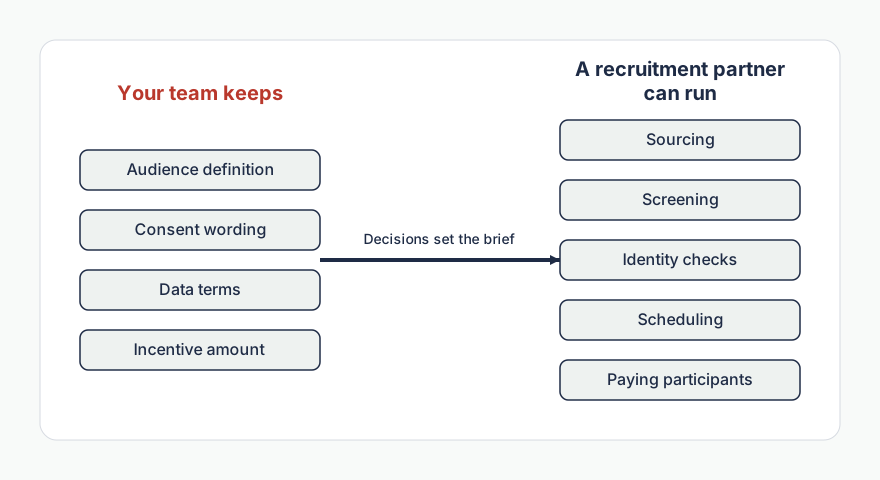
For a full recruitment sequence, see how to recruit participants for a study in India. For incentive amounts, see what to pay focus group participants.
- Task
- Audience and quotas
- Who owns it
- Your team
- Pass test
- A stranger could screen against it: behaviour, city, language and exclusions are each written down. Fail if it says only "urban millennials".
- Task
- Screener
- Who owns it
- Your team writes, partner runs
- Pass test
- You can see why each person was screened out. Fail if you only get a final list.
- Task
- Sourcing and identity check
- Who owns it
- Partner
- Pass test
- Every invited person was identity-checked before the invitation.
- Task
- Scheduling and backups
- Who owns it
- Partner
- Pass test
- Each hard quota cell (a group you must fill, such as four people in one city) has a named floater (an extra recruited participant who steps in if someone drops out), as NN/g recommends.
- Task
- Consent notice
- Who owns it
- Your team or legal writes, partner delivers
- Pass test
- The notice itemises the data collected, states the purpose, and says how to withdraw and complain.
- Task
- Data handover
- Who owns it
- Your team
- Pass test
- Every recipient of recordings and contact details is named, with a retention period.
- Task
- Incentive
- Who owns it
- Your team sets, partner pays
- Pass test
- Amount, method and timing are shown to the participant before they commit.
- Task
- Deletion
- Who owns it
- Your team sets policy
- Pass test
- The partner states in writing who deletes, how, and how it is confirmed.
- Task
- Repository, tools, training
- Who owns it
- Your team
- Pass test
- Fail if recordings and notes sit in personal drives; pass if one named person owns a shared, access-controlled repository.
What does the DPDP Act change for recruiting, consent and paying participants?
Most DPDP duties start eighteen months after the Rules were published, on a notification dated 13 November 2025, which is 13 May 2027 by the usual count. Check the Gazette before you rely on May 2027. Rules 3 and 5 to 16 are among those waiting for that date, according to Rule 1(4) of the Gazette notification.
Four rules matter most for participant operations:
- Rule 3, notice. The notice must stand alone, in clear and plain language. It must itemise the personal data, state the purpose, and give a link and other means to withdraw consent "with the ease of doing so being comparable to that with which such consent was given", to exercise rights and to complain to the Data Protection Board.
- Rule 6, security. Safeguards include encryption, obfuscation (scrambling data so it cannot be read directly), masking or virtual tokens, access control, logs and monitoring, and backups. Where a processor (a company that handles data on your behalf) is involved, the contract must carry security terms.
- Rule 8(3), retention. Personal data, traffic data (records of when and how the data was handled) and logs must be kept for at least one year for the Seventh Schedule purposes, such as enabling the Government to call for information in specified circumstances. This may cut across a promise to delete data after the study, so check the wording with counsel. This is general information, not legal advice.
- Rule 16 and section 17(2)(b), research exemption. The Act does not apply to research processing that follows the standards listed in the Second Schedule (such as limiting data to what is necessary and keeping it only until the purpose is met) and where the data is not used to take any decision specific to the individual participant, as set out in section 17(2)(b) of the Act and Rule 16 of the Gazette notification. Do not assume a commercial study qualifies. Get legal advice first.
See the informed consent guide for a consent form. The Ministry of Electronics and Information Technology (MeitY) publishes the data protection page.
Where do teams go wrong when they buy participant recruitment?
Teams compare the recruiting fee and forget the study cost. A per-session fee usually excludes incentives, replacements and fieldwork, so a low headline fee tells you little.
Costs depend on method, audience, participant profile, sample size, geography and recruitment complexity. Ask any provider to split its quote into recruiting, screening, replacements and incentives. The recruitment budget worksheet shows the lines.
How Qualfacto handles it
Qualfacto provides recruitment services. It runs the recruitment and participant coordination for a study while the client keeps the decisions in the table above. It recruits by city, supplies moderators, runs sessions in languages other than English, checks participant identity before invitation, and targets by household and demographic profile.
Clients send a research brief covering objective, method, audience, geography, sample size and timelines. Qualfacto assesses feasibility and returns a tailored proposal, and prices each project by proposal with no fixed rate card, because the price depends on method, audience, sample, geography and recruitment difficulty. Its approach to consent and privacy is guided by Market Research Society of India (MRSI) and ESOMAR (the global market research association) principles. It processes incentives after participation is completed and validated.
A free pilot is available. Email the brief to support@qualfacto.io, Monday to Friday, 10:00 to 18:00 Indian Standard Time (IST); the aim is to reply within one business day. If you are choosing a partner, see how to choose a qualitative research agency.
Example
A study with a hard quota of four people in one city recruits a fifth as a named floater, so a drop-out does not leave the cell empty. Each invited person is identity-checked first, and the consent notice itemises the data collected and states whether recording, client viewing and future contact are agreed separately. Incentive amount, method and timing are shown before anyone commits.
Frequently asked
Sources
- 1.ResearchOps 101, NN/g, Nielsen Norman Group, 16 August 2020
- 2.ResearchOps study guide on participant management and governance, NN/g, Nielsen Norman Group, published 9 January 2022, reviewed 27 August 2024
- 3.About ResearchOps, ResearchOps Community, ResearchOps Community
- 4.Digital Personal Data Protection Rules, 2025, Gazette of India notification G.S.R. 846(E) (PIB copy), Government of India, 13 November 2025
- 5.The Digital Personal Data Protection Act, 2023, Ministry of Electronics and Information Technology
- 6.Data protection, Ministry of Electronics and Information Technology