
Glossary
Respondent Fatigue
Respondent fatigue is the drop in answer quality as a participant tires during a survey, interview or group. Rotating the order of topics across sessions shows whether it affects your study.

By Jitendra Kumar Nirala, Founder · Updated 24 Oct 2026
Also called Survey fatigue
On this page
- 01Definition
- 02Respondent fatigue beyond questionnaires
- 03What people mean by respondent fatigue, and what it is confused with
- 04How long a session can run before quality drops
- 05How respondent fatigue shows up in interviews, groups and diaries
- 06How to check for respondent fatigue in your own study
- 07How Qualfacto handles it
- 08Example
- 09Related terms
- 10Frequently asked
What is respondent fatigue?
Respondent fatigue is the decline in the completeness, care and honesty of a participant's answers as they tire, lose interest or feel the task is pointless.
Key takeaways
- Suggested lengths are 5 to 10 minutes for diary entries, 1 to 2 hours for groups and about an hour for interviews; no study sets a universal limit.
- The phrase covers three problems: tiredness inside one session, being asked too often, and repeat participants giving rehearsed answers. Each needs a different fix.
- In interviews and groups, fatigue is likely to show up as shorter answers, fewer examples and quick agreement rather than people leaving.
- Moving the same topic early in some sessions and late in others is a low-cost check, though not a published test.
Respondent fatigue beyond questionnaires
No single session length is safe for every study, and that is the awkward fact behind respondent fatigue. The point where it starts depends on the format, the topic and the person.
Most explanations come from questionnaires: grids of tick-boxes, identical answers down a column, abandoned forms. If you run interviews, groups or diaries, the same problem looks different. In a long group, a tired participant may give shorter, safer answers in the last third and agree quickly with the moderator. Another takes part in many paid studies and may give a practised version of their opinion. Neither drops out, so neither gets noticed.
Because this kind of fatigue rarely announces itself, a check built into your own fieldwork is worth more than a rule about minutes.
What people mean by respondent fatigue, and what it is confused with
Survey researchers also call it survey fatigue. People skip questions, pick the same option repeatedly, give default answers or stop early (Ghafourifard, Journal of Caring Sciences, 2024).
People use the phrase for three different problems, and mixing them leads to the wrong fix.
- Session fatigue. Quality falls within one long task. Fix: shorten, split or reorder the session.
- Over-asking. The same people are invited too often and stop responding. Researchers treat over-surveying as its own type (Ghafourifard, 2024). Fix: spread invitations.
- Repeat-participant staleness. Someone who has done many studies answers from habit. This is an inference, not a published finding. Fix: screen on recent participation.
It is often confused with response bias, the wider family of distortions, of which fatigue is one cause. Related terms: satisficing (taking the first acceptable answer instead of thinking), straightlining (the same answer down a rating grid) and survey fatigue (the questionnaire version).
How long a session can run before quality drops
A suggested guide is 5 to 10 minutes for diary entries, about 2 hours for focus groups, and must-have interview topics in the first hour. No study fixes a universal limit.
The strongest evidence is from long surveys. Researchers randomised question order in in-person surveys of two to three hours in Liberia and Malawi. Each extra hour raised the chance of skipping a question by between 10 and 64 per cent depending on the question type, and reported food spending fell about 25 per cent per extra hour (Jeong et al., Journal of Development Economics, 2023; working paper, NBER, 2022). Because order was randomised, the drop was caused by position, not by the questions. That setting is not India and not qualitative, so it shows the mechanism rather than a limit for your study.
For diaries, the Nielsen Norman Group advises entries of about 5 to 10 minutes, and says participants are likely to skip questions or abandon the diary beyond 15 (NN/g, 2025). It describes focus groups as typically 1 to 2 hours with 6 to 9 people (NN/g).
- Format
- In-depth interview
- Typical duration
- No published safe limit
- Suggested practice
- Aim for about an hour. For longer sessions, put must-have topics first and add a break.
- Format
- Focus group
- Typical duration
- 1 to 2 hours (NN/g)
- Suggested practice
- Aim for 1 to 2 hours. Past that, break it up or split it into two sessions.
- Format
- Diary entry
- Typical duration
- 5 to 10 minutes advised (NN/g)
- Suggested practice
- Keep each entry short; add days, not length.
How respondent fatigue shows up in interviews, groups and diaries
Inferring from how the survey findings would carry over, fatigue in qualitative fieldwork is likely to appear as thinner answers, not missing ones. Look for: replies that become short and factual, fewer stories and examples, little response to probing (follow-up questions that ask for more detail), quick agreement with the moderator, and neutral opinions. Diary entries may be skipped or batched at the end of the week.
A well-run session tires people less than a dull one, so the cause is often the guide rather than the clock.
How to check for respondent fatigue in your own study
Rotate topic order across sessions and compare the same topic early and late. This adapts the randomised design above; it has not been published as a test for interviews.
Rotating topic order to test for fatigue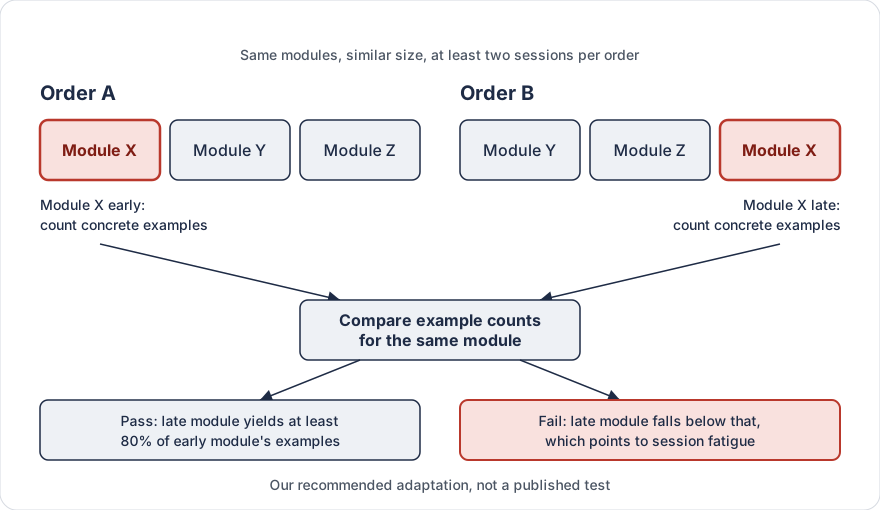
- Split your guide into modules of similar size.
- Run at least two sessions per order, with one module early in some sessions and last in others.
- For that module, count concrete examples (a specific occasion, person or purchase) per module per session. In groups, count for the whole group, not per participant.
- Pass: the late module yields at least 80% of the early module's example count, averaged across sessions. Fail: it yields below 80%, or fewer in every pair. This 80% is a rule of thumb, not a published threshold. On a fail, shorten or split the session, or move key topics earlier.
For repeat participants, ask in the screener how many paid studies they have taken in the last 6 months and exclude anyone above 3. Write it into your research screener.
How Qualfacto handles it
We recruit participants for in-depth interviews, focus groups, digital diary studies, online bulletin boards, ethnography, shop-alongs, product tests, and usability and app testing. Our interview sessions run 30 to 120 minutes. We recruit by city, check participant identity before invitation, and target by household and demographic profile. You can bring your own moderators, and we run sessions in languages other than English; for sessions longer than an hour, put key topics first and add a break.
We offer a free pilot, so you can test session length and the check above on a small group before full fieldwork. Plan the fuller study with the focus group discussion guide and diary study guide. Send your brief and ask for a free pilot at support@qualfacto.io; we aim to reply within one business day (Monday to Friday, 10:00 to 18:00 India Standard Time).
Example
For illustration only: a payments module that produces several stories at the start of group A but one vague answer at the end of group B points to session fatigue, not a weak topic.
Frequently asked
Sources
- 1.Survey Fatigue in Questionnaire Based Research: The Issues and Solutions, Journal of Caring Sciences, 13(4), 2024
- 2.Exhaustive or exhausting? Evidence on respondent fatigue in long surveys, Journal of Development Economics, 161, 2023
- 3.Exhaustive or Exhausting? Evidence on Respondent Fatigue in Long Surveys, NBER working paper, 2022
- 4.Get the Responses You Want: Designing Diary Study Entries, Nielsen Norman Group, 28 November 2025
- 5.Focus Groups 101, Nielsen Norman Group