
Glossary · research-methods
UX Research vs Market Research
UX research vs market research comes down to the decision: UX research tests whether people can use a product, market research tests whether enough people want it and who they are.

By Jitendra Kumar Nirala, Founder · Updated 24 Oct 2026
On this page
- 01Definition
- 02What is the difference between UX research and market research?
- 03Which decisions belong to which kind of research?
- 04Why does the "say versus do" gap matter more than the label?
- 05How far apart are the sample sizes in an Indian study?
- 06What do UX research and market research get confused with?
- 07How do you stop recruiting the wrong people?
- 08How Qualfacto handles it
- 09Example
- 10Related terms
- 11Frequently asked
What is the difference between UX research and market research?
UX research tests whether people can use a product; market research tests whether enough people want it and who they are.
Key takeaways
- Choose by the decision, not the method.
- Both use interviews and groups. What differs is who you recruit: people who use the product for UX research, people who buy in the category for market research.
- Sample sizes diverge sharply: for a payments app in three cities and two age bands, 18 to 24 usability sessions answer the UX question and 2,310 survey completes (finished survey responses) answer the demand question.
- Teams often run both, so write two screeners (the short questionnaire that decides who qualifies), one per decision.
The same ten interviews can be user experience (UX) research on Monday and market research on Tuesday. The method does not change. The question you carried into the room does, and so does what you do with the answers. Same room, same recording, different job. That is why a table of methods cannot separate the two; a table of decisions can.
What separates the two is the decision waiting at the end. That decision dictates who you recruit, how many, and what a useful answer looks like. Get it wrong and the sessions still run and the transcripts still look useful, so the mistake is cheap to make and slow to notice. Recruit buyers to test a checkout flow and you learn little about the flow. Recruit only current users to judge demand and you learn about your fans.
This entry defines both terms, gives a decision table you can paste into a brief, and works through how far apart the sample sizes land for a three-city study in India.
What is the difference between UX research and market research?
UX research studies how people use and experience a product so the design can be fixed. Market research falls within what the ICC/Esomar International Code (2025 edition, definitions) calls research: "the systematic gathering, analysis and interpretation of information about individuals and organisations", using methods from the applied sciences "to generate insights and support decision-making". ESOMAR is the global body for the research industry.
In practice, market research asks who the customer is, how big the opportunity is and what they will pay. UX research asks whether a specific person can finish a specific task, and where they stumble.
Which decisions belong to which kind of research?
Match the decision to the research type first, then pick the method and the recruit. This table is built for a brief. For qualitative sizes, see the sample size guide.
Two decisions, two recruits, two sample sizes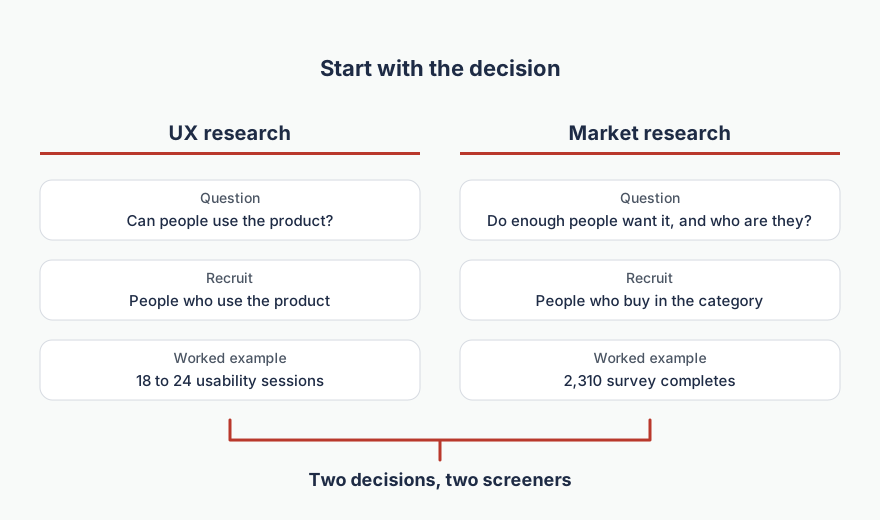
Pick by the first column. If two rows fit, you have two decisions and need two screeners.
- Decision you face
- Can people finish the task?
- Type
- UX
- Method
- Moderated usability test
- Recruit
- People who use, or would use, this product
- Size
- 3-4 per segment (Nielsen Norman Group)
- Decision you face
- Why do users drop off?
- Type
- UX
- Method
- In-depth interview (IDI), diary study (participants log their use over several days)
- Recruit
- Active and lapsed users
- Size
- Small, as set out in the sample size guide for qualitative research
- Decision you face
- Will enough people want this? Which segment first?
- Type
- Market
- Method
- Survey
- Recruit
- Buyers in the category, not only your users
- Size
- 385 per group for ±5% (calculated below)
- Decision you face
- Why do buyers pick one brand?
- Type
- Both
- Method
- IDI, focus group (FGD), shop-along (watching a shopper in a real or online store)
- Recruit
- A mix of buyers and users
- Size
- Small, per segment
Why does the "say versus do" gap matter more than the label?
The label matters less because both fields use the same methods; what matters is whether the decision needs what people say (demand, preference) or what they do (task success). Attitudinal research records what people say, and behavioural research records what they do; the two often differ, as Nielsen Norman Group (NN/g)'s guide to attitudinal and behavioural research explains. Its map of 20 UX methods places methods on that split whether they are qualitative or quantitative.
So "UX is qualitative, market is quantitative" is wrong. Both use both. The Interaction Design Foundation (IxDF) makes the same point: the tools are shared, the aims differ. If your question is "will they buy", a stated answer is a start. If it is "can they use it", you need to watch them. For the wider choice, see qualitative vs quantitative research.
- Aspect
- Decision it serves
- UX research
- Fixing how a product works
- Market research
- Sizing and understanding demand
- Aspect
- What the decision needs
- UX research
- What people do (task success)
- Market research
- What people say (demand, preference)
- Aspect
- Who is recruited
- UX research
- People who use the product
- Market research
- People who buy in the category
- Aspect
- Typical question
- UX research
- Can a specific person finish a specific task?
- Market research
- Who is the customer, how big is the opportunity, what will they pay?
How far apart are the sample sizes in an Indian study?
For a payments app in three cities and two age bands, usability testing needs 18 to 24 sessions across the six groups and the demand survey needs 2,310 completes. This is a worked model, not an official figure.
- Survey. To estimate a share within ±5 percentage points at 95% confidence, use n = z² × p × (1 − p) ÷ e², with z = 1.96, p = 0.5 (the worst case) and e = 0.05. That gives 1.96² × 0.25 ÷ 0.0025 = 384.2, rounded up to 385. Three cities × two age bands = 6 groups, and 6 × 385 = 2,310. It assumes a random sample and a ±5% margin in each group separately.
- Usability. NN/g (3 June 2012) recommends about 5 users for a qualitative usability study and 3-4 per group when user groups differ markedly. Six groups at 3-4 each gives 18-24 sessions.
The two answer different questions, so this is a contrast, not a trade-off. NN/g's same article says a quantitative usability study needs at least 20 users.
What do UX research and market research get confused with?
Three terms muddy the picture:
- User research is the wider label, and UX research sits inside it.
- Usability testing, often searched as "user testing", is one UX method: watching people attempt tasks. See remote usability testing.
- Consumer or customer research is usually market research on buyers, who may never touch your product.
How do you stop recruiting the wrong people?
Write the decision at the top of the brief, then test your screener against it. Use three tests.
- Person test. Does the screener name who the decision is about? Pass: it asks for recent product use (for example, in the last month) for a UX decision, or category purchase for a demand decision. Fail: it asks only age and city.
- Split test. Pass: each decision has its own screener or quota (a fixed number of respondents required per group). Fail: one screener serves both.
- Size test. Pass: the sample matches the question, as in the table. Fail: 10 interviews are reported as "market size".
The research screener template and market research brief cover both.
How Qualfacto handles it
Qualfacto recruits for and arranges the qualitative side of both, run by Qualfacto or by research partners depending on the project: usability and app testing, in-depth interviews, focus groups, diary studies and shop-alongs. For each it recruits by city, targets by household and demographic profile, checks participant identity before inviting, arranges sessions in languages other than English, and can supply moderators. Its in-depth interview guide shows how it plans one.
A 2,310-complete survey is separate work from the qualitative fieldwork. Pricing is a tailored proposal for each study, and a free pilot is offered. Replies aim to arrive within one business day, Monday to Friday, 10:00 to 18:00 India Standard Time (IST). Use email for briefs and WhatsApp for quick queries. Email your brief to support@qualfacto.io.
Example
For a payments app in three cities and two age bands, the UX question (can people finish the task?) needs 18 to 24 usability sessions, at 3-4 per group across six groups. The demand question (will enough people want it?) needs 385 survey completes per group, or 2,310 in all.
Frequently asked
Sources
- 1.ICC/Esomar International Code (2025 edition), definitions, ESOMAR, 2025
- 2.Attitudinal vs. Behavioral Research in UX, Nielsen Norman Group, 1 March 2024
- 3.When to Use Which User-Experience Research Methods, Nielsen Norman Group, 17 July 2022, reviewed 15 July 2026
- 4.How Many Test Users in a Usability Study?, Nielsen Norman Group, 3 June 2012
- 5.What is Market Research?, Interaction Design Foundation, 22 September 2026