Online Bulletin Board in Research: How It Works, When to Use It
An online bulletin board is a moderated, asynchronous qualitative research method. Participants answer tasks and moderator probes over several days at their own pace, so it suits considered answers from people in different cities, but not research that needs to watch live reactions.

By Jitendra Kumar Nirala, Founder · Updated 22 Oct 2026

Key takeaways
- An online bulletin board is a moderated, multi-day, asynchronous group discussion. Choose it for considered answers from people spread across cities and schedules, not for live reactions.
- Published sources disagree: from 15–20 participants (Corona Insights, Bain) to 30–100 (Indeemo), and from two days (Fieldwork Hub) to four weeks (Indeemo). Scope is agreed per project.
- In India, settle city quotas, reply languages, phone-first task design, and consent and incentive terms before fieldwork.
- Participants can read each other's posts, so consent must say so. The Digital Personal Data Protection Act, 2023 will set the baseline for notice and consent.
In this article
- 1What Is an Online Bulletin Board in Market Research?
- 2How Does an Online Bulletin Board Run, Day by Day?
- 3How Many Participants, and How Long Does an Online Bulletin Board Run?
- 4Online Bulletin Board vs Focus Group vs In-Depth Interview vs Diary Study: Which Should You Choose?
- 5When Does an Online Bulletin Board Fit?
- 6When Does an Online Bulletin Board Not Fit?
- 7How Do You Run an Online Bulletin Board in India?
- 8Languages and Mobile-First Participation
- 9Recruitment, Incentives and Identity Checks
- 10What Do Consent, Visible Posts and Data Protection Mean for a Board?
- 11What Can a Buyer Receive From a Bulletin Board Study?
- 12How Do You Brief and Commission a Board With Qualfacto?
- 13Conclusion
- 14Frequently asked questions
Many results for “online bulletin board” are notice-board tools. This page is about the research method that shares the name. Notice-board tools are for pinning information. The research version is moderated, private and built to collect opinions.
In August 2024, 57 US adults took part in an online board for the Pew Research Center What Is News study (2025). They logged in at their own pace across three days within a week to discuss what counts as news. Nobody had to be online at the same moment, which is the point of the method.
In an Indian study, a few practical questions decide whether a board works. Which cities should you recruit from? Which languages will people write in? Will they post from a phone? What have they agreed to when others can read their posts?
Below: how a board runs, what published sources report on size and length, a table for choosing it over other methods, and the India-specific checks.
What Is an Online Bulletin Board in Market Research?
An online bulletin board is a private, moderated online forum where research participants answer a researcher's questions and tasks over several days, at times that suit them. It is asynchronous: nobody has to be online together. Tasks can ask for text, photos or video, and participants can usually read and reply to one another.
You will also see it called an online discussion board or, loosely, an asynchronous focus group. An online research community (MROC, short for market research online community) is different. A board is time-bounded around one research question, while a community usually runs longer as an ongoing group.
How Does an Online Bulletin Board Run, Day by Day?
A board runs as a short sequence: briefing, daily prompts from the moderator, participant replies, moderator probes on those replies, and a wrap-up. The schedule below is illustrative, not a Qualfacto specification. Your research question sets the real length.
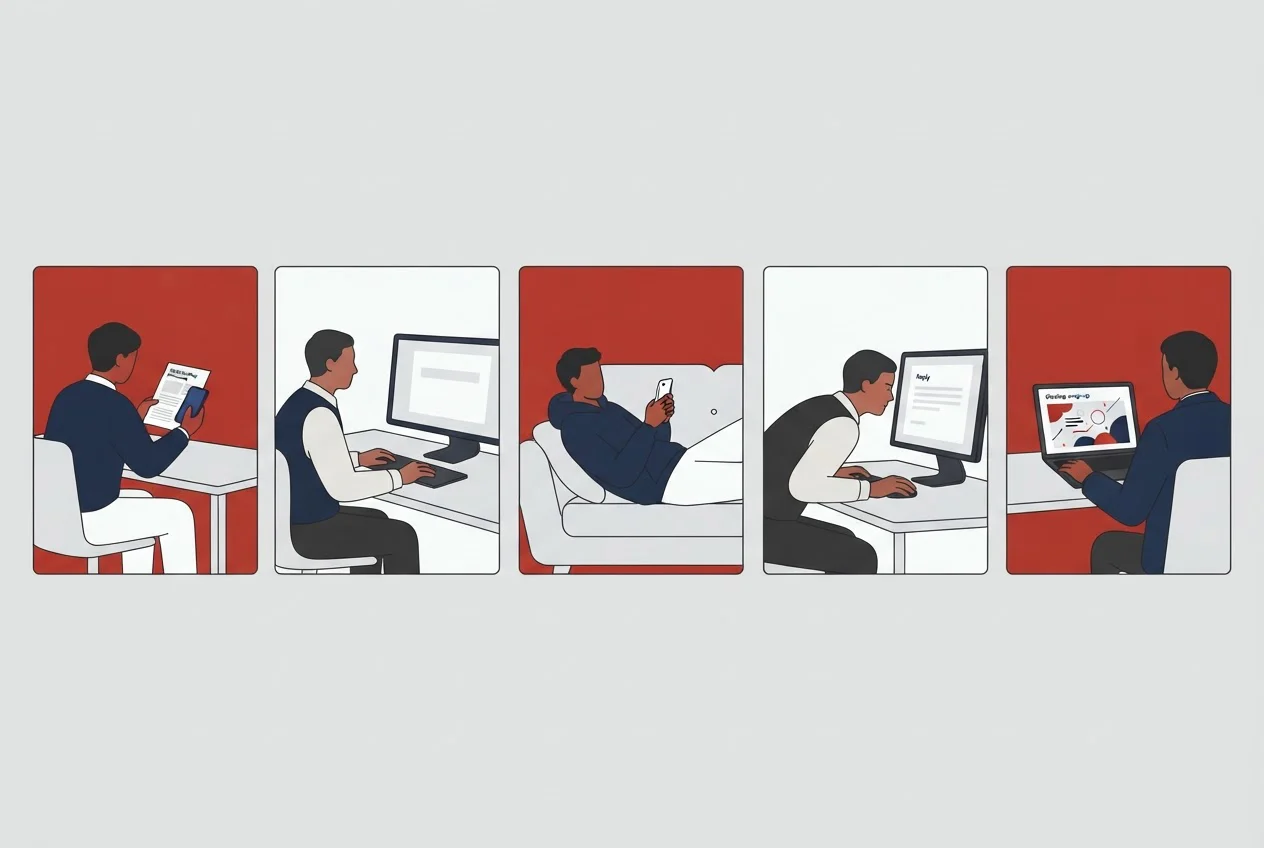
- Before day oneParticipants receive the log-in, the task rules and the incentive terms, and give consent.
- Day oneAn introduction task and a first, easy prompt.
- Days two to fourA new prompt each morning. Participants reply when it suits them, and the moderator reads each reply and probes.
- Final dayA closing task, thanks and wrap-up.
Sample tasks (also illustrative):
- Text reflection: "Describe the last time you bought this. What happened next?"
- Photo upload: "Photograph where you keep it at home and say why."
- Short video: a 30-second clip showing how you use it.
- Concept reaction: read a concept card, then say what is clear, what is unclear, and what you would change.
A probe is a follow-up question on one person's reply, such as "What made you choose that one?" Probe enough to build trust, but not so much that you steer the group (Bain). The moderator also chases participants who fall behind with a short, friendly nudge, because follow-up keeps the board complete (Fieldwork Hub).
Pro tip: Ask participants to finish early. Pew offered a prize draw to those who completed everything by Wednesday of a Monday-to-Friday week, leaving time to probe (Pew Research Center).
How Many Participants, and How Long Does an Online Bulletin Board Run?
Published sources do not agree on one typical board, so treat the figures below as ranges. Participant numbers run from 15–20 per board to 300 or more in multi-market studies, and length runs from two days to several weeks, with some boards lasting up to three months. These are industry ranges, not Qualfacto specifications.
| Source | Participants | Duration and log-in rhythm |
|---|---|---|
Corona Insights (2022, updated 2023) | Typically 15–20 per board | Suggested log-in every 24 or 48 hours |
Bain (2017) | 15 or 20 | Consecutive days or weeks; a classic three-day concept-testing sequence |
Fieldwork Hub (2025) | – | Usually two to five days; some boards up to three months |
Indeemo (2024) | 30–100 typical; 300 or more for multi-market studies | Most run one to four weeks |
Pew Research Center (fieldwork August 2024) | 57 participants | Three active days within one week |
The sources differ, and scope is agreed per project.
Corona Insights ties its typical 15–20 participants to the moderator not having to be present all the time, which also lets one moderator run more than one board (Corona Insights). Larger numbers appear in multi-market studies (Indeemo). Whatever the size, expect some participants to go quiet, so plan extra recruits (see the India section below).
For general reasoning on numbers, see sample size in qualitative research.
Online Bulletin Board vs Focus Group vs In-Depth Interview vs Diary Study: Which Should You Choose?
Choose an online bulletin board when answers need thought, respondents are spread across cities and schedules, and you can do without watching reactions form. Otherwise pick a live group, an interview or a diary study, as below.
| Factor | Online bulletin board | Focus group | In-depth interview | Diary study |
|---|---|---|---|---|
| Timing | Asynchronous, over days | Live; our groups run 1–3 hours | Live; our sessions run 30–120 minutes | Multi-day tasks done individually |
| Who sees whose answers | Group can read posts (or not, by design) | Everyone, live | Only moderator | Usually only the researcher |
| Best for | Considered answers, spread-out respondents | Live reaction, group dynamics | One person's depth | Behaviour as it happens |
| Weakest at | Live reaction | Scheduling across cities | Group effects | Group comparison |
The 1–3 hour and 30–120 minute figures are our own formats; our diary studies are multi-day photo and video tasks on a mobile app or the web.
Rule: need to watch a reaction form, run a live group (see online vs in-person focus groups). Need one person's story, run an interview (the in-depth interview method). Need behaviour in the moment, use a diary; our guide to diary studies explains when a diary beats an interview. A board often complements these rather than replacing them.
When Does an Online Bulletin Board Fit?
A board fits when time to think improves the answer: considered opinions, topics that unfold over several days, respondents in different cities or time zones, sensitive topics, and reviews of visual material. Reasons to choose it:
- Considered answers: replies are not time-pressured, so they tend to be more reflective (Corona Insights).
- Multi-day topics: feedback builds over days, as in product use.
- Spread-out respondents: schedules and distance matter less.
- Sensitive topics: people often feel more comfortable sharing real views when they are not face to face (Indeemo).
- Visual stimulus: participants can look at images or concepts calmly and respond in detail.
Use cases named by the sources:
- Concept or creative testing: testing creative material before launch (Fieldwork Hub); Bain describes a three-day concept sequence.
- Product trial feedback: send samples and collect feedback over time (Bain).
- Journey pain points: understanding customer journeys and their pain points (Fieldwork Hub).
When Does an Online Bulletin Board Not Fit?
A board does not fit when you need live reaction, when your audience cannot type or stay connected comfortably, or when you expect thin replies you cannot fix. Then use a live method.
- Live reaction: the biggest drawback of a board is the loss of non-verbal cues (Bain). If a facial reaction is your data, run a live session.
- Low literacy or low connectivity: in Pew’s Spring 2025 survey in India, 36% of adults said they did not use the internet at all. Pew’s 2023 survey (fieldwork 25 February to 22 May 2023) shows the age gap: fewer than half of Indian adults owned a smartphone, and 73% of under-40s used the internet against 36% of those aged 40 and over. The two 36% figures come from different surveys and questions. For older or lower-connectivity audiences, we recommend interviews, possibly in person.
- Thin responses: boards have less participant-to-participant exchange than live groups (Corona Insights). Write tasks that ask for an example or a story, not yes or no, and probe early.
How Do You Run an Online Bulletin Board in India?
Running a board in India comes down to four decisions made before fieldwork: which cities, which languages, how tasks work on a phone, and what participants are paid and told. Our recommendations follow; none come from a published benchmark.
Languages and Mobile-First Participation
Let participants reply in the language they think in. We recommend allowing mixed-language posts, planning translation time up front, and using a moderator who reads the language.
Design for a phone first. Keep each task to one screen of reading, ask for photos taken on the camera, and keep videos short. Test the board on a basic phone over mobile data before launch.
Recruitment, Incentives and Identity Checks
Recruit by city quotas written into a screener (the questionnaire that decides who qualifies); see research screeners. Identity checks before invitation reduce fake or duplicate participants.
Recruit extra people, since not everyone stays engaged (Drive Research advises budgeting for this). In the Pew board, 60 people were recruited and 57 completed it.
Pay incentives in stages for longer boards (Fieldwork Hub). Agree incentive terms before the study, and release each payment once the matching participation requirements are completed and validated.

What Do Consent, Visible Posts and Data Protection Mean for a Board?
Because participants can read each other's posts, consent for a board must say who will see what, before anyone posts. Under the Digital Personal Data Protection (DPDP) Act, 2023, personal data processing needs a notice and consent that is free, specific, informed, unconditional and unambiguous, and consent can be withdrawn (Act text, MeitY).
As of October 2026, the DPDP Rules, 2025 (notified 14 November 2025) are being phased in over 18 months, so most obligations, including notice, apply from about May 2027 (PIB).
- Public and private tasks: a moderator can set questions so everyone sees the replies, or only the participant and moderator do (Corona Insights).
- Blinded replies: participants cannot see others’ comments until they have posted their own (Bain). This limits groupthink.
- Informed consent: state purpose, visibility, recording and withdrawal; see informed consent.
- Anonymised handling: we recommend first names or usernames on the board, and exports with identifiers removed. Pew’s board kept participants’ names private from other participants and out of its reports (Pew Research Center).
What Can a Buyer Receive From a Bulletin Board Study?
A buyer receives what the agreed scope includes. We agree on deliverables, file formats, and responsibilities before the study begins. Depending on scope:
- Participant recruitment
- Transcripts
- Recordings
- Structured data exports
- Research reports
How Do You Brief and Commission a Board With Qualfacto?
Share a brief with us. We review the objective, method, audience, geography, sample size and timelines, check feasibility, then send a tailored proposal and quote. Pricing is set per project, with no fixed rate card. Once scope, commercials and timelines are agreed, recruitment begins.
On top of the market research brief, add these board fields:
- Reply languages and cities
- Daily time you ask of participants
- Task types: text, photo, video
- Whether participants may see each other's posts
- Consent and incentive terms
- Deliverables
Email support@qualfacto.io (Monday to Friday, 10:00 to 18:00 Indian Standard Time, IST); we aim to reply within one business day.
Conclusion
Use an online bulletin board when people need time to think, live in different places, and can type comfortably on a phone. Choose a live method when you need to watch a reaction form, or when your audience has low connectivity or finds typing hard.
Published sources disagree on board size and length, so agree on both for your own question. In India, settle city quotas, reply languages, phone-first task design, and consent and incentive terms before fieldwork.
To discuss a study, send your brief to support@qualfacto.io or visit Qualfacto.
Brief Qualfacto on your online bulletin board study
Frequently asked questions
Sources
- 1.Pew Research Center, What News Is (and Isn't) According to Americans: methodology (2025)
- 2.Pew Research Center, Most adults across 24 countries are online at least several times a day (2025)
- 3.Pew Research Center, 8 charts on technology use around the world (2024)
- 4.Digital Personal Data Protection Act, 2023 (MeitY)
- 5.Press Information Bureau, Digital Personal Data Protection Rules, 2025
- 6.Bain, Make the Most of Online Bulletin Board Groups (2017)
- 7.Corona Insights, What are Online Bulletin Boards? (2022, updated 2023)
- 8.Fieldwork Hub, Running a successful online bulletin board (2025)
- 9.Indeemo, Online Bulletin Board Guide
- 10.Drive Research, What is an Online Bulletin Board in Market Research?