Shop Along Research: When It Fits and How to Run It in India
Shop along research is a qualitative method where a researcher observes a real shopper's purchase, in person, from their recording or by screen-share, and asks why. It suits shelf and price questions.

By Jitendra Kumar Nirala, Founder · Updated 10 Oct 2026
Key takeaways
- 01Use shop along research when your question is about what a shopper does between walking in and paying. For questions about how many people behave a certain way, use a survey.
- 02Match the format to the store. An in-person shop gives the richest "why", but in a small store a self-recorded shop or a live screen-share often gives more natural behaviour.
- 03The most avoidable failures are practical (our recommendation): permission asked too late, consent that ignores bystanders, and screeners that ask "would you" instead of "have you".
- 04Plan the sample per shopper segment, not in total. Recruit 25% more than you need (25 recruits for 20 completes), which assumes 20% no-shows and drop-outs.
In this article
- 1What is shop along research and what does it answer?
- 2Should you use shop along research or a different method?
- 3Which shop-along format suits Indian stores?
- 4Why do shop-along studies go wrong in India?
- 5What must be in place before a shop-along starts?
- 6How many shop-alongs do you need, and how many hours?
- 7How does Qualfacto help with shop-along recruitment?
- 8Frequently asked questions
In India, around 91% of grocery sales still pass through kirana stores, the small neighbourhood shops, according to a Redseer Strategy Consultants report covered by Business Today in June 2026. That matters for shop along research because it decides where much of your fieldwork will happen.
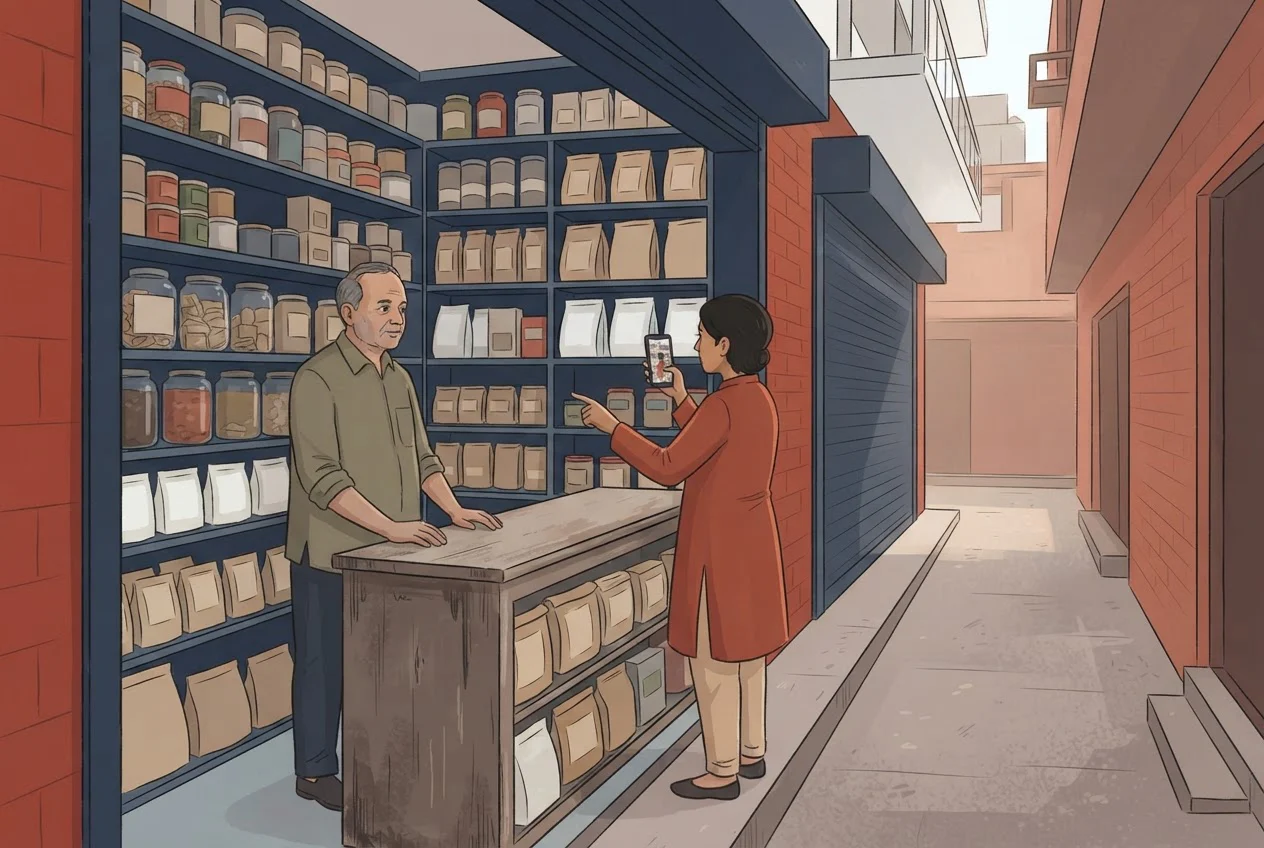
A kirana shopper often buys across a counter. Space is tight, the shopkeeper joins the conversation, and a phone camera is noticed at once. A researcher standing beside the shopper changes what is bought and how the shopkeeper behaves.
In a large chain store, a researcher is less conspicuous, so the same method behaves differently there. The choice of format, and the permissions and consent behind it, decide whether the study shows real shopping.
This page shows how to decide whether a shop-along answers your question, which of three formats to use, what to arrange before fieldwork, and how to plan hours and recruits, using pass or fail tests.
What is shop along research and what does it answer?
Shop along research is a qualitative study in which a researcher observes a real shopper making a real purchase and asks why they chose as they did. The researcher can be at the shopper's side, can watch the shopper's own phone recording afterwards, or can watch a live screen-share.
Definition
It answers questions such as:
- Why does the shopper choose one brand or pack size over another at the shelf?
- Which part of a display, label or price tag do they read, and which do they ignore?
- How do offers and competing prices change the decision on the spot?
- Where do they hesitate, switch or give up, in a store or on an app?
Because it is qualitative, it explains behaviour in depth from a small number of people. It does not count how common that behaviour is. That is the job of quantitative research, such as a survey.
Should you use shop along research or a different method?
Choose a shop-along when the decision you need to understand happens at the shelf or on the screen, and when people would struggle to describe it afterwards. For anything you need to count, or anything that happens away from the shelf, another method fits better.
| Your question | Best fit |
|---|---|
| Why do shoppers choose X over Y at the shelf? | Shop-along |
| What do shoppers notice about our new pack or display? | Shop-along |
| How does a shopper move from search to payment on an app? | Live screen-share shop-along |
| How many shoppers prefer X? | Survey (quantitative) |
| Is a concept appealing before it exists on any shelf? | Interviews or concept testing |
| What happens on very short trips, such as a quick top-up purchase? | Poor fit: the trip is over before there is anything to observe |
Recruit on behaviour, not intention. The screener, the short qualifying questionnaire, should ask "In the last month, have you bought [product] at a [type of store]? Which store, and when did you last buy it?" and never "Would you buy [product]?". People answer the second question optimistically, and the session then has nothing real to observe. Our guide to research screeners covers how to write them.
Which shop-along format suits Indian stores?
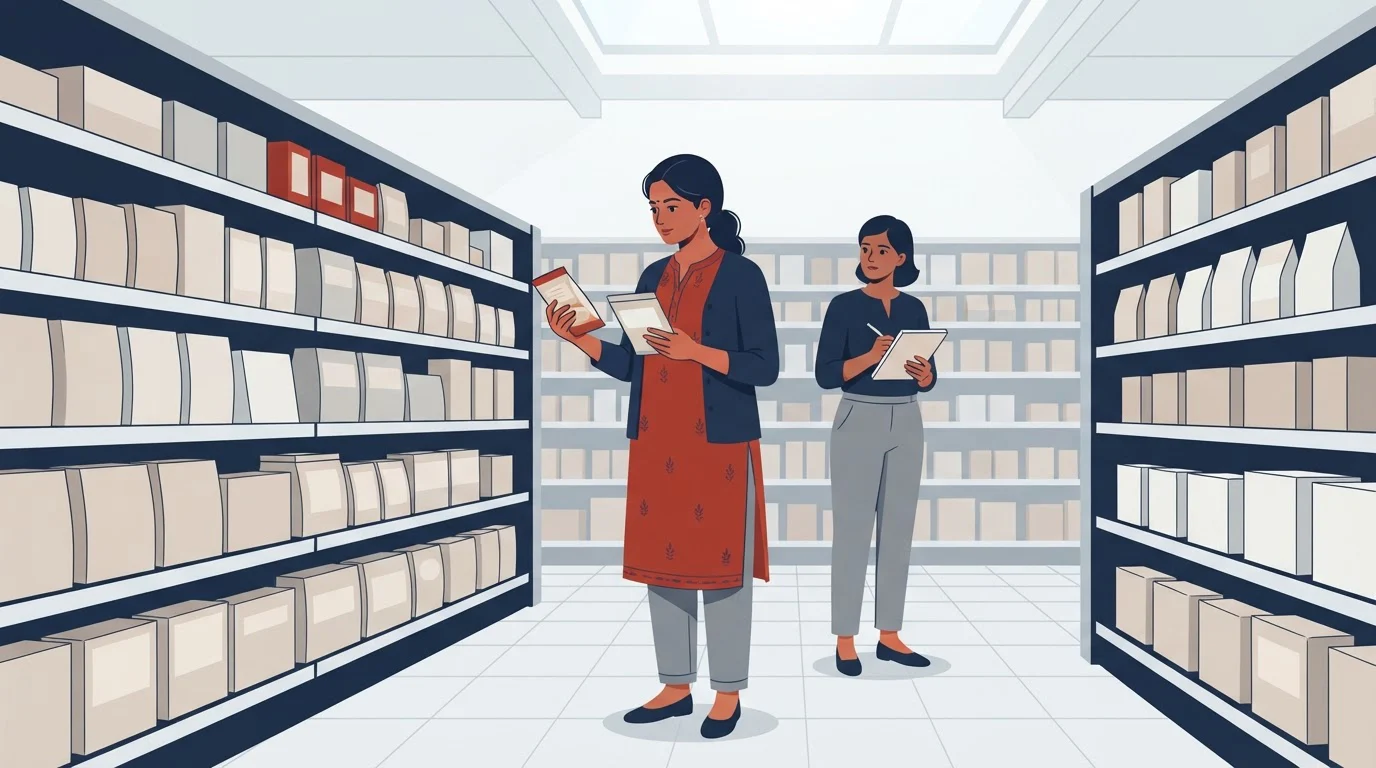
Pick the format by how visible a second person will be. In a modern-trade store (a large organised chain store such as a supermarket or hypermarket), an in-person accompanied shop works well. In a kirana or a crowded market, a moderator at the shopper's shoulder is hard to miss.
| Format | How it works | Strongest for | Main risk |
|---|---|---|---|
| Accompanied shop | Moderator walks with the shopper | The "why" at the moment of choice; what the shopper does not look at | The shopper may behave differently with a researcher present |
| Self-recorded shop | Shopper films or photographs key moments on their phone, then talks them through | Small stores, many cities, low-key behaviour | The interview happens after the shop, so small details are forgotten |
| Live screen-share | Shopper shares their phone screen on a video call while buying online | Online path to purchase | Covers only the app or site, not the physical store |
Observers can make a research situation too intimidating for natural behaviour, as Nielsen Norman Group notes in its guidance on field studies. In a small shop, a second person at the counter is hard to miss, so our recommendation for kirana work is a self-recorded shop followed by a call straight after the visit, while the details are fresh. Keep accompanied shops for larger stores.
Why do shop-along studies go wrong in India?
Shop-along studies usually fail before the shopper reaches the shelf. In our view, these five planning gaps are the most likely to derail one:
Store permission is sought after recruiting.
If the store says no, you have a recruited shopper with nowhere to go.Consent covers only the shopper.
Staff and other customers appear on video, and no one has told them.The screener asks "would you".
Participants who have never bought the product turn up.The incentive ignores the cost of the trip.
A shopper who must travel and buy products at their own expense either drops out or shops differently.The camera draws staff attention.
The session becomes about the filming, not the shopping.
Each of these is a planning step, not a research skill, which is why the checklist comes before any discussion guide.
What must be in place before a shop-along starts?
Before a shop-along starts, you need six things in place: written store permission, consent that covers staff and bystanders, a lawful data plan, a behaviour-based screener, an incentive that covers the trip, and a non-video fallback. Run each test below before fieldwork. A single fail means you are not ready.

Does the store agree in writing?
Pass: you hold written permission from the owner or manager covering the date, the number of sessions and any recording. Fail: a verbal agreement, or permission only for "a visit".
Does the consent form cover everyone who may be recorded?
Pass: the form tells the shopper what is recorded, who sees it, how long it is kept and how to withdraw, and a written plan covers staff and other customers (for example, filming shelves and hands only, and telling staff beforehand). Fail: consent covers the shopper alone. Our guide to informed consent in research goes into the detail. The ICC/ESOMAR International Code, the international code of practice from the European Society for Opinion and Market Research, requires in Article 1 that participation is voluntary and based on clear information, and that participants can withdraw.
Is the personal data handled lawfully?
Pass: before the session, a plain-language notice lists the personal data collected and the purpose, a named person holds the footage and contact details, and a retention period is set in writing. Fail: any of these is missing. As of 10 October 2026, the notice and consent duties under the Digital Personal Data Protection (DPDP) Act, 2023 apply from 13 May 2027, 18 months after the Digital Personal Data Protection Rules, 2025 were notified on 13 November 2025 (Gazette notification G.S.R. 846(E)). The Rules also set 13 November 2026 for the registration of Consent Managers. Our recommendation is to meet the notice and consent standard now. The Act itself is summarised on MeitY's data protection page.
Does the screener test behaviour?
Pass: every qualifying question starts "In the last month, have you…", asks for the store and the date, and screens out anyone who cannot name them. Fail: any "would you" or "do you plan to" question.
Does the incentive cover the trip?
Pass: the reward is at least the shopper's stated travel cost, plus the full price of any products they must buy, plus a time fee, confirmed in writing before the session. Fail: the shopper pays any part from their own pocket. Our guide to what to pay research participants in India covers the time fee.
Is there a fallback if filming draws attention?
Pass: the shopper can switch to photos or written notes, and the consent form says so. Fail: video is the only option.
How many shop-alongs do you need, and how many hours?
Plan 8 to 10 shop-alongs for each shopper segment, and stop adding sessions when three in a row give no new reasons for choice. This is our recommendation for a qualitative study, not an official figure. With two segments that gives 16 to 20 sessions.
Our model for a two-segment study (modern-trade shoppers and kirana shoppers), using 10 sessions per segment:
- Modern-trade shoppers, accompanied shop: 10 sessions × 3.5 hours (0.5 pre-interview + 1.5 in store + 0.5 post-interview + 1.0 travel and notes) = 35 moderator hours
- Kirana shoppers, self-recorded shop with a follow-up call: 10 sessions × 2.0 hours (0.5 pre-interview + 0.5 reviewing recordings + 0.5 post-call + 0.5 notes) = 20 moderator hours
- Fieldwork total: 35 + 20 = 55 moderator hours
- At 7 productive hours per moderator per day (our assumption), 55 ÷ 7 = 7.9, so 8 moderator-days (5 for the accompanied shops at two a day, 3 for the kirana sessions)
- Recruits: with 20% no-shows and drop-outs as the model's assumption, 20 completes ÷ 0.8 = 25 people recruited, about 12 or 13 per segment
Analysis time is extra, and a small sample explains behaviour without representing every shopper. For the cost lines on the recruitment side, see our guide to user research recruitment cost in India.
How does Qualfacto help with shop-along recruitment?
We recruit, screen and coordinate the shoppers for your study. You send us your research brief, covering the objective, method, target shopper, geography, sample size, timeline and recruitment criteria. We assess feasibility and send a tailored proposal and quote, because pricing depends on the method, audience, geography and how hard the profile is to recruit. Once scope, commercials and timelines are agreed, recruitment begins.
Our recruitment covers India: metros, Tier 1 and Tier 2 cities, and urban, semi-urban and rural locations. We work across multiple Indian languages, assessed project by project, so a shopper can screen and take part in the language they shop in. Participants are told what a study involves and how they will be rewarded before they commit, and incentives are processed after the session is completed and validated.
If you are new to us, we are open to a small pilot or introductory first project, depending on your requirements, so you can judge participant quality before a larger study. Share your brief and the shopper profile you need at Qualfacto and we will tell you what is feasible.
Recruit the right shoppers for your shop-along study
Frequently asked questions
Sources
- 1.Redseer Strategy Consultants report on kirana share of grocery sales, as reported by Business Today, 5 June 2026
- 2.Digital Personal Data Protection Rules, 2025, Gazette notification G.S.R. 846(E), 13 November 2025
- 3.Ministry of Electronics and Information Technology (MeitY), Data protection: DPDP Act 2023
- 4.ICC/ESOMAR International Code on Market, Opinion and Social Research and Data Analytics, Article 1
- 5.Nielsen Norman Group, Field Studies