Comparison
Qualfacto vs GLG: Expert or Consumer Interviews
Expert interviews suit questions that only insiders can answer, while consumer questions need real users recruited by profile. Choose by who holds the knowledge, then screen with yes/no facts.

By Jitendra Kumar Nirala, Founder · Updated 10 Nov 2026
Qualfacto
Consumer and user interview recruiter, India
Best for: Interviews with consumers and users in India
GLG
Expert calls; offices in Gurugram and Mumbai
Best for: Questions only insiders can answer
On this page
- 01At a glance
- 02How each looks
- 03Which to choose
- 04Detailed comparison
- 05Introduction
- 06Key takeaways
- 07Do you need an expert interview or a consumer interview?
- 08Why do teams interview the wrong people?
- 09How do we screen and recruit consumers for an in-depth interview?
- 10What does it cost, and how do you start?
- 11How we compared
- 12Frequently asked
The short answer
You need an expert interview when you are asking how something works, and a consumer interview when you are asking what people do and why. For researchers in India who need to hear from consumers and users, we recommend Qualfacto: we recruit by city, household and demographic profile, check identity before inviting, and run sessions in languages other than English.
At a glance
People you reach
- Qualfacto
- Consumers and users in India, recruited by profile
- GLG
- Experts such as former employees and specialists with long experience
Targeting
- Qualfacto
- By city, household and demographic profile
- GLG
- By expert experience
Typical session
- Qualfacto
- One-on-one in-depth interview, 30 to 120 minutes, online or in person
- GLG
- Expert calls
Checks before the session
- Qualfacto
- Participant identity checks before invitation
- GLG
- Compliance screening and a confidentiality agreement before a call
Typical buyers
- Qualfacto
- Research agencies, brands, UX and product teams, insights teams
- GLG
- Financial services firms, consulting firms, corporates, law firms
India base
- Qualfacto
- Operated by Think Design Research Services, a Delhi-based partnership firm
- GLG
- Offices in Gurugram and Mumbai
Source: Both companies' websites, Nov 2026
How each looks
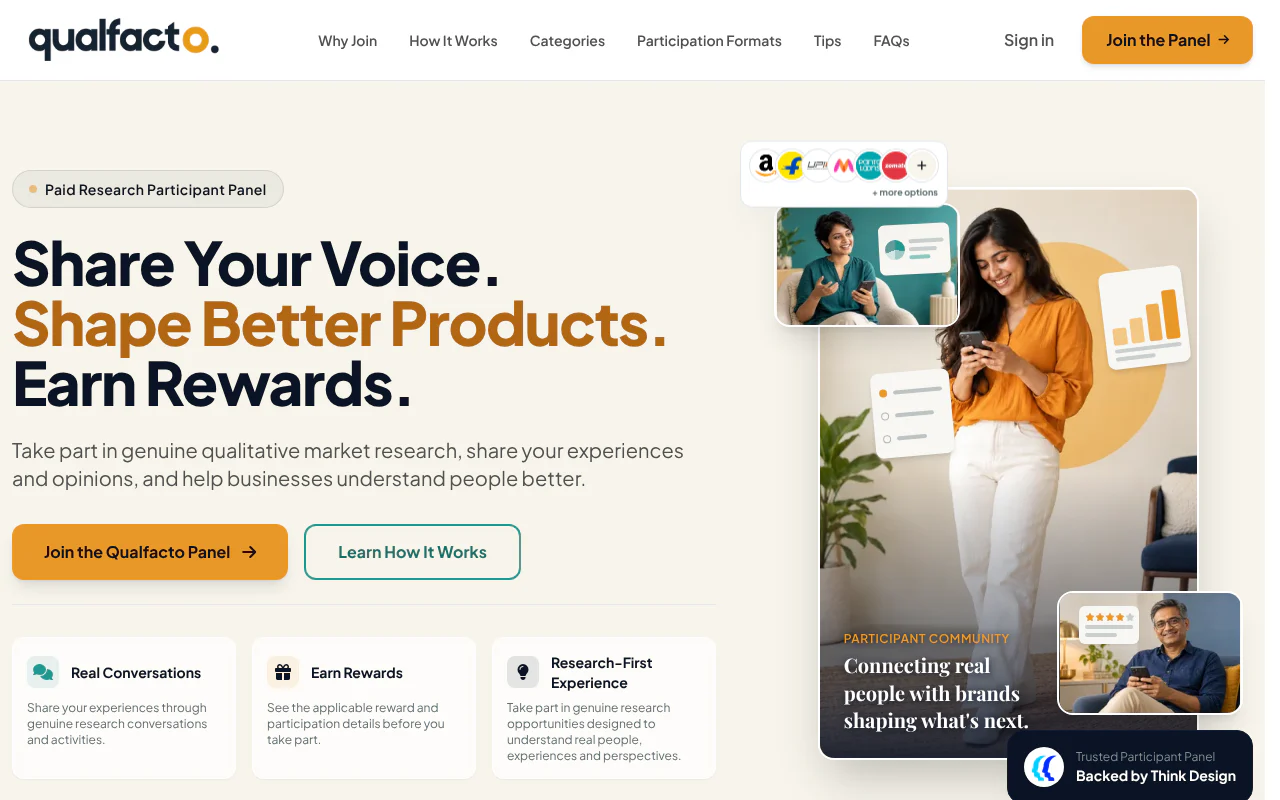
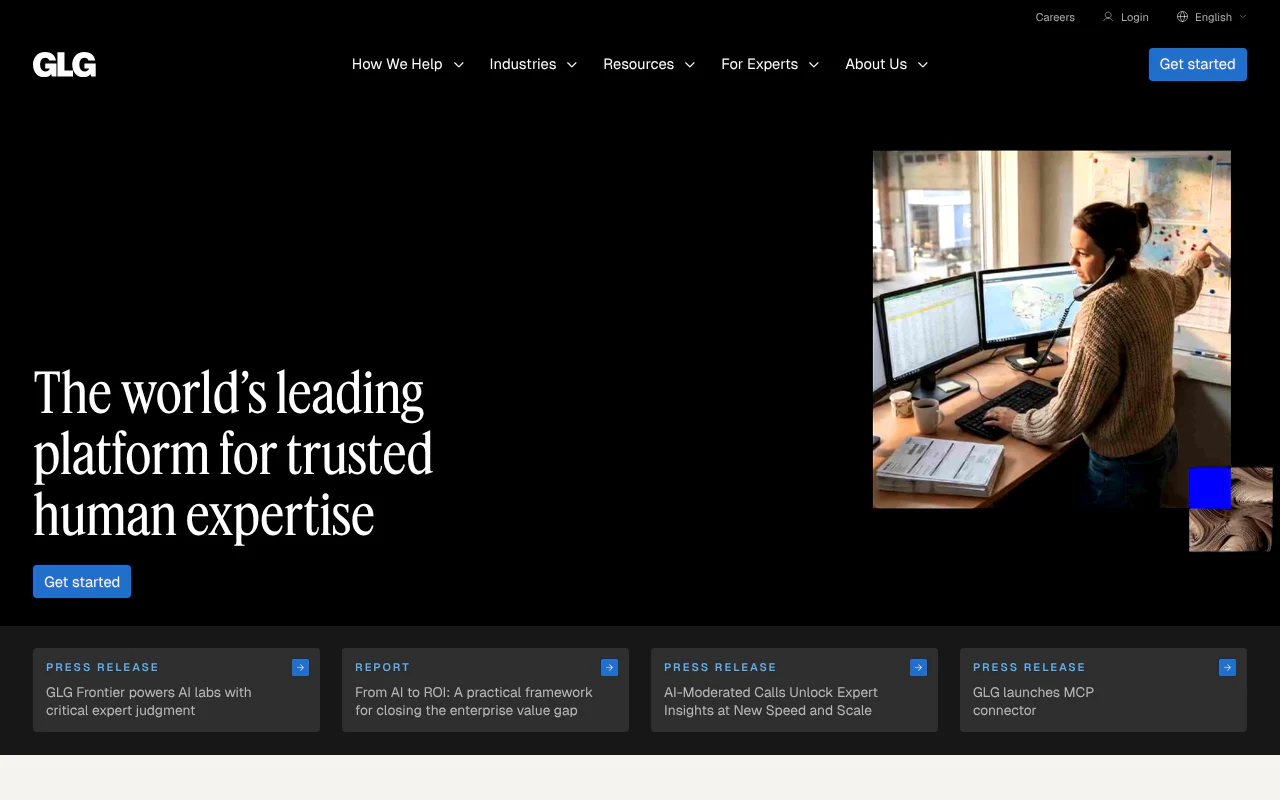
Which should you choose?
Choose Qualfacto if
- You need to target the people who actually use the product, by city, household and demographic profile
- You need sessions in the language people think in, not only English
- You need participant identity checked before anyone is invited
- You need moderators, recordings, transcripts, data exports and reports agreed before the study begins
- You want to test a provider first with a free pilot, quoted on methodology, audience, geography and recruitment difficulty
Choose GLG if
- You need to learn how a market, process or system works from former employees or specialists with long experience
- You are framing a question with insiders before you test it with consumers
- You need compliance screening and a confidentiality agreement before an expert call
Qualfacto vs GLG, point by point
A check marks the stronger side on that point. Points without a check are even, or depend on what you need.
| What matters | Qualfacto | GLG |
|---|---|---|
| Fit for the question | ||
| Questions answered best | Stronger hereWhat people do, choose and why | How a market, process or system works |
| What the evidence represents | Consumers recruited by profile, treated as evidence | One perspective shaped by the expert's position, treated as context |
| Place in a study | Used to test the question once it is framed | Used first to frame the question |
| Decisions about products | ||
| Which pack, price or message works | Stronger hereConsumers recruited by profile are the ones choosing | Using experts as a proxy is a common mistake |
| How a household really cooks, pays, shops or stores | Stronger hereConsumers, ideally at home, because behaviour differs from what people say | Relying on a single specialist's account is a common mistake |
| Why people choose, drop or misuse a product | Stronger hereLived experience of consumers or users | Asking a specialist to speak for them is a common mistake |
| Sampling and planning | ||
| How many interviews | 9 to 17 per distinct audience when the group is uniform and the question narrow | 5 to 8 expert conversations for a focused topic, stopping when new calls add nothing new |
Fit for the question
Questions answered best
- QualfactoStronger here
- What people do, choose and why
- GLG
- How a market, process or system works
What the evidence represents
- Qualfacto
- Consumers recruited by profile, treated as evidence
- GLG
- One perspective shaped by the expert's position, treated as context
Place in a study
- Qualfacto
- Used to test the question once it is framed
- GLG
- Used first to frame the question
Decisions about products
Which pack, price or message works
- QualfactoStronger here
- Consumers recruited by profile are the ones choosing
- GLG
- Using experts as a proxy is a common mistake
How a household really cooks, pays, shops or stores
- QualfactoStronger here
- Consumers, ideally at home, because behaviour differs from what people say
- GLG
- Relying on a single specialist's account is a common mistake
Why people choose, drop or misuse a product
- QualfactoStronger here
- Lived experience of consumers or users
- GLG
- Asking a specialist to speak for them is a common mistake
Sampling and planning
How many interviews
- Qualfacto
- 9 to 17 per distinct audience when the group is uniform and the question narrow
- GLG
- 5 to 8 expert conversations for a focused topic, stopping when new calls add nothing new
Introduction
A vet can tell you what a pet owner should do. Only the pet owner can tell you what they actually do, whom they trust and why. Expert interviews give you the first kind of knowledge. Consumer or user interviews give you the second. Mixing them up gives you confident answers to the wrong question.
Search for expert interviews and most results teach you to talk to specialists: professors, former employees, sector heads. That is the right method for some questions and the wrong one for others. The mistake usually shows up late, after the interviews are done. A consumer pack decision made on a specialist's opinion can mean redoing fieldwork.
This page shows how to decide between the two. It shows how we at Qualfacto recruit and screen consumers for in-depth interviews in India. It includes a decision table and a screener sheet you can copy, a screener being the short set of yes/no questions that decides who qualifies for a study.
Key takeaways
- Use an expert interview when the answer sits with someone who knows how a market, process or system works. Use a consumer interview when the answer sits with people who buy, use or live with the product.
- For researchers in India who need to hear from consumers and users, we recommend Qualfacto: we recruit by city, household and demographic profile, check identity before inviting, and run sessions in languages other than English.
- Qualfacto interviews consumers and users in India for studies where the answer sits with buyers and users, not specialists.
- A screener works when every criterion is a yes/no fact. "Engaged users" fails the test; "bought the brand in the last three months" passes.
Do you need an expert interview or a consumer interview?
You need an expert interview when you are asking how something works, and a consumer interview when you are asking what people do and why.
Use this table before you write a single question. This table is our recommendation.
We recommend experts first to frame the question, then consumers to test it. For a focused topic, keep interviewing experts until a new conversation stops adding new points.
- What you need to know
- How an industry, supply chain or regulation works
- Talk to
- An expert
- Why
- They hold the system-level view
- Common mistake
- Asking shoppers about things they never see
- What you need to know
- Why people choose, drop or misuse a product
- Talk to
- Consumers or users
- Why
- The knowledge is lived experience
- Common mistake
- Asking a specialist to speak for them
- What you need to know
- Whether an idea is realistic before you build it
- Talk to
- Experts first
- Why
- They have seen similar efforts succeed and fail
- Common mistake
- Testing with consumers before you know the constraints
- What you need to know
- How a household really cooks, pays, shops or stores
- Talk to
- Consumers, ideally at home
- Why
- Behaviour differs from what people say
- Common mistake
- Relying on a single specialist's account
- What you need to know
- How a business buys from vendors
- Talk to
- A person in that buying role
- Why
- They own the decision
- Common mistake
- Interviewing a general user
- What you need to know
- Which pack, price or message works
- Talk to
- Consumers recruited by profile
- Why
- They are the ones choosing
- Common mistake
- Using experts as a proxy
Why do teams interview the wrong people?
Teams interview the wrong people because "expert" sounds safer than "customer". A specialist has a title and a tidy answer, but an expert's account is one perspective, shaped by their position, and it is not a count of how common a view is.
The Design Kit, published by IDEO.org, places expert interviews early in a project to give a systems-level view and to learn from recent successes and failures. It treats them as supplementary to talking with the people you are designing for.
Authority is also more scattered than a title suggests. A June 2026 article in QRCA Views, the publication of the Qualitative Research Consultants Association, shows pet owners weighing advice from vets, influencers, peers and rescue workers, not deferring to one expert. The authors, from the research firm Trek Solutions, argue that in-home visits, ethnographies and shop-alongs reveal routines that surveys miss.
Our recommendation: if your decision depends on what people do and choose, treat experts as context and consumers as evidence.
How do we screen and recruit consumers for an in-depth interview?
We write the audience as yes/no facts, agree the screener with you, check identity before inviting, and book more sessions than you need. An in-depth interview (IDI) is a one-to-one conversation that explores why and how people decide; our in-depth interview guide covers the method.
Participants join our panel free and register an interest. We invite them only when their profile fits a study, so registration does not guarantee an invitation. Each invitation states the activity, duration and incentive, and rewards depend on the specific study's terms. We never ask anyone to pay to register. What we collect is explained in our privacy policy. If you are unsure whether a message is ours, write to support@qualfacto.io.
How many interviews? Our guide is 9 to 17 interviews per distinct audience when the group is fairly uniform and the question is narrow. For two audiences, that is 2 × 9 = 18 to 2 × 17 = 34 interviews. A typical consumer or product session runs 45 to 60 minutes.
How many sessions to book? Sessions to book = completed interviews ÷ (1 − expected loss), where expected loss is the share of booked sessions that do not end in a completed interview. This is our worked example, not an official figure: with 12 completed interviews needed and 20% loss assumed, 12 ÷ 0.80 = 15 sessions.
Screener sheet you can copy
- Check
- Audience defined by facts
- Pass
- Every criterion is a yes/no question, such as city or a brand used in the last three months
- Fail
- A definition that needs judgement, such as "engaged users"
- Check
- Language
- Pass
- The participant can read the consent notice in the interview language
- Fail
- An English-only notice for a Hindi interview
- Check
- Termination answers (answers that end screening)
- Pass
- You have signed off the answer that ends screening for each question
- Fail
- Screening ends on answers you never saw
- Check
- City quota
- Pass
- Sessions per city, and who recruits in each, are written down
- Fail
- "As required"
- Check
- Identity
- Pass
- A written description of how identity is checked before an invitation goes out
- Fail
- Checks only after the session
- Check
- Booking
- Pass
- Sessions booked = completed interviews ÷ (1 − loss), with a stated number and payer
- Fail
- No buffer stated
- Check
- Incentive
- Pass
- Amount and timing stated in the invitation before agreement
- Fail
- Terms revealed after consent
What does it cost, and how do you start?
Cost is set per project, as the fifth reason above describes. To start, send your brief by email to support@qualfacto.io, with the decision, audience segments, interviews per segment, session length, language and city, and deliverables. We review feasibility and send a proposal. We aim to reply within one business day (Monday to Friday, 10:00 AM to 6:00 PM India Standard Time); detailed briefs may take longer. WhatsApp is available for quick queries.
Our verdict
Choose Qualfacto when your decision depends on what consumers and users in India do and choose, because we recruit by city, household and demographic profile and check identity before inviting.
How we compared
We publish this page, so we are one of the two providers compared. GLG facts are as of November 2026.
This page is published by qualfacto. If anything here is out of date, tell us and we will correct it.
Sources
- 1.Design Kit: Expert Interview, IDEO.org
- 2.QRCA Views, 23 June 2026: When Everyone's an Expert, Qualitative Research Consultants Association, 2026-06-23
- 3.ICC/ESOMAR International Code