Comparison
Qualfacto vs Outset: AI-Moderated Interviews in India
AI moderated interviews work for structured, bounded questioning, but a human moderator is worth paying for when follow-up is the insight.

By Jitendra Kumar Nirala, Founder · Updated 16 Nov 2026
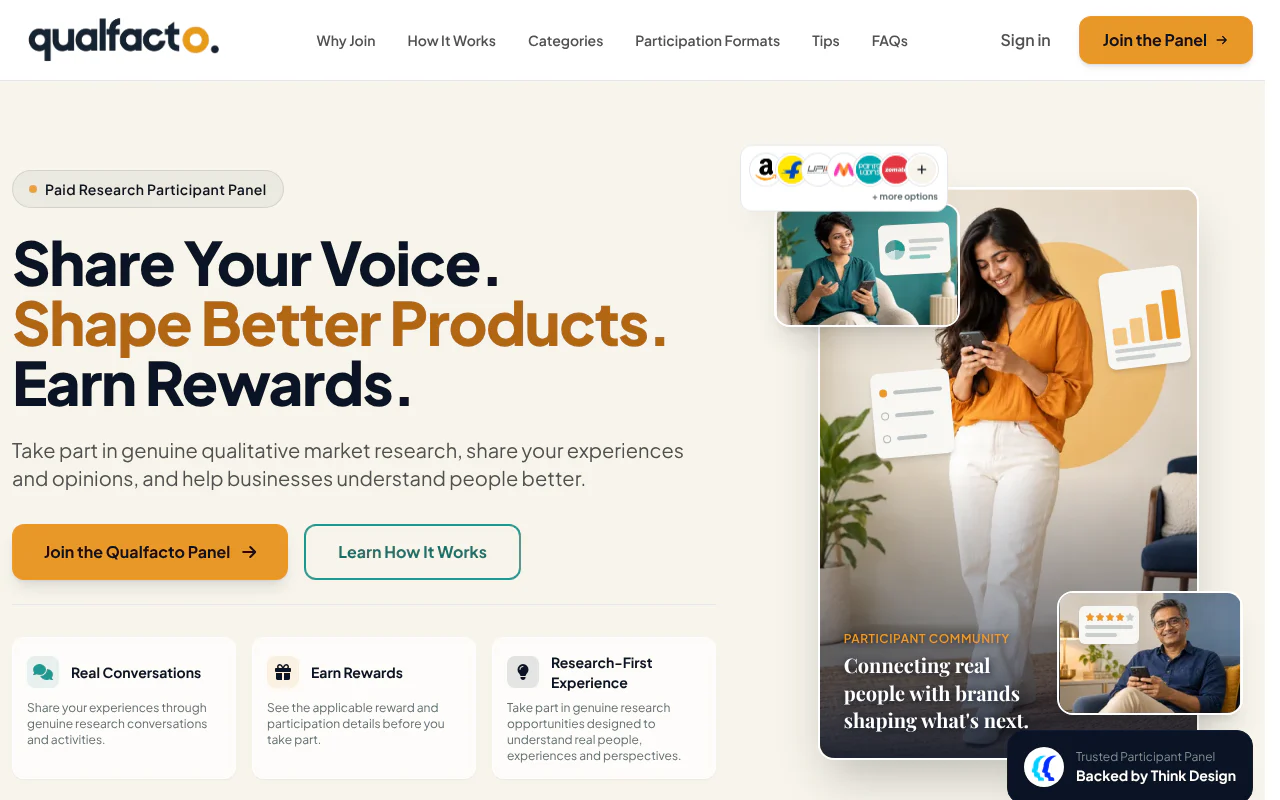
Qualfacto
Human-moderated IDIs with identity-checked participants in India
Best for: IDIs with identity-checked Indian participants in local languages
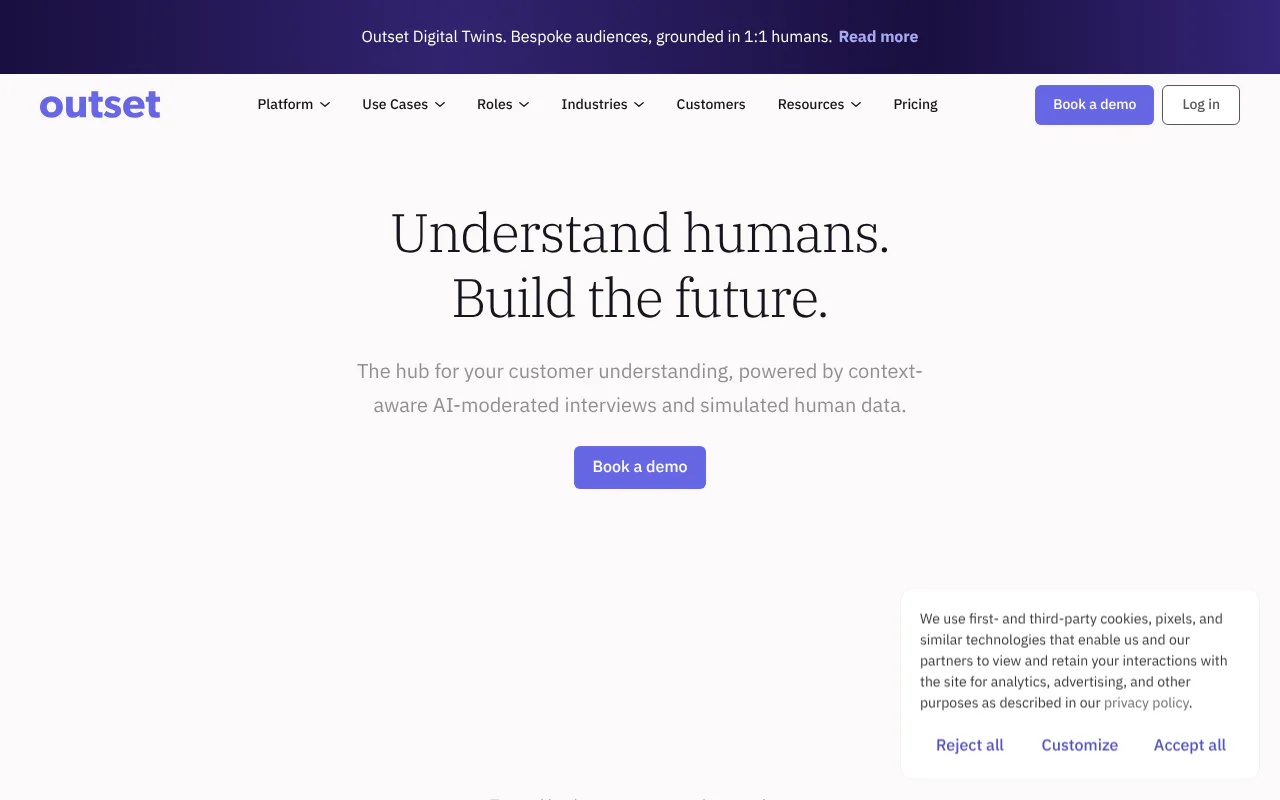
Outset
AI interview platform
Best for: Structured AI-moderated interviews by text, voice or video
On this page
- 01At a glance
- 02How each looks
- 03Which to choose
- 04Detailed comparison
- 05Introduction
- 06Key takeaways
- 07When is a human moderator worth paying for in AI-moderated interviews?
- 08What does the evidence on AI-moderated interviews show, and what has it not tested?
- 09How do Qualfacto and Outset compare on the points buyers decide on?
- 10How we compared
- 11Frequently asked
The short answer
AI-moderated interviews suit structured interviews in a language already tried on a real sample. Pay for a human moderator when the language fails a trial, or when two of the four judgement tests point to one. The 2026 review of AI-moderator studies reports none in an Indian language, so run your own trial.
At a glance
Moderator
- Qualfacto
- A human moderator; we can supply moderators
- Outset
- An AI moderator
Interview formats
- Qualfacto
- IDIs of 30 to 120 minutes, online or in person
- Outset
- Interviews by text, voice or video
Languages
- Qualfacto
- Sessions in languages other than English
- Outset
- 40+ languages
Participants
- Qualfacto
- Adults in India; recruitment by city, household and demographic profile
- Outset
- Your own panel or customer lists, or recruitment through Outset; participants from 85+ countries
Deliverables
- Qualfacto
- Recordings, transcripts, data exports and reports, as scoped
- Outset
- Automated summaries, themes, quotes and highlight reels
Pricing
- Qualfacto
- Per project, from a tailored proposal after we read your brief; free pilot
- Outset
- Custom pricing through a demo
Source: Both companies' websites, Nov 2026
How each looks
Which should you choose?
Choose Qualfacto if
- Your language is not yet proven
- Participants must be verified Indian residents
- Follow-up is the insight
- You need to see behaviour
- You want to test before committing
Choose Outset if
- You want an AI moderator to run interviews by text, voice or video
- You want automated summaries, themes, quotes and highlight reels
- You want to interview your own panel or customer lists, with participants from 85+ countries
Qualfacto vs Outset, point by point
A check marks the stronger side on that point. Points without a check are even, or depend on what you need.
| What matters | Qualfacto | Outset |
|---|---|---|
| Moderation | ||
| Follow-up | Stronger hereA human moderator, supplied by us or by you, adapts to what participants say within a 30 to 120 minute IDI | An AI moderator uses a guide you customise |
| Conditional questions | Stronger hereA human moderator can follow an unexpected answer | The AI interviewers NN/G tested in January 2026 did not create new questions, reorder or skip questions, or adapt questions that seemed irrelevant |
| Sensitive disclosures | Guides on income, debt, health, family conflict or religion suit a human moderator under test 6 | A 64-person study in the MeasuringU review reported a slight preference for disclosing to AI (21% against 9% for a human) |
| Participants and trust | ||
| Identity and security | Identity checks before invitation; participants register with a +91 mobile number and a WhatsApp code | SOC 2 Type II, an independent audit report on security controls |
| Language confirmation | Stronger hereName your language in the brief and we confirm it with you before the study begins | The 2026 review of AI-moderator studies reports none in an Indian language |
| Buying terms | ||
| Price drivers | Price depends on method, audience, participant profile, sample, geography, recruitment complexity and scope | Pricing page lists no prices or limits |
Moderation
Follow-up
- QualfactoStronger here
- A human moderator, supplied by us or by you, adapts to what participants say within a 30 to 120 minute IDI
- Outset
- An AI moderator uses a guide you customise
Conditional questions
- QualfactoStronger here
- A human moderator can follow an unexpected answer
- Outset
- The AI interviewers NN/G tested in January 2026 did not create new questions, reorder or skip questions, or adapt questions that seemed irrelevant
Sensitive disclosures
- Qualfacto
- Guides on income, debt, health, family conflict or religion suit a human moderator under test 6
- Outset
- A 64-person study in the MeasuringU review reported a slight preference for disclosing to AI (21% against 9% for a human)
Participants and trust
Identity and security
- Qualfacto
- Identity checks before invitation; participants register with a +91 mobile number and a WhatsApp code
- Outset
- SOC 2 Type II, an independent audit report on security controls
Language confirmation
- QualfactoStronger here
- Name your language in the brief and we confirm it with you before the study begins
- Outset
- The 2026 review of AI-moderator studies reports none in an Indian language
Buying terms
Price drivers
- Qualfacto
- Price depends on method, audience, participant profile, sample, geography, recruitment complexity and scope
- Outset
- Pricing page lists no prices or limits
Introduction
A platform that lists 40 languages has not necessarily been tested in yours. The independent studies of AI-moderated interviews are almost all in English, and for an interview in Tamil, Bengali or Marathi that gap matters more than price or speed.
An in-depth interview (IDI) is a one-to-one conversation of 30 to 120 minutes in which the moderator follows what the participant says. An AI (artificial intelligence) moderator is software that asks the questions, listens and generates follow-ups in text, voice or video. The useful question is how much of your interview can be written in advance, because software handles that part best.
Below are a six-test checklist, the evidence behind it, and a comparison of Qualfacto with Outset, an AI interview platform.
Key takeaways
- AI-moderated interviews suit structured interviews in a language already tried on a real sample. Pay for a human moderator when the language fails a trial, or when two of the four judgement tests below point to one.
- The independent evidence is mixed. The 2026 review of AI-moderator studies reports none in an Indian language, so run your own trial.
- For IDIs with identity-checked Indian participants in local languages, we recommend Qualfacto: human moderators, identity checks before invitation, sessions in languages other than English, and a free pilot.
- Whichever vendor you choose, ask for a trial interview with a native speaker and read the transcript before you commit.
When is a human moderator worth paying for in AI-moderated interviews?
A human moderator is worth paying for when the interview language fails a trial with a native speaker, or when two or more of four judgement tests (conditional questions, follow-up as the insight, behaviour to watch, sensitive consent) point to one. An identity check comes before both. This is our rule of thumb, built on the evidence in the next section.
Test 1: Has the interview language passed a trial with a native speaker?
Pass means a native speaker of your participants' language took a trial interview and found no lost or wrong meaning in the transcript. Ask the vendor for a trial in that language and have a native speaker read the transcript against what was said. Include a sentence that mixes two languages, such as Hindi and English. Any failure decides the choice: use a human moderator who speaks the language. A list of supported languages is a claim, and the trial is the test.
Test 2: Were participants identity-checked before they were invited?
Pass means you can name the step, who ran it and when, in writing. This is a gate, not a vote. If nobody can answer, stop before fieldwork, whoever moderates, because a fluent interview with the wrong person is useless. On our panel, participants register with a +91 mobile number and a WhatsApp code, and we run identity checks before inviting anyone to a study.
Test 3: Do three or more questions depend on the answer before them?
Fail means three or more questions in your guide that you would ask only after hearing a particular answer. Mark every question that begins "if they say…". In the AI interviewers tested by Nielsen Norman Group (NN/G, a UX research consultancy) in January 2026, the tools did not create new questions, reorder or skip questions, or adapt questions that seemed irrelevant (NN/G, 30 January 2026). Every conditional question is a place where a fixed script loses ground.
Test 4: Is the follow-up where the insight lives?
Fail means the topic turns on money, family decisions, status or trust, where the useful part is the second or third "why". Check it by reading three pilot transcripts and asking whether the best quote came from the scripted question or the follow-up. In one small study of 11 sessions, the AI moderator missed 88% of follow-up opportunities on unclear answers, as reported in the MeasuringU literature review (8 September 2026). With so few sessions, treat it as a warning, not a rate.
Test 5: Do you need to watch behaviour, not only hear about it?
Fail means any part of the study needs you to see something: a payment flow, a kitchen, a shop shelf. Our recommendation is a human moderator, or a method that lets you watch, in those cases. You can commission in-person IDIs, ethnography, shop-alongs and usability testing through Qualfacto. Depending on the project, we or a research partner run them.
Test 6: Could participants hold back because of who is listening?
Fail if the guide asks about income, debt, health, family conflict or religion, or if three native-speaker readers of the consent text cannot say who is interviewing and how the recording is used. In NN/G's test, one participant said they held back information because they did not know how it would be used. The tests cut both ways: a 64-person study in the MeasuringU review reported a slight preference for disclosing to AI (21% against 9% for a human). For embarrassing but simple disclosures an AI interview may suit; read about social desirability bias before deciding.
How to score
Count the fails on tests 3 to 6.
- Zero fails: the study is simple enough to pilot cheaply, provided tests 1 and 2 pass. Ask us for the free pilot and compare transcripts.
- One fail: run a small pilot both ways.
- Two or more: use a human moderator.
Two illustrative scenarios, not real studies:
- A payments-app concept interview with participants who mix Tamil and English fails test 1 until trialled. It also fails test 3, because several questions depend on earlier answers. It fails test 4, because money and family decisions are the topic. The result is a human moderator.
- A ten-question satisfaction follow-up in Hindi, with fixed questions, a low-stakes topic, nothing to observe and a language that passed trial, scores zero fails. It is simple enough to pilot cheaply: ask us for the free pilot and compare transcripts.
What does the evidence on AI-moderated interviews show, and what has it not tested?
The evidence is mixed: AI moderators suit structured, bounded interviews and fall short when the interviewer must follow the unexpected. The MeasuringU review (published 8 September 2026) describes its sources as primarily in English. Its only non-English studies are a Chinese study (Zhu et al.), a Hungarian study (Danó et al.) and a Spanish interview in NN/G's test. It reports none in an Indian language.
Two findings drive the tests above. The tools NN/G tested followed a fixed guide, and interview length varied from 13 to 56 minutes. NN/G recommends using AI interviews to supplement, not replace, human moderation for structured feedback such as product feedback and recruitment screening (NN/G, 30 January 2026). In the Spanish interview, an Argentinian participant completed the whole session, and the tool occasionally mixed Argentinian and Mexican Spanish. Our inference is that regional variants matter in India as well. With no Indian-language test reported, a trial you run yourself is the only evidence you can rely on.
How do Qualfacto and Outset compare on the points buyers decide on?
The deciding points are moderation, language, identity checks, recruitment, formats, deliverables, price and how a study starts. We lead with where we differ most.
Other methods
You can also commission focus groups, diary studies, ethnography, shop-alongs and usability testing through Qualfacto; depending on the project, we or a research partner run them.
Recruitment and registration
For who does what in recruitment and fieldwork, see our responsibility sheet. People in India can register to be considered for suitable studies; registration does not guarantee invitations, which depend on each project's requirements and the participant's profile.
Price and timing
For how long each stage takes, see our qualitative research timeline.
How a study starts
You share a brief. We review the objective, method, audience, geography, sample and timelines, assess feasibility, send a proposal, then recruit, screen and schedule. After completion and validation we process participant incentives and deliver what was agreed. See how we run in-depth interviews.
Send your research brief to Qualfacto by email or WhatsApp and ask for the free pilot. We aim to reply within one business day, Monday to Friday, 10:00 to 18:00 Indian Standard Time (IST).
Our verdict
For insight teams commissioning IDIs with identity-checked Indian participants in local languages, we recommend Qualfacto.
How we compared
We compared Qualfacto and Outset on moderation, language, identity checks, recruitment, formats, deliverables and pricing, using both companies' websites, the NN/G and MeasuringU studies and the ESOMAR checklist, as of November 2026. We did not test either platform in an interview.
This page is published by qualfacto. If anything here is out of date, tell us and we will correct it.
Sources
- 1.AI Interviewers, Nielsen Norman Group (Maria Rosala), 30 January 2026
- 2.Effectiveness of AI Moderators: A Literature Review, MeasuringU (Plabst, Sauro and Lewis), 8 September 2026
- 3.Outset home page, Outset, November 2026
- 4.Outset pricing page, Outset, November 2026
- 5.20 Questions to Help Buyers of AI-Based Services, ESOMAR, March 2024