Glossary
Social Desirability Bias
Social desirability bias is answering to look acceptable rather than to be accurate. It matters on sensitive topics and can be screened with four tests on each discussion guide question.

By Jitendra Kumar Nirala, Founder · Updated 24 Oct 2026
On this page
- 01Definition
- 02Introduction
- 03What is social desirability bias?
- 04How big is social desirability bias, and when does it matter?
- 05Is social desirability bias the same as acquiescence bias?
- 06How can you check a discussion guide for social desirability bias?
- 07Which research format changes who the participant is performing for?
- 08How Qualfacto handles it
- 09Example
- 10Related terms
- 11Frequently asked
What is social desirability bias?
Social desirability bias is the tendency to answer questions in a way others will view favourably, so people overreport good behaviour and underreport bad.
Key takeaways
- It has a deliberate form (impression management) and an honest-but-inflated form (self-deceptive enhancement).
- It depends on the topic. In political surveys, across 264 list experiments, biases were typically under 10 percentage points, near zero on prejudice topics and about 14 points on support for authoritarian regimes.
- One 15-country survey study (Tellis and Chandrasekaran, 2010) found acquiescence bias highest in Brazil and India, so rule it out before blaming social desirability.
- A discussion guide question is high risk only when it fails all four tests below. Rewrite those questions, or move them to a format with a different audience.
Introduction
A participant in an interview rates every concept 9 out of 10. Either they like everything or they are being polite, and those two explanations need different fixes. This case is an illustration, not data.
Social desirability bias is the polite habit: answering in the way that looks acceptable to whoever is listening. Acquiescence bias, also called yea-saying, is the agreeing habit: saying yes to any statement put to you, whatever it says.
One 15-country survey study (Tellis and Chandrasekaran, 2010) found yea-saying highest in Brazil and India, and socially desirable responding highest in Singapore and Italy.
The cures differ. Social desirability responds to who can see the answer, while acquiescence responds to how the question is worded. The four-test guide check later on this page targets the first of the two.
How big is social desirability bias, and when does it matter?
Social desirability bias is large on some topics and near zero on others, so it needs checking per topic. In political surveys, a review of 264 list experiments across 92 papers found biases typically under 10 percentage points. Support for authoritarian regimes was overreported by about 14 points on average, turnout by about 7 (suggestive only), and prejudice biases were near zero (Blair, Coppock and Moor, 2020). A list experiment hides the sensitive answer inside a count of items. These topics are political. Read them as proof that topic matters, not as figures for your category.
Bias appears only when four conditions hold together (same source):
- The participant has someone in mind to impress.
- They think that person can infer their answer.
- They think that person prefers certain answers.
- They expect a cost for giving the other answer.
List experiments are about 14 times noisier than direct questions (same source).
Is social desirability bias the same as acquiescence bias?
No. Social desirability bias is answering to look good. Acquiescence bias is agreeing with a statement whatever it says. In the 15-country study, acquiescence bias was highest in Brazil and India, while socially desirable responding was highest in Singapore and Italy (Tellis and Chandrasekaran, 2010). That is one survey study, so treat it as a pointer, not a league table. It measured survey respondents, not interview participants.
Where social desirability does appear in India, it need not flatter in the obvious way. In a list experiment with Amazon Mechanical Turk crowd workers, Indian workers under-reported "killing time" and "fun" as motives and drastically over-reported "sense of purpose" (Antin and Shaw, 2012). Crowd workers are not consumers. The lesson is direction: people reach for the respectable answer, not always the positive one.
How can you check a discussion guide for social desirability bias?
Run each guide question through four tests, one per condition. A question is high risk only when it fails all four. The tests turn Blair, Coppock and Moor's conditions into a check.
Four tests that flag a high-risk question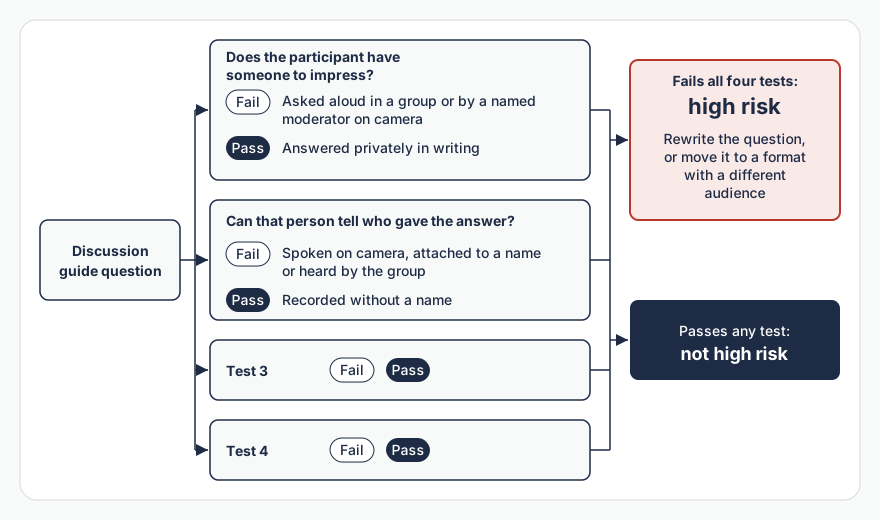
Does the participant have someone to impress?
Fail if the question is asked aloud in a group or by a named moderator on camera. Pass if it is answered privately in writing.
Can that person tell who gave the answer?
Fail if the answer is spoken on camera, attached to a name or heard by the group. Pass if it is recorded without a name.
Is there an answer that person would prefer?
Fail if one answer is plainly healthier, thriftier, more loyal or more modern. Pass if both answers sound equally ordinary.
Would the other answer feel costly?
Fail if the honest answer could bring judgement or embarrassment. Pass if it would not.
In an interview the moderator is always someone to impress and sees the answer, so the first two tests usually fail. The last two are the ones that separate one question from another. If a question fails all four, rewrite it or move it to a different format. Rewrites for risky questions are below.
The last rewrite follows the documented practice of asking about friends instead of the participant (Wikipedia).
- Risky question
- Do you like this concept?
- Rewrite
- What would make you not buy it?
- Risky question
- Do you check labels for sugar?
- Rewrite
- Walk me through the last time you bought this.
- Risky question
- Would you pay ₹X?
- Rewrite
- What did you last pay for something similar?
- Risky question
- Do you do [sensitive behaviour]?
- Rewrite
- How common is it among people like you?
Which research format changes who the participant is performing for?
Format changes who the participant has in mind to impress (condition 1) and how easily that person can tell who gave the answer (condition 2). In a focus group the audience is the other participants. In an interview it is the moderator. In an online bulletin board or diary the moderator and brand still read every answer, but there is no live group and no face to read, so less social pressure is expected. This is an inference; no study cited here tests it. None of these formats removes the bias.
How Qualfacto handles it
Qualfacto is a qualitative research participant panel in India. Its recommendation for a study in India is to rule out acquiescence bias before blaming social desirability. When concepts score well, it suggests asking what would stop the participant buying, and treating agreement with both a statement and its opposite as acquiescence bias. It applies the four-test check to discussion guides as its own recommendation, and views list experiments, being about 14 times noisier than direct questions, as a poor fit for a sample of 20 to 30 interviews. Its formats for this:
- In-depth interviews: one to one, 30 to 120 minutes, online or in person.
- Online bulletin boards: asynchronous, so participants reply in their own time.
- Diary studies: multi-day photo and video tasks on mobile or web.
- Shop-alongs, in-home product tests and opt-in digital behavioural tracking: they record what people do, so your evidence does not rest only on what they say. That is Qualfacto's view.
Qualfacto recruits by city, runs sessions in languages other than English, checks participant identity before invitation, and works with moderators you supply. Share your brief by email (support@qualfacto.io) or WhatsApp, Monday to Friday, 10:00 to 18:00 Indian Standard Time (IST), and ask about the free pilot. It aims to reply within one business day.
Example
A moderator asks a group, "How often do you check the sugar on the label?" Each person hears the others, a healthy answer is obvious, and admitting you never check feels costly. All four tests fail, so the question is high risk and is better rewritten as "Walk me through the last time you bought this."
Frequently asked
Sources
- 1.Blair, Coppock and Moor (2020), "When to Worry about Sensitivity Bias", American Political Science Review
- 2.Tellis and Chandrasekaran (2010), "Extent and impact of response biases in cross-national survey research", International Journal of Research in Marketing
- 3.Antin and Shaw (2012), "Social desirability bias and self-reports of motivation", CHI 2012
- 4.Social-desirability bias, Wikipedia