
Glossary
Affluent Consumers
Affluent consumers are people whose income, wealth or spending sits well above the norm, but India has no single cut-off. Counts run from 13 million to 56 million depending on the unit.

By Jitendra Kumar Nirala, Founder · Updated 23 Oct 2026
On this page
- 01Definition
- 02Quick facts
- 03What does "affluent consumers" mean in India?
- 04How many affluent consumers does India have, and why do the counts differ?
- 05Which definition of affluent should a research brief use?
- 06How do you screen for affluent consumers without asking about income?
- 07Why are affluent consumers harder to recruit, and what should the plan allow?
- 08Which terms get confused with affluent consumers?
- 09How Qualfacto handles it
- 10Example
- 11Related terms
- 12Frequently asked
What are affluent consumers in India?
Affluent consumers are people whose income, wealth or spending sits well above the norm. India has no official cut-off, so researchers define them by income, spending or investable assets.
Key takeaways
- Choose the unit that matches the decision the study informs, then write the rupee cut-off and a purchase behaviour into the brief.
- Screen on what people buy and do. If you must ask about income, use wide bands with a "prefer not to say" option.
- Plan for a harder recruit than a general-population study: more lead time, flexible slots and a higher incentive.
- Check which scheme your client's data uses, since ISEC now redefines NCCS.
Quick facts
- Official cut-off
- None in India
- Ways to define it
- Income (per person or household), spending, or investable assets
- Published counts
- 13 million to 56 million people
- Individual income line (Visa)
- Over ₹10 lakh a year
- Household income line (PRICE)
- Above ₹30 lakh a year, 2020-21 prices
A brief that asks for "affluent consumers" can mean a salaried professional earning ₹12 lakh a year or a family on ₹30 lakh. Both fit the word. A ₹12 lakh professional fails a ₹30 lakh screener, and a screener set at ₹12 lakh lets in people the client never meant.
The mismatch shows up late. A recruiter fills the quota against whatever definition they assumed, the interviews run, and the client finds the room is not who they had in mind. Fixing it means re-recruiting and a delay to the readout. Affluent people can also be harder to recruit, so there is little slack to rework a sample.
The fix is cheap and comes before fieldwork: choose the unit, write the cut-off into the brief, and screen on behaviour. A cut-off written in rupees, with its unit, is something a recruiter can check and a client can challenge. This entry defines the term, shows how far apart published definitions sit for India, and gives a fill-in table for doing exactly that.
What does "affluent consumers" mean in India?
Affluent consumers are people whose income, wealth or spending sits well above the norm. India has no official cut-off. Researchers draw the line in three ways: income (per person or per household), spending, or investable assets. Each unit gives a different cut-off and a different headcount, so the word alone does not define an audience.
How many affluent consumers does India have, and why do the counts differ?
Published counts run from 13 million to 56 million because each source measures a different unit in a different year. As of October 2026, the common definitions look like this:
Three units give three different affluent headcounts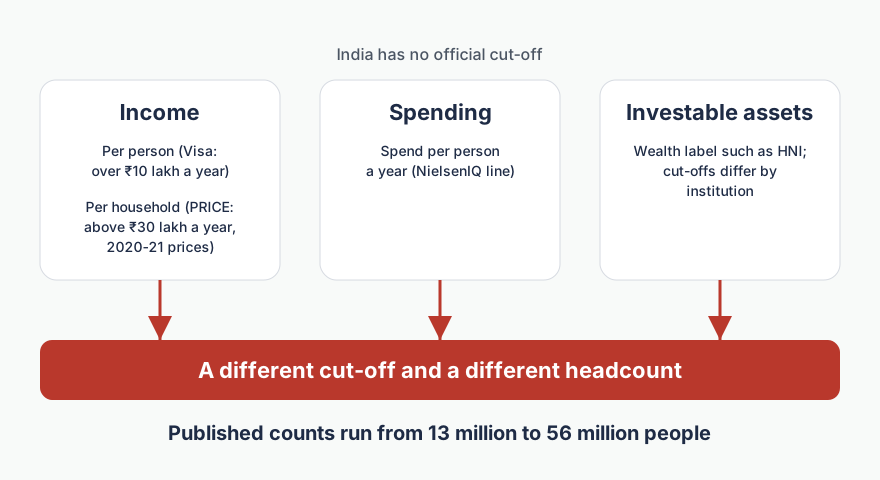
From the PRICE table for 2020-21: its four top bands hold 3,263 thousand (Near Rich), 3,171 thousand (Clear Rich), 2,431 thousand (Sheer Rich) and 1,807 thousand (Super Rich) households. That is 10,672 thousand in all, or 3.5% of 307,563 thousand households. PRICE's 56 million people is 4% of its 1,416 million.
The NielsenIQ line is spending, not income. $90 × 365 is $32,850 per person a year, so $131,400 for a family of four.
The counts cannot be added or ranked against each other. PRICE also says its survey groups above ₹10 lakh are small, so its top bands are indicative.
- Source
- NielsenIQ and World Data Lab, 12 August 2026
- Unit
- Spending per person
- Cut-off
- More than $90 a day, nominal US dollars
- Count
- 2.6 crore (26 million) people in 2026
- Source
- PRICE (People Research on India's Consumer Economy), ICE 360° surveys (its household survey), 2020-21 prices
- Unit
- Household income
- Cut-off
- Above ₹30 lakh a year
- Count
- About 11 million households, 56 million people
- Source
- Visa, 22 April 2026
- Unit
- Individual income
- Cut-off
- Over ₹10 lakh a year
- Count
- 130 lakh (13 million) individuals
Which definition of affluent should a research brief use?
Use the unit that matches the decision the study informs, then write a rupee cut-off and a purchase behaviour into the brief. The table below is built from the units above. PRICE's ₹30 lakh is in 2020-21 prices, so adjust it for inflation or choose a round current figure, and treat it as indicative because PRICE's survey groups above ₹10 lakh are small.
A market research brief template has a place for the definition.
- If the study is about
- A household purchase (car, appliance, home, holiday)
- Define affluent by
- Household annual income
- Write into the brief, for example
- Household income at or above your chosen rupee line, starting from PRICE's ₹30 lakh "Rich" line (2020-21 prices)
- If the study is about
- Personal products, cards, personal banking
- Define affluent by
- Individual annual income
- Write into the brief, for example
- Individual income over ₹10 lakh (the line Visa uses)
- If the study is about
- Premium versus mainstream choice in a category
- Define affluent by
- Category behaviour
- Write into the brief, for example
- Bought at the premium tier in the last 12 months, with household income above your chosen rupee line
- If the study is about
- Investing or advisory products
- Define affluent by
- Investable assets
- Write into the brief, for example
- A rupee amount of investable assets, never "HNI" alone
How do you screen for affluent consumers without asking about income?
Screen on what people buy and do, and ask about income only in wide bands with a "prefer not to say" option. A US account from 2022 by the Nielsen Norman Group advises that high earners may find a direct income question offensive or uncomfortable. It suggests luxury shopping habits or profession as indirect criteria. Each check below has a pass and a fail:
- Purchase: ask for the category purchase in the last 12 months, with model, brand or spend. Pass: specifics that match your premium tier. Fail: vague or mismatched answers.
- Role: ask occupation and seniority. Pass: matches the role in your definition. Fail: a role outside the list in the brief.
- City: ask where they live. Pass: a named city in your plan. Fail: a city outside the plan.
- Income band: ask only if the definition needs it. Pass: a top band, or "prefer not to say" plus a pass on check 1. Fail: a band below the cut-off, or "prefer not to say" with a fail or vague answer on check 1.
A research screener template has the wording. NCCS (New Consumer Classification System, which grades households by the chief wage earner's education and the durables owned) is a rough extra filter, covered in NCCS Classification. In February 2024 the Market Research Society of India introduced ISEC (Indian Socio-Economic Classification) to redefine NCCS; check which scheme your client's data uses.
Why are affluent consumers harder to recruit, and what should the plan allow?
The Nielsen Norman Group's 2022 US account suggests affluent people can be harder to recruit: it describes them as busy, hard to contact and not drawn by standard incentives. It is one case, not proof. The same account reports recruiting mainly through word of mouth and referrals. It paid roughly double its standard rate, offered a donation in the participant's name as an alternative, and ran remote sessions with flexible slots and easy rescheduling. The donation was popular with the highest earners.
That is a single study, so treat it as a pattern to test, not a price list. For India, the plan should:
- budget a premium incentive (see what to pay focus group participants)
- offer evening and weekend slots
- say upfront that there is no sales intent
- give a clear privacy statement (see informed consent)
The recruitment cost worksheet shows where to add the premium.
Which terms get confused with affluent consumers?
Affluent consumers is often confused with wealth and class labels that measure something different:
- HNI (high-net-worth individual): a wealth label based on investable assets. Cut-offs differ by institution and no standard exists. Someone can earn a high salary and hold modest assets.
- Mass affluent: the tier just below high net worth. No standard definition exists.
- Middle class: PRICE defines it as households earning ₹5 lakh to ₹30 lakh a year (2020-21 prices), which is where the affluent line begins.
- NCCS A: the top grade of NCCS (New Consumer Classification System), which grades households by the chief wage earner's education and the durables owned, not income. ISEC now redefines it.
- Luxury buyer: a behaviour. Visa describes affluent consumption as intentional, experience-led spending, so a person can be affluent without buying luxury.
How Qualfacto handles it
We recruit affluent participants from your written definition, by city and by household and demographic profile, and we check participant identity before inviting anyone. We run in-depth interviews, focus groups, shop-alongs, in-home use tests and diary studies, in English and other languages, with moderators supplied if you need them.
Send the definition from the table above with your brief. We review the audience, sample size, geography and timelines, assess feasibility, and send a tailored proposal and quote for the project. We price projects individually, so the final incentive is confirmed in the quote. A free pilot is available. Email your brief to Qualfacto at support@qualfacto.io. The team works Monday to Friday, 10:00 to 18:00 Indian Standard Time (IST) and aims to reply within one business day; detailed briefs may take longer.
Example
A complete definition reads: "Affluent = household income of [your chosen rupee line] or more a year, working as a senior manager, business owner or doctor, living in Delhi NCR, Mumbai or Bengaluru, who took a paid holiday abroad in the last 12 months." It names the unit, the rupee line, the role, the city and a purchase, so a recruiter can check each part.
Frequently asked
Sources
- 1.NielsenIQ and World Data Lab, A Tale of Two Consumers, NielsenIQ, 12 August 2026
- 2.NielsenIQ and World Data Lab, A Tale of Two Consumers report PDF
- 3.Vibes of India, India affluent consumers to surpass China by 2036
- 4.PRICE, The Rise of India's Middle Class: results from the ICE 360° surveys, PRICE
- 5.Visa India, a new premium spending playbook in affluent India, Visa, 22 April 2026
- 6.Nielsen Norman Group, Recruiting High-Income Participants, Nielsen Norman Group, 1 May 2022
- 7.Research Live, India adopts new socioeconomic classification, Research Live