
NCCS Classification: How to Recruit by Socio-Economic Class in India
NCCS classification lets recruiters grade a household from A1 to E3 using the chief wage earner’s education and a count of 11 durables. ISEC (Indian Socio-Economic Classification), announced by MRSI in February 2024, is reported to be awaiting wide adoption.

By Jitendra Kumar Nirala, Founder · Updated 22 Oct 2026

Key takeaways
- NCCS classification grades a household from A1 to E3 using the chief wage earner's education and a count of 11 durables, so a screener needs only a handful of plain questions.
- ISEC was announced in February 2024 and its adoption is reported as pending, so a brief may name either scheme. Ask which one, and write one screener that can return both codes.
- In a small sample, group the grades (for example A/B and C/D/E) and write the borderline rule before fieldwork, because one durable can move a household across a cut.
- Re-check durables and education close to the session with an adult who can speak for the whole household, then recompute the grade.
In this article
- 1What Is NCCS Classification? Full Form and Meaning
- 2Is NCCS Still Used? NCCS vs ISEC Explained
- 3What to ask when a brief says SEC, NCCS, or ISEC
- 4How the NCCS Classification Grid Works
- 5The 11 Consumer Durables
- 6Education of the chief wage earner
- 7Reading the A1–E3 grid
- 8NCCS Screener Questions You Can Copy
- 9How Do You Set Class Quotas in a Small Qualitative Study?
- 10Grouping classes
- 11Minimum fill
- 12Verifying Class at Recruitment: Which Checks Catch a Wrong Grade?
- 13Common Mistakes When Recruiting by NCCS Class
- 14What to Put in Your Recruiter Brief
- 15Next Step: Recruit by NCCS Class
- 16Frequently asked questions
Two recruiters can screen the same city for class and field different households, because the label depends on which scheme the brief means. According to a Kantar analysis of its proprietary panel, published on 7 May 2024, 90+% of respondents who self-classified as NCCS B, C, D or E fell into ISEC’s upper-middle or middle segments. The two schemes group households differently.
Even within one scheme, the grade is fragile. A household that owns one durable more or fewer than you recorded can land in a different quota cell, and the answers you took at screening may no longer hold on the day of the session.
This page covers recruitment only: the questions to put in a screener, how to quota a small sample by class, and the checks that keep a household in the right cell. It leaves out media planning and audience measurement. For the process around it, see how to recruit participants for a study in India.
What Is NCCS Classification? Full Form and Meaning
NCCS stands for New Consumer Classification System. It places an Indian household in one of 12 grades, from A1 (highest) to E3 (lowest), using the education of the chief wage earner, the household member who contributes most to household expenses, and how many of 11 listed durables the household owns. This is set out in the Broadcast Audience Research Council (BARC) methodology of April 2026. The Media Research Users Council (MRUC) also calls it the New SEC system.
SEC means socio-economic classification, the general label for any such grading. The grade belongs to the household, not to the person you interview. For a recruiter it is useful because a few plain questions can be checked, and the same grid gives every recruiter the same answer.
Is NCCS Still Used? NCCS vs ISEC Explained
Yes. BARC's April 2026 methodology document still assigns households an NCCS grade, while ISEC, announced by the Market Research Society of India (MRSI) in February 2024, is reported to be awaiting wide adoption. Check which scheme your client's brief names before you write a screener.
Status, with each report attributed:
- Reported by MRSI on its ISEC page: ISEC was announced in February 2024.
- Reported by exchange4media in March 2026: adoption was still pending, in "Two years on, ISEC still awaits take-off".
- Reported by exchange4media in March 2026: the Indian Broadcasting and Digital Foundation (IBDF) said it is not resisting ISEC and disputed the "stalled" framing, in "IBDF is not resisting ISEC".
- Reported by MRSI: its ISEC page shows the grid and questionnaires updated on 21 August 2026.
The two schemes ask for different things:
| Item | NCCS | ISEC |
|---|---|---|
| Occupation of chief earner | Not used | Used (six groups) |
| Education | Chief wage earner only | Best-educated adult man and best-educated adult woman |
| Durables | Count of 11 listed items | Not used |
| Result | Grade A1 to E3 | Code from 1 to 12 |
The ISEC inputs and the 1 to 12 code are taken from MRSI’s ISEC grid. MRSI’s introduction to ISEC groups the 12 codes into five named bands:
| Band | ISEC codes |
|---|---|
| High/Upper | 1 to 6 |
| Upper Middle | 7 to 8 |
| Middle | 9 to 10 |
| Lower Middle | 11 |
| Lower | 12 |
An NCCS letter and an ISEC number are not interchangeable.
What to ask when a brief says SEC, NCCS, or ISEC
"SEC A" on its own does not tell you the scheme, so ask before fieldwork:
- Which scheme, NCCS or ISEC? Without a scheme name you cannot write the questions.
- Which grades or codes go in each quota cell? Ask for the cut-off in writing.
- For ISEC, which questionnaire version? MRSI publishes separate face-to-face and online urban versions.
How the NCCS Classification Grid Works
The NCCS grid is a table. Education of the chief wage earner runs across, the number of durables owned runs down, and the cell where they meet is the household's grade, A1 to E3. You need two answers and the grid. No income figure enters.
The 11 Consumer Durables
The 11 items below are the NCCS durables list in BARC's Appendix 2. In practice the chief wage earner may not be the highest earner, so ask who contributes most, not who earns most. The suggested wording is ours.
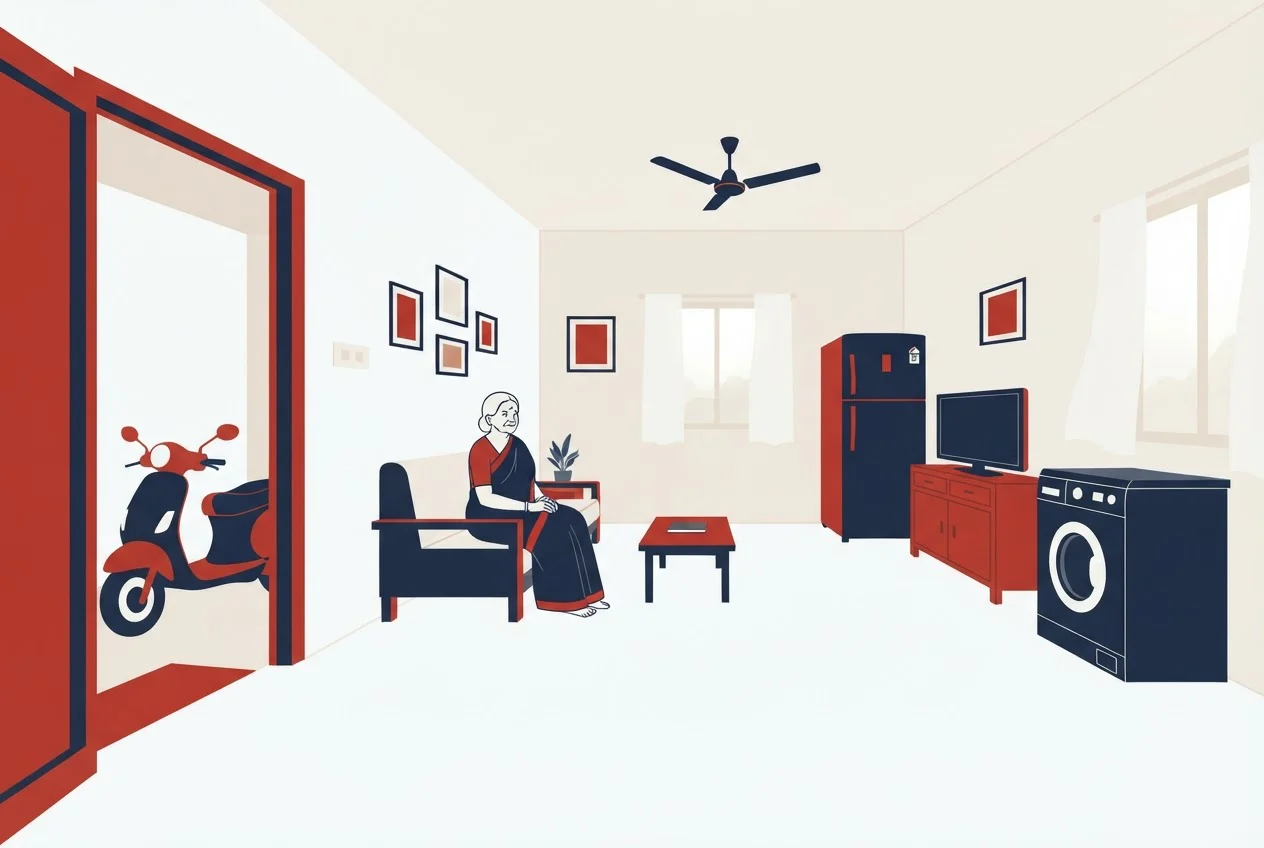
| # | Durable | Ask it as |
|---|---|---|
| 1 | Electricity connection | Is your home connected to the electricity supply? |
| 2 | Ceiling fan | Does your household own a ceiling fan? |
| 3 | LPG stove | Do you cook on an LPG stove? |
| 4 | Two-wheeler | Does your household own a two-wheeler (motorcycle or scooter)? |
| 5 | Colour TV | Does your household own a colour TV? |
| 6 | Refrigerator | Does your household own a refrigerator? |
| 7 | Washing machine | Does your household own a washing machine? |
| 8 | Personal computer or laptop | Does your household own a computer or laptop? |
| 9 | Car, jeep or van | Does your household own a car, jeep or van? |
| 10 | Air conditioner | Does your household own an air conditioner? |
| 11 | Agricultural land | Does your household own agricultural land? |
Education of the chief wage earner
The grid has seven education bands for the chief wage earner, as set out in BARC’s Appendix 2:
- Illiterate
- Literate but no formal schooling, or schooling up to the 4th standard
- Schooling between the 5th and 9th standard
- SSC/HSC (Secondary or Higher Secondary School Certificate)
- Some college but not graduated
- Graduate or postgraduate, general
- Graduate or postgraduate, professional
For band 7 we use the examples in MRSI's ISEC questionnaire for a professional degree: BE/BTech, CA, MBBS, LLB or MBA. That is our recommendation, not a rule in the NCCS documents.
Reading the A1–E3 grid
Find the education band across the top, count the durables down the side, and read the cell. More education and more durables both push towards A1, and the two trade off. The grid tops out at nine or more durables. MRUC publishes the full grid and BARC reproduces it in Appendix 2.
Examples from BARC's Appendix 2, which show how sensitive a grade is to one item:
- A graduate or postgraduate (general) chief wage earner with 3 durables is C2, with 4 is B2, and with 5 is B1.
- An SSC/HSC chief wage earner with 3 durables is D1, and with 4 is C1.
NCCS Screener Questions You Can Copy
One six-question block can return both an NCCS grade and an ISEC code. Ask who contributes most to household expenses, that person's occupation and education, the best-educated man's and woman's education, and a tick-list of the 11 durables. Score it after the call. The full screener, with consent and the rest, is in our research screener template; this section covers class questions only.
| Question | Answer options | Feeds |
|---|---|---|
| 1. Who contributes most to the household's running expenses? Note relationship and age, and whether the respondent is that person. | Open answer | Both |
| Open, then coded | ISEC |
| 3. What is that person's highest education? | The seven NCCS bands | NCCS |
4 and 5. What is the highest education among adult men in the household? Then among adult women? MRSI's face-to-face questionnaire counts adults as over 21, and uses the 18 to 20 group if there is no adult of that sex. | No such adult, then bands from no formal education to a professional degree | ISEC |
| 6. Tick every item your household owns. | The 11 durables as one list | NCCS |
Scoring: NCCS is the education band from question 3 against the count from question 6. ISEC is the occupation group with the two education answers, read from MRSI's grid. Write the scheme name next to every code you record.
Question order. Put these questions after the qualifying questions on category, city and age, so class is not the first thing a respondent sees. Ask who contributes most before asking education, so the answers describe the right person.
Avoiding leading or flattering answers.
- Do not say you are checking "class" or "income". Introduce the block as household background.
- Ask for the job in the respondent's words and code it yourself, rather than offering "manager" as an option.
- Show the 11 durables as one tick-list, not a run of separate yes/no questions that makes the "right" answer obvious.
- Ask about ownership, not access. A neighbour's television does not count.
- Never show the grid or say what a grade needs.
How Do You Set Class Quotas in a Small Qualitative Study?
Group the 12 NCCS grades into two or three broad cells, such as A/B and C/D/E, and fill them in parallel. A small sample cannot support twelve cells, and neighbouring grades are close. Agree the grouping and the borderline rule with the client before fieldwork.
BARC’s own panel design uses the same split, with NCCS A or B and NCCS C or D/E sub-panels (BARC methodology, April 2026).
Grouping classes
| Group | NCCS grades | Use it when | Watch for |
|---|---|---|---|
| A/B | A1, A2, A3, B1, B2 | The brief targets higher-class households | A graduate (general) chief wage earner with 4 durables is B2, but with 3 is C2 |
| C/D/E | C1, C2, D1, D2, E1, E2, E3 | The brief targets middle and lower-class households | An SSC/HSC chief wage earner with 3 durables is D1 and with 4 is C1, so both sit in this group |
For ISEC, agree which codes from 1 to 12 form each cell in the same way. MRSI’s five named bands (High/Upper 1 to 6, Upper Middle 7 to 8, Middle 9 to 10, Lower Middle 11, Lower 12) are one starting point.
The cut sits between B2 and C1. A graduate household that owns one more or one fewer durable than you recorded can swap cells, so treat grades on either side of that line as borderline.
Minimum fill
Set the smallest number of households per cell that the client will accept, and fill the hardest cell first. Keep replacements ready at the same grade group. If a cell cannot be filled, tell the client and decide whether to merge it with its neighbour, rather than quietly loosening the screener. For the overall number of participants, see sample size in qualitative research.
Verifying Class at Recruitment: Which Checks Catch a Wrong Grade?
Re-ask the class questions close to the session, with an adult who can speak for the whole household, and recompute the grade. A household’s class can shift between listing and recruitment, because MRSI’s introduction to ISEC notes that a household’s NCCS is likely to change when it acquires a durable. Answers given on an online panel are self-reported, so re-check them before the session as well.
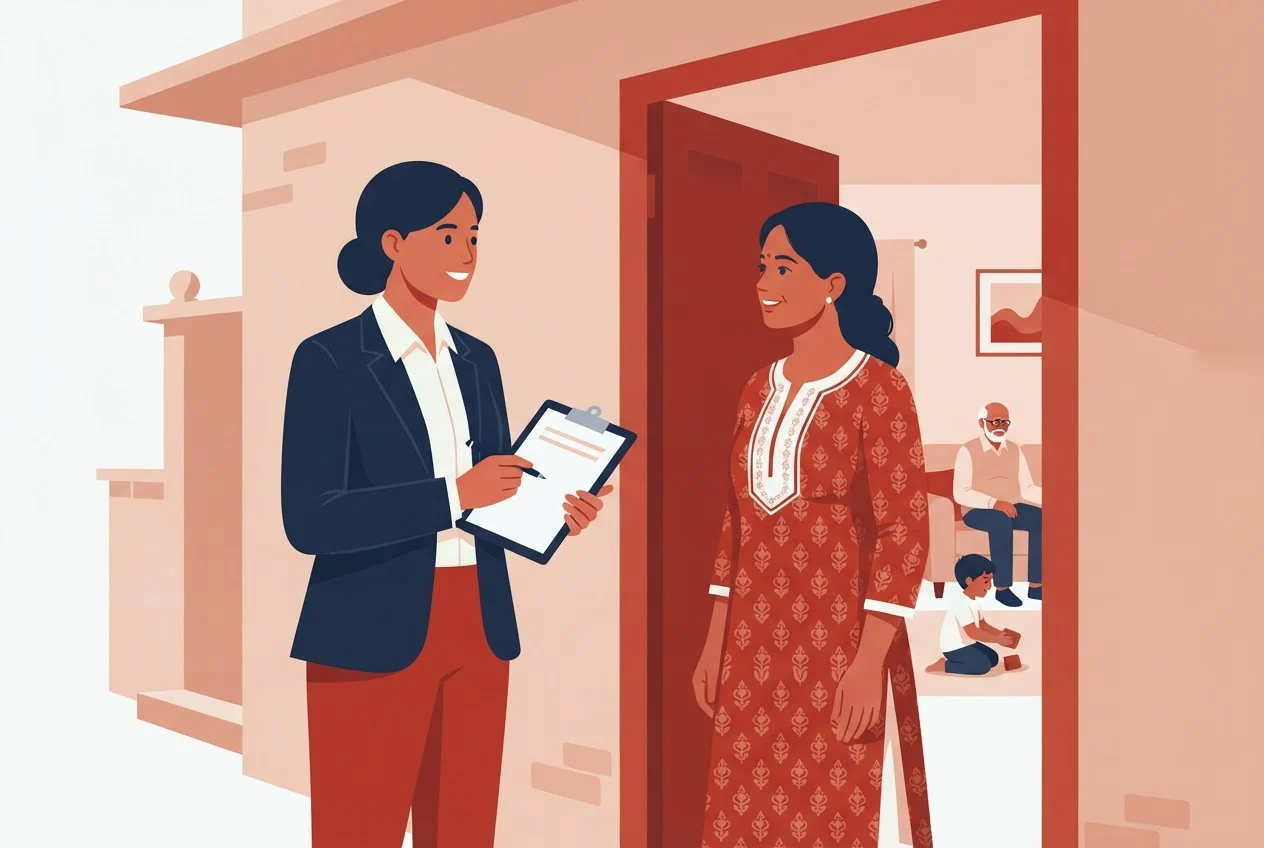
- Right person answers. Pass: the respondent lives in the household and answers from knowledge about the chief wage earner and, for ISEC, the best-educated man and woman. Fail: one person is guessing for the whole household; re-ask with another adult.
- Durables recounted. Read the 11 items again, one by one, at confirmation. Pass: the count matches the screener. Fail: any difference; recompute the grade and re-check the quota cell.
- Re-asked close to the session. Repeat the block the day before or on arrival. Pass: the grade is unchanged. Fail: the grade moved; the household now belongs to a different cell or is out.
- Education cross-checked. Ask a neutral follow-up, such as the course or the school stage reached. Pass: the answer fits the band given. Fail: a mismatch; do not record either band, re-ask with another adult who knows the household, and recompute the grade from the confirmed answer.
- Borderline households flagged. A household one durable from the cut follows a written rule from the brief. Pass: the rule decides. Fail: the recruiter decides on the spot.
- Disqualified households logged. Thank them and record the reason. Pass: the replacement comes from the same cell and the household is not asked again. Fail: the household is re-screened with changed answers.
Pro Tip: Keep the raw answers behind every grade, not only the grade itself. If a household moves between cells at the re-check, you can see which answer changed and recompute the grade rather than guess.
To judge how a panel profiles households before you rely on it, use our research participant panel quality checklist.
Common Mistakes When Recruiting by NCCS Class
Most errors come from mixing schemes or from using the wrong version of a question set. Run each of these as a test on your own screener before it goes live.
- Mixing NCCS and ISEC codes. Pass: every wave records one named scheme, and an NCCS letter is never read as an ISEC number or the reverse. Fail: a "B1" in one wave sits beside an ISEC number in the next.
- Treating class as income. NCCS is built from the chief wage earner’s education and durables, and ISEC from occupation and education, so neither uses a household income figure. Pass: no income question feeds the grade or any quota cell. Fail: a cell is filled or closed on income.
- Using the wrong questionnaire version for the setting. MRSI publishes separate face-to-face and online (urban) ISEC questionnaires. Pass: the version matches how and where you recruit. Fail: the online version is read out on a village visit. For the rural method, see our rural market research guide.
What to Put in Your Recruiter Brief
A recruiter needs the scheme, the cells, the questionnaire version and the borderline rule in writing. Without them, each recruiter fills class cells differently. Add these lines to your brief; our market research brief template covers the rest.
- Scheme named. Pass: one line says NCCS, ISEC or both. Fail: the brief says only "SEC A/B".
- Cells and grades listed. Pass: every quota cell lists named grades or codes. Fail: a cell says only "upper class".
- Chief wage earner defined. Pass: the brief says who counts as the chief wage earner. Fail: the recruiter picks the eldest man or the top earner.
- Questionnaire version stated. Pass: the brief says face-to-face or online urban for ISEC. Fail: the version is left to the recruiter.
- Borderline rule written. Pass: the brief says whether a household one durable from the cut is in or out. Fail: nothing is written and each recruiter decides.
- Re-check timing set. Pass: the brief names the day before or arrival as the re-check. Fail: class is asked once at screening only.
- Who may answer. Pass: the brief asks for an adult who knows the household's education and durables. Fail: any household member, including a visitor, may answer.
If you would like us to recruit against these cells, email your brief to support@qualfacto.io.
Next Step: Recruit by NCCS Class
Name the scheme, ask the class block once, score it after the call and re-check before the session. That sequence keeps each household in the quota cell your client agreed. Write the borderline rule down before fieldwork, and group grades such as A/B and C/D/E so a small sample can be filled.
When someone registers with us, the household section of the profile asks about the chief wage earner’s education and the same 11 durables listed above. We recruit by city and can target by household and demographic profile. If you will go on to run groups, see how to conduct focus groups in India.
To discuss a recruitment brief with class cells, email support@qualfacto.io.
Recruit by NCCS class with Qualfacto
Email support@qualfacto.io to discuss a recruitment brief with class cells, or use WhatsApp for quick queries.
Frequently asked questions
Sources
- 1.MRUC, New Consumer Classification System
- 2.BARC India, Description of Methodology, April 2026, Appendix 2 (NCCS assignment grid)
- 3.MRSI, ISEC page
- 4.MRSI, ISEC classification grid (PDF)
- 5.MRSI, The New Socio-Cultural Outlook: Introducing ISEC
- 6.MRSI ISEC questionnaires: face-to-face
- 7.MRSI ISEC questionnaires: online urban
- 8.MRSI, guidelines for coding ISEC occupation
- 9.Kantar, India's growing middle class (7 May 2024)
- 10.exchange4media, "Two years on, ISEC still awaits take-off" (March 2026)
- 11.exchange4media, "IBDF is not resisting ISEC: Broadcasters push back on stalled rollout narrative" (March 2026)