Glossary
Blind Product Testing
Blind product testing means consumers judge products with brand names and packaging removed. In a two-product test of 100 people, one product needs 61 picks before the result counts.

By Jitendra Kumar Nirala, Founder · Updated 24 Oct 2026
On this page
- 01Definition
- 02Key takeaways
- 03What is blind product testing?
- 04What is blind product testing confused with, and which related terms matter?
- 05Why does hiding the brand change the result?
- 06How many consumers does a blind test need before the result counts?
- 07How do you run a blind product test? A checklist for your brief
- 08How Qualfacto handles it
- 09Example
- 10Related terms
- 11Frequently asked
What is blind product testing?
Blind product testing is a consumer test in which brand names, packaging and other identifying features are removed, so consumers judge the product on its merits.
Key takeaways
- Test the formula blind and the whole offer branded; run both before a launch.
- Check the pick count in the table before calling a winner: 61 of 100, or 70% at 30 consumers.
- Remove every clue and have three outsiders try to name the brand.
- Use random codes, rotate the order and keep the key hidden from whoever serves the products.
- Set the pass mark in the brief before fieldwork.
In a two-product test of 100 consumers, 51 picks for one product is chance, and 61 picks is a real preference. The gap between those two results is the subject of this page.
Brand teams hide the brand because it changes ratings. In a 1964 study for the brewer Carling, drinkers rated beers blind and then labelled. Blind, no beer was rated significantly better by its regular drinkers. Labelled, they rated their own brand higher.
A 55/45 split from 40 consumers is within chance. The table below shows the pick count needed at 30, 60 and 100 consumers. Ratings also shift once the brand is shown, so a blind result and a branded result answer different questions.
This page defines the term, separates it from the terms it is confused with, and gives you a sample-size table and a seven-point checklist you can paste into a brief. It is written for insights, product and brand teams in India who need to compare their product with a competitor's and trust the answer.
Key takeaways
- Blind product testing hides the brand so that consumers rate the product itself. The result tells you about the formula, not the full offer.
- Removing the brand changes ratings, so a blind result and a branded result answer different questions. Run both before a launch.
- A winner needs a big enough share: 61 of 100 in a two-product choice, 70% at 30 consumers. A 51/49 split proves nothing.
- Decide the pass mark before fieldwork. The checklist below turns that into seven checks you can run.
What is blind product testing?
The definition comes from the Quirk's Marketing Research Review glossary. The product is visible, tasted or used. Only its identity is hidden.
Typical categories are food and beverage, personal care and household goods. The same logic applies wherever buyers hold strong brand opinions. Removing the brand also takes away the halo effect, where good feelings about a brand lift every judgement of its product.
What is blind product testing confused with, and which related terms matter?
The terms most often confused with blind product testing are double-blind (the server is blind too), monadic and paired comparison designs (how many products each consumer sees), and the triangle test (a difference test, not a preference test).
- Double-blind test: the person handing over the products also does not know which is which, so no unconscious cue leaks. Aim for this whenever a person serves the products.
- Paired comparison test: each consumer sees two products and picks one (ISO 5495, the standard from the International Organization for Standardization, ISO).
- Triangle test: each consumer gets three samples, two identical and one different, and names the odd one out. It checks whether products differ, not which is liked (ISO 4120:2021).
- In-home use test (IHUT): consumers use the product at home over days. See In-Home Use Test for dropouts and household numbers. For concept comparisons, see Concept Testing.
- Paid product-tester roles: if you searched to take part rather than to commission, read Paid Research Studies in India.
Why does hiding the brand change the result?
Brand knowledge shapes what consumers report tasting and seeing. In a 1964 study for the brewer Carling, drinkers rated beers blind and then labelled. Blind, no beer was rated significantly better by its regular drinkers. Labelled, they rated their own brand higher (Allison and Uhl, Journal of Marketing Research, 1964; reference record).
That is one study of one drink, and it is old. Expect the same gap wherever buyers know the brands, and confirm it with a small pilot before relying on a blind result. Use blind testing to judge the formula and branded testing to judge the whole offer.
How many consumers does a blind test need before the result counts?
In a two-product test where every consumer must pick one, 30 consumers need 21 picks for one product (70%), 60 need 39 (65%) and 100 need 61 (61%). Below those counts, the split could be chance.
Picks needed to win a two-product blind test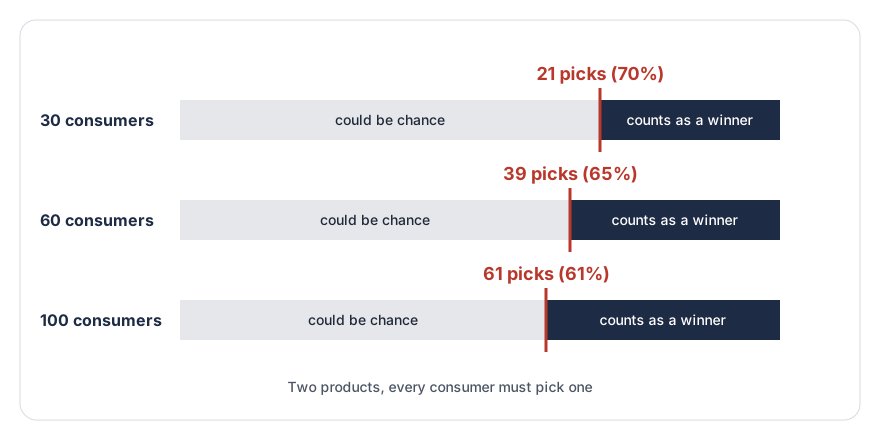
This is a model, not an official figure. It uses exact binomial probabilities. A binomial distribution is the pattern of counts you get when each consumer independently picks one of two options at chance. For X following a binomial distribution with n consumers, the threshold is the smallest number of picks k where 2 × P(X ≥ k) ≤ 0.05 for the paired comparison test, with a probability of 0.5 of picking either product by chance. For the triangle test the probability is 1/3 and the threshold is the smallest k where P(X ≥ k) ≤ 0.05, not doubled. The assumptions are:
- Every consumer picks one product, with no "no preference" option.
- Consumers choose independently.
- The threshold is a 5% chance of a false win. Two-sided means either product could win; one-sided means only a correct answer above one in three counts.
- For paired comparison tests the threshold is two-sided. For triangle tests, chance is one in three and the test is one-sided.
At 200 consumers a product needs 115 picks (57.5%). At 385 it needs 213 (55.3%).
These numbers do not apply to rating-scale designs, which need a different calculation. For small qualitative blind sessions, aim to hear why consumers react as they do, not to name a winner; see Sample Size in Qualitative Research. For home tests, recruit above your target to cover dropouts; see In-Home Use Test for how many extra.
- Consumers
- 30
- Paired comparison test: picks needed for one product
- 21
- Share
- 70%
- Triangle test: correct answers needed
- 15
- Consumers
- 60
- Paired comparison test: picks needed for one product
- 39
- Share
- 65%
- Triangle test: correct answers needed
- 27
- Consumers
- 100
- Paired comparison test: picks needed for one product
- 61
- Share
- 61%
- Triangle test: correct answers needed
- 42
How do you run a blind product test? A checklist for your brief
Each check has a pass and a fail. Put the answers in a one-page market research brief.
- One question. Pass: the brief says whether you test "do they differ" (triangle), "which is preferred" (paired comparison) or "does it meet the brand promise" (branded). Fail: "see what consumers think".
- Every clue removed. Pass: three colleagues outside the project cannot name the brand from look, smell, texture or shape. Fail: any can.
- Random codes. Pass: each sample carries a random three-digit code (the practice ISO 4120:2021 recommends), with no order or meaning such as A/B or 1/2. Fail: codes hint at order or identity.
- Rotated order. Pass: each product is tried first by about half of the consumers. Fail: one product always goes first.
- Hidden key. Pass: whoever serves the products does not know which code is which. Fail: they do.
- The right consumers. Pass: the screener (the qualifying questions) sets quotas (target numbers) for users of your brand and of each competitor. Fail: anyone in the category qualifies.
- Pass mark set first. Pass: the threshold from the table is in the brief before fieldwork. Fail: you decide what counts after seeing the data.
How Qualfacto handles it
We recruit and run the participant side of a Product Testing (IHUT) study in India. We recruit by city, target by household and demographic profile, check participant identities before invitation, and run sessions in languages other than English. You can bring your own moderators, and we agree the deliverables before the study begins. Depending on scope, these include recordings, transcripts, structured data exports and reports.
Pricing is set per project, because it depends on method, audience, geography and sample. We offer a free pilot. Email your brief, question and sample size to support@qualfacto.io. We aim to reply within one business day.
Example
In a two-product test, 51 of 100 consumers pick Product A. The probability of a split that lopsided or more from a fair coin is about 0.92, so there is no evidence of a preference. At 61 of 100, a 22-point lead, the evidence clears the bar.
Frequently asked
Sources
- 1.Blind testing definition, Quirk's Marketing Research Review glossary, Quirk's Marketing Research Review
- 2.Allison and Uhl, "Influence of Beer Brand Identification on Taste Perception", Journal of Marketing Research 1, 36–39 (1964), Journal of Marketing Research, 1964
- 3.Reference record for the same paper, SCIRP, SCIRP
- 4.ISO 5495:2005, Sensory analysis, paired comparison test, ISO, 2005
- 5.ISO 4120:2021, Sensory analysis, triangle test, ISO, 2021