Glossary
Brand Name Testing
Brand name testing checks how a chosen audience reacts to candidate names before launch: what they think of, whether they can say and spell it, and whether they remember it.

By Jitendra Kumar Nirala, Founder · Updated 24 Oct 2026
On this page
- 01Definition
- 02Quick facts
- 03What brand name testing covers
- 04Why test names in sessions instead of a survey
- 05Can a name pick up a new meaning before launch?
- 06Who to recruit for name testing in India
- 07A name-testing session script
- 08How many participants a naming study needs
- 09Brand name testing vs trademark search and concept testing
- 10How Qualfacto handles it
- 11Example
- 12Related terms
- 13Frequently asked
What is brand name testing?
Brand name testing is research that measures how a defined audience reacts to candidate names before launch. It tests a shortlist and does not invent names.
Key takeaways
- Run moderated sessions (led by a trained interviewer who asks the questions) with buyers, who say each name aloud before you do.
- Ask what each name suggests, then whether it suits the product, never which name people prefer.
- Recruit category buyers by first language and city, and leave out friends, colleagues and anyone who helped name the product.
- Recruit about a quarter more than your interview target to cover no-shows.
Quick facts
- Run first
- A trademark search, so participants never fall for a name you cannot use
- First round
- About 20 names
- Finalists tested in depth
- Four or five
- Interviews per segment
- 9 to 17
- Session script
- 55 minutes, plus a 5-minute call the next day
A name that looks fine on a slide can be mispronounced or misheard by the people who must say it. Buyers in two cities may stress it differently. It may sound like another word in a language your team does not speak. A rating scale on a screen shows neither problem.
Sessions with real buyers show something different from a score. They reveal how people say a name, what they hear in it and why they would or would not trust it. You need that before you pay for a logo, a domain and a launch.
A participant who reads a name aloud and stumbles tells you more than a seven out of ten. A participant who hears the name and writes it down differently from how you spell it tells you more again.
Below: the definition, a session script you can copy, who to recruit in India and how many.
What brand name testing covers
Brand name testing covers what each name suggests, whether people can say, spell and remember it, and whether it fits the product.
It is often confused with other work. A trademark search checks whether you may legally use a name; testing does not. Run the search first. Naming is the creative work of producing candidates. Brand testing is a wider term than name testing.
Related terms: probing questions are the follow-ups you ask in a session. Concept testing means testing an idea or proposition, usually before launch. It can include a name, but name testing focuses on sound, meaning and recall.
Why test names in sessions instead of a survey
Sessions show why a name works or fails, and they let you hear it spoken. A survey can rank names, but a conversation shows that a name is read two ways or carries a meaning the team missed.
One experienced practitioner recommends keeping the first round to about 20 names and taking four or five finalists forward in depth, after trademark searches (Summers, Quirk's, 2006). The aim is to learn whether a name reflects the product's defining attributes, not only whether people like it.
Do not ask which name people prefer. A preference question rewards the familiar and gives no reasons. This is an inference, not a published finding.
Ease of saying a name matters beyond taste. In a study published in PNAS (Proceedings of the National Academy of Sciences), shares with easy-to-pronounce names outperformed shares with hard names in the short term (Alter and Oppenheimer, 2006). That finding is about stocks. Treat it as a reason to test pronunciation, not as proof about your category.
Can a name pick up a new meaning before launch?
Yes, and Tata Motors' hatchback is one Indian example. It was announced as Zica. On 22 February 2016 Tata renamed it Tiago because the Zika virus outbreak had changed what the name suggested, and the January launch was postponed (CarWale).
No session could have predicted an outbreak. The lesson is to repeat a short word-association check with fresh participants close to launch.
Who to recruit for name testing in India
Recruit people who buy in your category, split by first language and city. Exclude friends, colleagues and anyone involved in the naming. Language comes first because sound is what you are testing. A screener is how you confirm who qualifies.
A name read aloud by a Tamil, Bengali or Marathi speaker is a different test from one read by an English speaker in Delhi. Summers (Quirk's, 2006) notes that regional dialects can shift the stressed syllable and that names used in other markets need a check for unwanted meanings.
Use this grid. Each test has a pass or a fail.
- Recruit by
- Category
- Pass
- The screener (a short qualifying questionnaire) confirms they buy or would consider buying
- Fail
- Friends, family or colleagues
- Recruit by
- First language
- Pass
- Each language segment is covered in its own sessions
- Fail
- One English-only pool for a multi-language audience
- Recruit by
- City
- Pass
- Segments are split by city or region
- Fail
- One city stands in for all
- Recruit by
- Independence
- Pass
- Nobody involved in naming takes part
- Fail
- Anyone who has seen the long list
A name-testing session script
A good session has seven blocks, run one-to-one, with the participant saying the name before you do. A suggested script takes 55 minutes, plus a 5-minute call the next day. The timings are a suggestion, not a published standard.
Where name testing sits in the naming process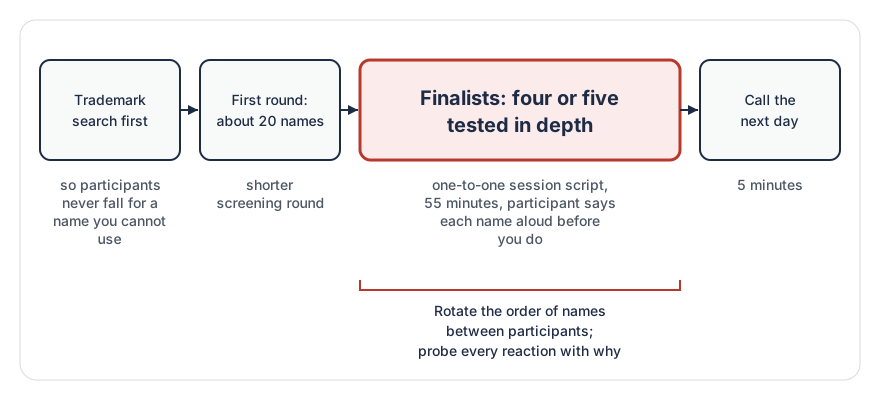
This script is for the second round: test the four or five finalists, not the first-round long list of about 20. The 20-name round is a shorter screening round.
Rotate the order of names between participants. Probe every reaction with "why".
- Block
- Warm-up
- Min
- 5
- You do
- Discuss the category with no names shown
- You record
- The words they use
- Block
- Read aloud
- Min
- 10
- You do
- Show each name in writing and ask them to read it aloud before you say it
- You record
- Read as intended, stumbled, or another reading
- Block
- Hear and write
- Min
- 8
- You do
- Say the name and ask them to write it down
- You record
- Spelling and any "sorry, what?"
- Block
- First reactions
- Min
- 10
- You do
- Ask what it makes them think of, who uses it and what it costs
- You record
- Associations, before any description
- Block
- Fit
- Min
- 10
- You do
- Give the one-line product description and ask again. Ask them to match names to descriptions
- You record
- Fit or clash
- Block
- Risks
- Min
- 7
- You do
- Ask whether it sounds like anything else in any language they speak
- You record
- Unwanted meanings
- Block
- Close
- Min
- 5
- You do
- Ask what they would change, not which they prefer
- You record
- Objections
- Block
- Next-day call
- Min
- 5
- You do
- Phone and ask them to name what they saw yesterday
- You record
- Delayed recall
How many participants a naming study needs
A 2022 systematic review of saturation studies found 9 to 17 interviews were enough to reach code saturation in relatively homogeneous groups (Hennink and Kaiser, Social Science & Medicine, 2022). That review is not about naming research. Treat each language group in one city cluster as a segment, and plan 9 to 17 one-to-one interviews for each. The interview method is a related read.
Then recruit extra for no-shows (participants who do not turn up): recruit the target divided by one minus the no-show rate. Sample size in qualitative research explains how to adjust the range.
Brand name testing vs trademark search and concept testing
These are separate jobs. Name testing reads an audience's reaction; a trademark search checks legal use; concept testing checks an idea.
- Aspect
- What it checks
- Brand name testing
- How an audience reacts to candidate names
- Trademark search
- Whether you may legally use a name
- Concept testing
- An idea or proposition
- Aspect
- Focus
- Brand name testing
- Sound, meaning and recall
- Trademark search
- Legal use
- Concept testing
- Can include a name
- Aspect
- When
- Brand name testing
- Before launch, after the trademark search
- Trademark search
- First, so participants never fall for a name you cannot use
- Concept testing
- Usually before launch
How Qualfacto handles it
We recruit and schedule participants for in-depth interviews of 30 to 120 minutes and focus groups of 1 to 3 hours, online or in person. We recruit by city, hold sessions in languages other than English, and check participant identity before invitation. You can bring your own moderator.
Pricing is set by proposal, based on audience, method, geography and recruitment difficulty. For what to pay participants and how to budget recruitment, see what to pay focus group participants in India and user research recruitment cost in India. We can arrange a free pilot. See how we handle multilingual research.
Send your shortlist, audience, cities and languages to support@qualfacto.io, or message us on WhatsApp for quick queries. We aim to reply within one business day, Monday to Friday, 10:00 to 18:00 Indian Standard Time (IST).
Example
A team with three language segments plans 9 interviews for each, which makes 27 completed sessions. With a 20% no-show rate, 27 ÷ 0.8 = 33.75, so it recruits 34 participants. The 9 to 17 range comes from a 2022 review of saturation studies.
Frequently asked
Sources
- 1.Using qualitative research to help name new products, Quirk's, 1 December 2006
- 2.Predicting short-term stock fluctuations by using processing fluency, PNAS, 13 June 2006
- 3.Tata Zica hatchback renamed as Tiago, CarWale, 22 February 2016
- 4.Sample sizes for saturation in qualitative research: a systematic review of empirical tests, Social Science & Medicine (Hennink and Kaiser), 2022