
Glossary
Card Sorting
Card sorting in user experience (UX) research needs at least 15 users, recruited from your audience, plus a buffer for no-shows. Moderated sessions reveal why people group cards as they do.

By Jitendra Kumar Nirala, Founder · Updated 5 Nov 2026
Also called Card sort
On this page
- 01Definition
- 02Quick facts
- 03Introduction
- 04Kinds of card sort and related terms
- 05Who should take part in a card sort
- 06How many completed sessions a moderated card sort needs
- 07How many to recruit once no-shows are counted
- 08How a moderated card sort session runs
- 09Checking your cards and plan before fieldwork
- 10What changes when you card sort in India
- 11How Qualfacto handles it
- 12Example
- 13Related terms
- 14Frequently asked
What is card sorting in UX research?
Card sorting is a user experience (UX) research method in which participants place labelled cards into groups that make sense to them.
Key takeaways
- Recruit 18 people to complete 15 moderated sessions, using a 15% no-show assumption.
- Sort with the people who will use the structure, not colleagues, unless colleagues are the users.
- Book 60-minute slots, one participant at a time; the sort itself takes 15 to 30 minutes.
- In India, put the cards in the language participants use in the product, and pilot them first.
Quick facts
- Qualitative sample
- At least 15 participants (Nielsen Norman Group)
- Quantitative sample
- 30 to 50 participants
- Number of cards
- 30 to 50
- Sorting time
- 15 to 30 minutes
- Slot to book
- 60 minutes per moderated session
Introduction
A card sort can fail before the first card is turned over. The cards are fine; the people are the problem. A team sorts its own labels in a meeting room, or a link goes to whoever answers, and the result describes the people who built the product rather than the people who use it. A sort run only with colleagues could show you one view of a label and miss another.
This page covers who should sort, how many to recruit once no-shows are counted, and how to run a moderated session. It includes a session run-sheet, a pre-fieldwork pass/fail check and a copyable worksheet.
Kinds of card sort and related terms
In an open sort, participants name the groups. In a closed sort, you supply them. A hybrid sort allows both. A moderated sort has a facilitator present to ask follow-up questions; an unmoderated sort runs on software alone (NN/g, February 2024).
Related terms: a mental model is how a person expects things to be organised; information architecture is how a product organises and labels its content. A qualitative card sort uses a small sample, so it gives groupings and reasons, not percentages; a quantitative sort needs 30 to 50 participants (NN/g, 2024). See UX Research Methods: How Many People Each One Needs in India for other methods.
Who should take part in a card sort
Participants should match the audience that will use the structure, with some familiarity with the subject (User Experience Professionals' Association, UXPA, 2009; NN/g). For a customer-facing product, colleagues are the wrong sorters: they know your internal terms and team structure. Sorting with staff is right only when staff are the users, as with an intranet.
If you serve distinct audiences, such as Hindi-first and English-first users, or metro and smaller-city users, sort each group separately. A blended sample hides differences. A study of British, Chinese and Indian participants found their mental models of the same websites differed (Petrie et al., INTERACT 2011); language and city differences within India may matter in the same way. Treat each audience as its own study: with two audiences you need about 30 completed sessions, so recruit 36 on the 15% no-show model. A research screener template helps you write the qualifying questions.
How many completed sessions a moderated card sort needs
Recruit enough to complete at least 15 sessions: NN/g recommends at least 15 for a qualitative sort and 30 to 50 for a quantitative one (2024). UXPA's 2009 overview reports that Tullis and Wood found reasonable structures from 20 to 30 participants, that Kaufman recommends at least ten, and that no clear evidence settles the number (UXPA).
In a 2004 study by Tullis and Wood, similarity scores from smaller groups were compared with the result from 168 participants (Nielsen reported). This measures how stable the groupings are, not what a moderated session reveals.
Gains slow after 15. It is one study, so treat the figures as a guide.
- Participants
- 5
- Correlation with the 168-participant result
- 0.75
- Participants
- 15
- Correlation with the 168-participant result
- 0.90
- Participants
- 20
- Correlation with the 168-participant result
- 0.93
- Participants
- 30
- Correlation with the 168-participant result
- 0.95
- Participants
- 60
- Correlation with the 168-participant result
- 0.98
How many to recruit once no-shows are counted
Now allow for no-shows. The model: recruit = completes ÷ (1 − no-show rate), assuming a 15% no-show rate and four to five 60-minute slots a day per moderator. The 15% is a planning assumption, not a measured rate; if past studies show higher no-shows, use that figure in the formula. The four to five slots a day is likewise a planning assumption.
From 18 recruited to 15 completed sessions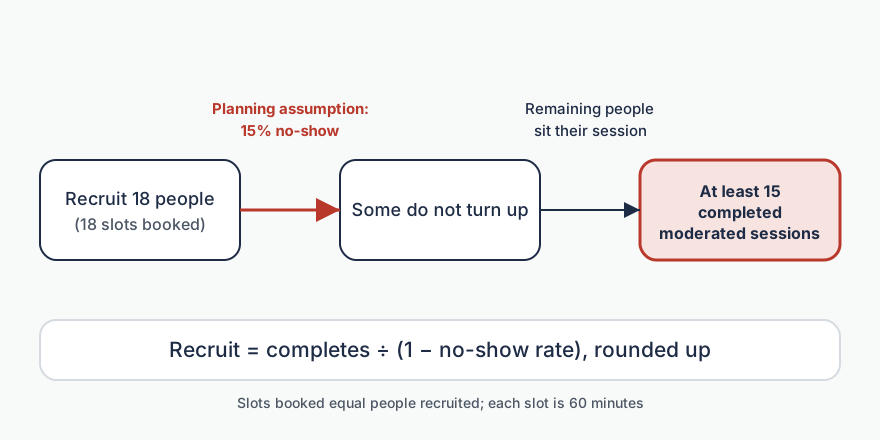
Rounded up. Slots booked equal people recruited. See over recruitment for the idea.
- Completed sessions
- 15
- Recruit
- 18
- Moderator days
- 4 to 5
- Completed sessions
- 20
- Recruit
- 24
- Moderator days
- 5 to 6
- Completed sessions
- 30
- Recruit
- 36
- Moderator days
- 8 to 9
How a moderated card sort session runs
Run it one participant at a time, or with two to three together, for 15 to 30 minutes of sorting (Digital.gov). The run-sheet adds the surrounding steps. The minutes are a recommendation.
That totals 42 to 59 minutes, so book 60. Do not say "good call" or "that makes sense", because praise steers the next choice. For narration prompts, use a think aloud protocol script.
- Step
- Welcome: reassure the participant that the cards are being tested, not them
- Minutes
- 5
- Step
- Consent
- Minutes
- 2
- Step
- Think-aloud demonstration
- Minutes
- 3
- Step
- Task instructions
- Minutes
- 5
- Step
- Sort (and name groups, in an open sort)
- Minutes
- 15 to 30
- Step
- Debrief: hardest card, why these belong together
- Minutes
- 10 to 12
- Step
- Close
- Minutes
- 2
Checking your cards and plan before fieldwork
Watch for superficial matches: participants grouping cards by shared keywords instead of meaning. NN/g's fixes are synonyms, non-parallel wording and longer card descriptions (June 2024). Use 30 to 50 cards (NN/g, 2024).
Run these checks before fieldwork:
- Screener: pass if every booked participant answered all qualifying questions correctly; fail if any was waived.
- Slots: pass if booked slots ≥ completes ÷ 0.85.
- Pilot: pass if one run finishes in 60 minutes or less.
Copy this worksheet:
CARD SORT WORKSHEET
Audience and screener: ______
Completes target: ______ (at least 15 per audience)
Recruit number: completes ÷ 0.85, rounded up = ______
Card count: ______ (30 to 50)
Slot length: ______ minutes (60)
What changes when you card sort in India
Language and place are likely to change the result, so build both into the plan. Write each card in the language participants use for the product, and use a pilot to check it: if the pilot participant asks what a card means, rewrite it. Include one synonym or Hindi and English mixed card to see whether people match words rather than ideas. Recruit across more than one city if your users do. Read more in multilingual research.
How Qualfacto handles it
We recruit participants by city, target by household and demographic profile, and verify identity before inviting anyone. We run sessions in languages other than English and can supply the moderator. You bring the card set and the sorting method, paper or software. We also run usability and app testing, remote or lab-based, if you want to test the structure afterwards. Choosing a tool? See Qualfacto vs Optimal Workshop.
We price each study as a project and offer a free pilot. Invitations depend on each project's requirements and the participant's profile; registering is an expression of interest and does not guarantee selection. Rewards and eligibility depend on the terms of each study.
Send your brief to support@qualfacto.io (or on WhatsApp) and we will review it and propose scope and price. We aim to reply within one business day (Monday to Friday, 10:00 to 18:00 India Standard Time); detailed briefs may take longer.
Example
A shopping app team writes 30 cards. One participant puts "Track my order", "Return an item" and "Cash on delivery" under "My orders". Another puts "Cash on delivery" under "Payments". That disagreement is the finding: the label needs a clearer name or a second home.
Frequently asked
Sources
- 1.Card Sorting: Uncover Users' Mental Models, Nielsen Norman Group, 2 February 2024
- 2.Card Sorting: How Many Users to Test, Nielsen Norman Group, 18 July 2004
- 3.Card Sorting: Terminology Matches, Nielsen Norman Group, 14 June 2024
- 4.Card Sorting, User Experience Professionals' Association (UXPA), June 2009
- 5.Organization testing guide, Digital.gov, US General Services Administration
- 6.Using Card Sorts for Understanding Website Information Architectures, Petrie, Power, Cairns and Seneler, INTERACT 2011, Springer, 2011