Logo Testing in India: Interview Plan for Design Agencies
Logo testing for an Indian audience works best as 12 interviews per city and language segment, with three options shown in rotated order, so each mark's meaning is heard in people's words.
By Jitendra Kumar Nirala, Founder · Updated 14 Nov 2026
Key takeaways
- Logo testing for an Indian audience works best as about 12 recorded interviews per city and language segment. Show three options one at a time in rotated order, then side by side.
- Client feedback shows what the client thinks. Interviews show what the mark says to the people it is for, including readings nobody intended.
- Twelve per segment is our planning figure, inside the 9 to 17 range at which published saturation studies stopped finding new themes. Two cities and two languages come to 48 interviews (assuming each city is recruited in both languages), about 44 hours of moderator time.
- Report readings, not a winner. Count how many people gave each reading of each option and flag the unintended ones. Scores and surveys can sit beside this, not replace it.
In this article
- 1What is a sound way to do logo testing with Indian participants?
- 2Why is client feedback not logo testing?
- 3How many interviews does logo testing need in each segment?
- 4Why show logo options one at a time and in rotated order?
- 5How do you read what each logo says to people?
- 6What do we recruit and run for logo interviews?
- 7Frequently asked questions
In December 2020, a complaint to Mumbai's cyber police said Myntra's logo was offensive to women. Myntra changed it across its website, app and packaging. The police officer's finding was blunt: "We found that the logo was offensive in nature for women" (The News Minute, 30 January 2021).
A client approval round is badly placed to surface a reading like that. The people approving a logo already know what it is meant to say. They have seen the brief and the sketches, so a reading outside the brief has nobody in the room to voice it.
A brand's customers can sit in different cities and speak different first languages from the client team, so each of those groups needs to be heard on its own.
Logo testing is the step that puts the options in front of the people the logo is for. The plan below gives you a sample size, a 55-minute interview script and a recruitment sheet you can paste into a brief.
What is a sound way to do logo testing with Indian participants?
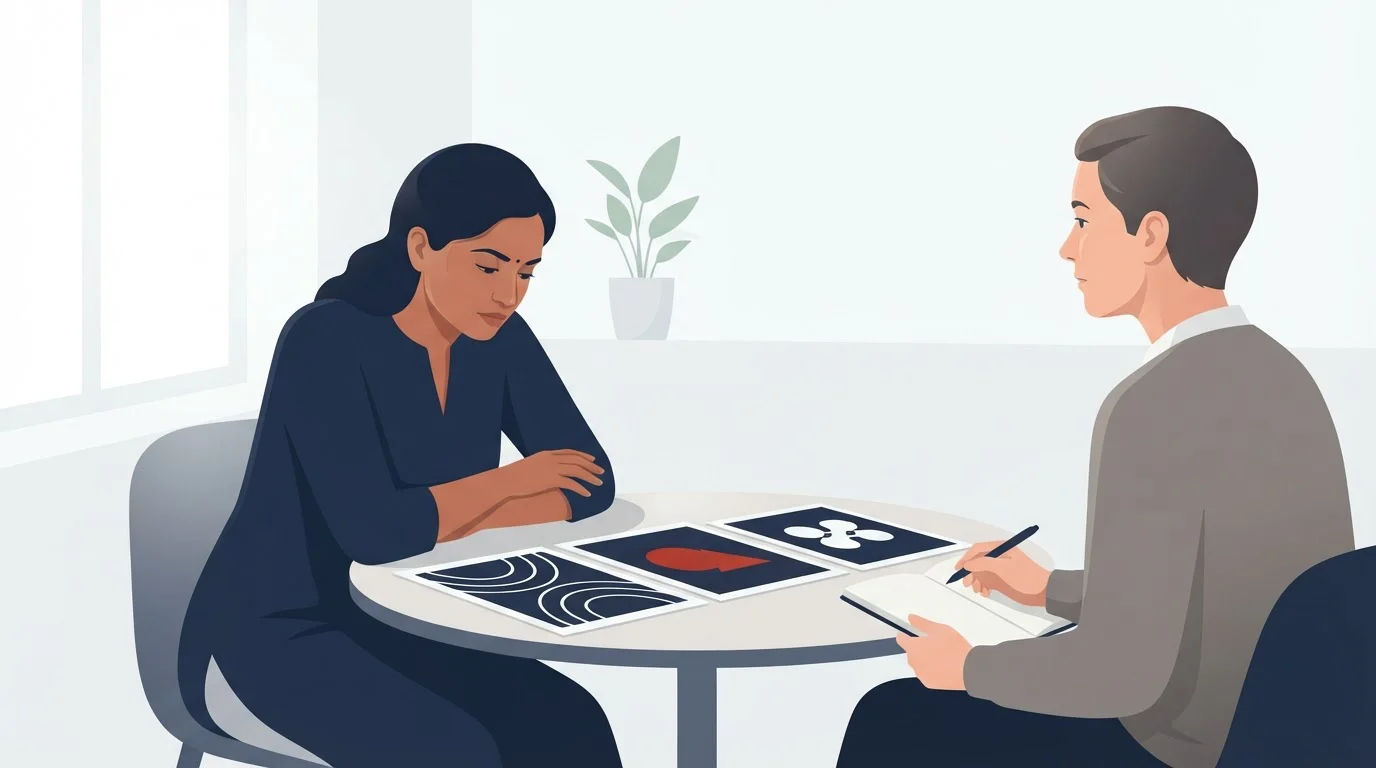
Recruit one segment per city and first language. Interview about 12 people in each. Show three logo options one at a time in rotated order, then side by side. Ask what each mark is, what it promises and what it could be mistaken for. A 55-minute session covers all of it.
The 55-minute script (three options, order rotated between interviews):
| Block | Minutes | What you do |
|---|---|---|
| Warm-up | 5 | Talk about the category and the brands they use. Show no logos. |
| Cold read, one option at a time | 12 (3 × 4) | "What kind of business is this? What is it promising? Who is it for?" If the mark carries a name, ask them to read it aloud before you say how it is pronounced. |
| What it says and what else it could be | 10 | "What else could this be? Does it remind you of anything? Would anyone object to it?" Follow every answer with "what makes you say that?" (see probing questions). |
| Side by side | 10 | "Which would you trust most? Which looks like it belongs to a different kind of business?" |
| In context | 8 | Show each option at app-icon size, on a signboard and in black and white. |
| Risks and objections | 5 | "Is there anything here a family member or a customer might not like?" |
| Close | 5 | "What did we not ask that we should have?" |
The recruitment sheet. Each line is a test with a pass and a fail:
- Segment. Every participant matches one city and one first language. Pass: the screener confirms both. Fail: a mixed segment.
- Exclusions. Nobody has worked on the brief, the naming or the design, and nobody is a friend or colleague of the client team. Pass: the screener asks and every answer is no.
- Rotation. Each presentation order appears equally often. Pass: 12 interviews cover the six orders of three logos twice each.
- Even stimulus. All options are the same size, finish and polish, on identical boards. Unequal polish makes people judge the presentation, not the idea (see stimulus material). Pass: a stranger cannot tell which option you prefer.
- Over-recruitment. Recruit about 20% more people than seats, because some will not attend. Pass: 15 recruited for 12 seats (12 × 1.2 = 14.4, rounded up).
- Consent. Participants are told before the session that it is recorded and why. Pass: it is in the invitation and repeated at the start.
If the brand name is still open, test the name first, then the logo (brand name testing).
Why is client feedback not logo testing?
Client feedback records what the people who commissioned the logo think of it. Logo testing records what the people the logo is for take it to mean. The two diverge most when the audience lives in other cities, speaks other languages or sits in another life stage than the client team.
As of November 2026, none of seven Indian logo-design agencies we reviewed describes an audience step: Bytset, Logopie, Ditto Media, Identity Makers, Verve Branding, Creative Orion and ROIHunt. This is a small sample and says nothing about the wider market. The pages and the search are listed in Sources.
Public reactions to Indian logos show what that step would have been listening for:
- Myntra, 2020 to 2021: the complaint above, about what the mark was taken to represent.
- Godrej Industries Group, April 2026: a designer's LinkedIn post and online commenters called its new identity template-like (Storyboard18).
- Air India's Vista logo: a commentary argues that its gold window frame turned away from symbols such as the red swan and the Konark Chakra (PRINT Magazine, 7 February 2024).
These are reactions from activists and designers after launch, not test results. We cannot say that interviews would have prevented any of them. What they show is that the reading of a mark is not fixed by its makers.
Recognition and image are also different goals. A 1998 Journal of Marketing study of 195 logos, rated on 13 design characteristics, treated high recognition and strong image as separate objectives needing different design traits (Henderson and Cote, 1998). A score or a survey counts how many people hold a view. It cannot tell you why, which is where interviews come in (brand perception research covers the survey side).
How many interviews does logo testing need in each segment?
Plan 12 completed interviews per segment. That sits inside the range at which studies using real interview data reached saturation, the point where new interviews stop producing new themes. It also divides evenly across the six possible orders of three logos.
A review of empirical tests found saturation within 9 to 17 interviews or 4 to 8 focus group discussions. This held particularly for homogeneous groups and narrow questions, and multi-country research needed more (Hennink and Kaiser, Social Science & Medicine, 2022). In an experiment with 60 in-depth interviews, saturation arrived within the first 12 (Guest, Bunce and Johnson, Field Methods, 2006).
Those studies were about themes in interviews, not logo reactions, so 12 is our recommendation, not a proven threshold. We split segments by city and first language because a mixed group is the case where the studies needed more interviews.
Worked example (our model, not an official figure):
- Three options give 3 × 2 × 1 = 6 presentation orders. Twelve interviews give each order two interviews.
- Assuming each of the 2 cities is recruited in both languages, a brief covering 2 cities and 2 first languages makes 4 segments, so 4 × 12 = 48 completed interviews.
- At 55 minutes each, 48 × 55 = 2,640 minutes, or 44 hours of moderator time. One segment alone is 12 × 55 = 660 minutes, or 11 hours.
- With 20% over-recruitment, each segment needs 15 recruits, so 4 × 15 = 60 in all.
If the budget allows one segment, choose the one that buys the most. Do not blend two segments into one group of 12.
For groups, 6 to 9 people over 1 to 2 hours is the usual size, and strong personalities can steer what everyone else says (Nielsen Norman Group, 31 July 2022). We would use groups to discuss a shortlist after interviews. We would not use them for the first cold reading.
Why show logo options one at a time and in rotated order?
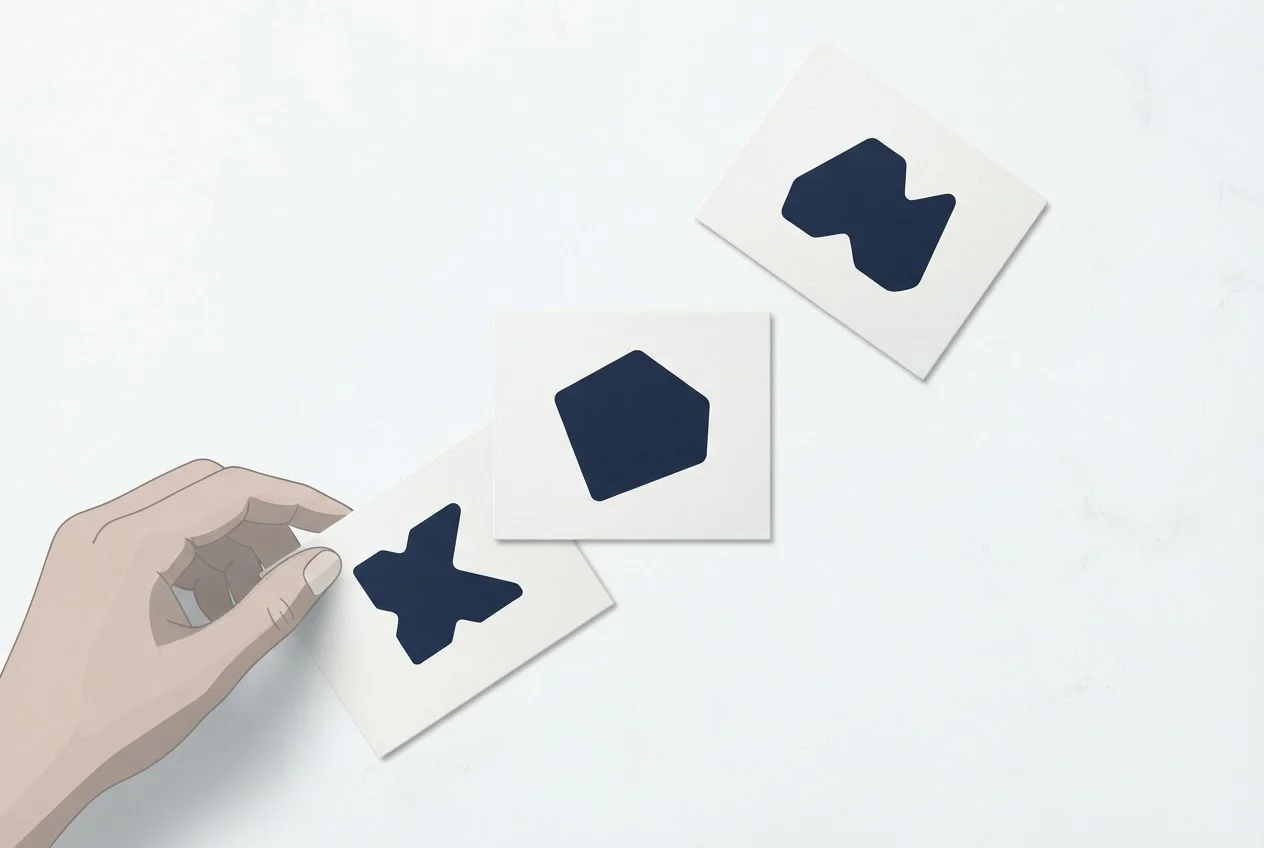
In our experience, and as our recommendation, order can colour what people say about later options, so we rotate it. Rotating the order across interviews spreads that effect evenly. Showing each option alone first captures a cold reading before any comparison begins.
Three options keep the cold read to 12 minutes and give six orders to balance. With four options there are 24 orders, which 12 interviews cannot cover. Use a four-order rotation in which each option opens equally often, so 12 interviews give 3 per order. Cold reads then take 16 minutes, so cut the side-by-side block to 6 minutes to stay at 55.
In a 120-minute group, we plan for 4 items. That is our model: assuming 30 minutes of the 120 go to opening and close, 90 usable minutes divided by an assumed 20 minutes per item gives 4. Logos may need less time each, but do not go above four.
How do you read what each logo says to people?
Write one line per option: the readings people gave, how many of the 12 gave each, and which were unintended. Count readings and do not average scores. Twelve interviews describe a segment. They do not support a percentage for the whole market.
Report each segment separately. Meaning does not travel evenly across cities and languages, and we would not let one segment speak for another. As working bars, which are our recommendation and not a published threshold:
- Category check. Look for at least 9 of 12 naming the right kind of business in the cold read. Fewer means the mark is not carrying its category.
- Unintended readings. Treat any unintended reading raised by two or more people in a segment as a finding to act on. A reading raised by one is a note.
- The "odd one out" answer. If one option is repeatedly picked as belonging to another kind of business, that matters more than which option people say they like.
Give the client the readings in the participants' own words, with the recordings behind them. That settles a disagreement faster than a score does.
What do we recruit and run for logo interviews?
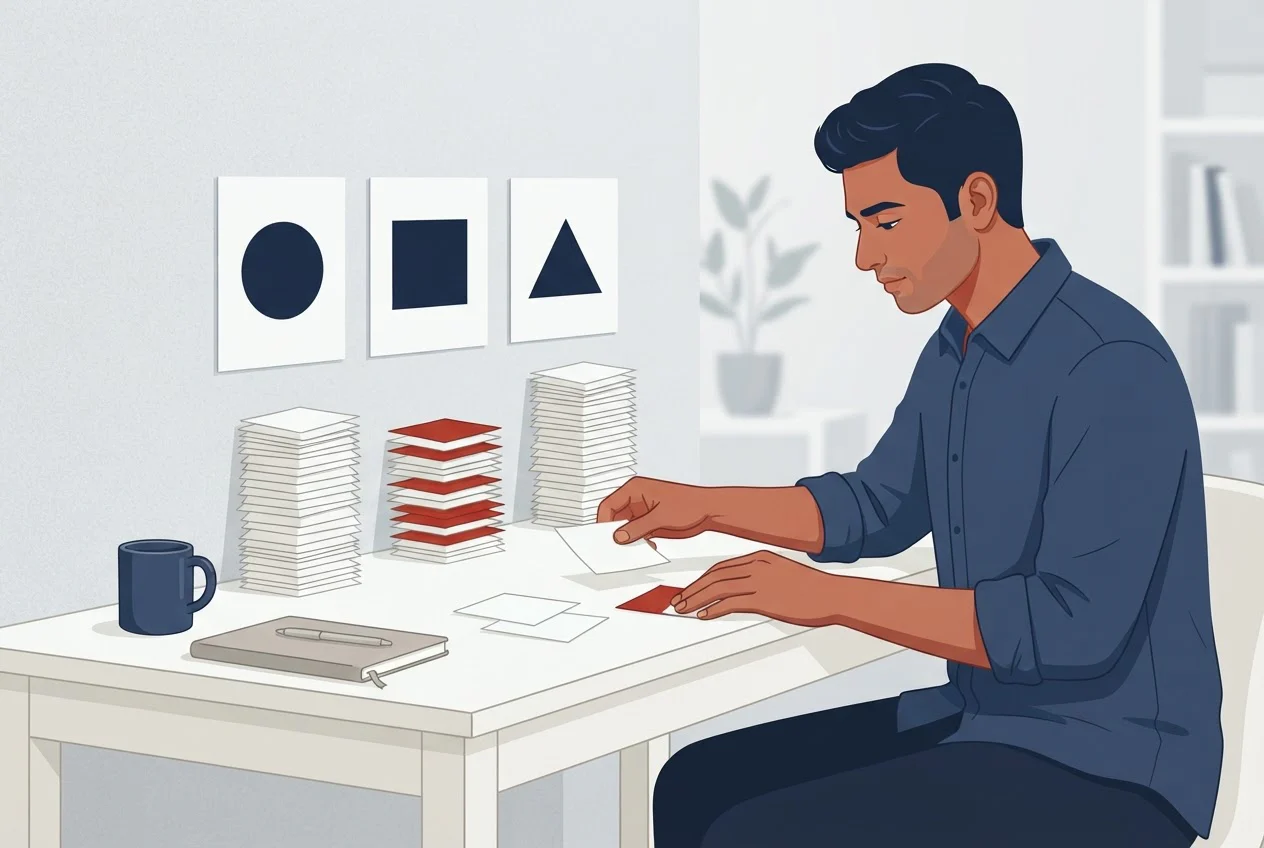
We recruit and schedule participants in your client's cities and first languages. Your team supplies the logo boards. We can supply the moderator for the sessions. Sessions run online or in person: one-to-one interviews of 30 to 120 minutes, or moderated groups of 1 to 3 hours.
We check participant identity before inviting anyone. We can target by household and demographic profile and run sessions in languages other than English. Depending on the scope you agree with us, you receive recordings, transcripts and structured exports. Pricing is a tailored proposal.
Email your brief and logo options to support@qualfacto.io to start a free pilot. Include the audience, the cities and the languages. We aim to reply within one business day, Monday to Friday, 10:00 to 18:00 Indian Standard Time.
Test your logo options with real audiences in India
Email your brief and logo options to support@qualfacto.io to start a free pilot.
Frequently asked questions
Sources
- 1.Hennink and Kaiser (2022), Sample sizes for saturation in qualitative research: a systematic review of empirical tests, Social Science & Medicine 292, article 114523
- 2.Guest, Bunce and Johnson (2006), How many interviews are enough? An experiment with data saturation and variability, Field Methods
- 3.Henderson and Cote (1998), Guidelines for selecting or modifying logos, Journal of Marketing
- 4.Nielsen Norman Group (Therese Fessenden, 31 July 2022), Focus groups 101
- 5.The News Minute (30 January 2021), Myntra changes logo after complaint it was "offensive to women"
- 6.Storyboard18 (April 2026), Godrej Industries Group rebrand sparks online debate
- 7.PRINT Magazine (Roshita Thomas, 7 February 2024), A window of opportunity: the lack of cultural nuance in Air India's rebrand
- 8.Our own check (14 November 2026): we ran the Google search "Indian design agency client logo options choose "logo" feedback from customers India designers community discussion how to present logo concepts". We opened seven logo-design agency pages from the results and looked for any step where people from the logo's audience see the concepts. The pages: Bytset (https://bytset.com/logo-design-agency-in-india/), Logopie (https://logopie.com/logo-design-service/), Ditto Media (https://dittomedia.in/logo-design-agency-in-india), Identity Makers (https://identitymakers.co/logo-design-agency-india/), Verve Branding (https://www.vervebranding.com/logo-design.html), Creative Orion (https://creativeorion.com/logo-designing-company-in-india/) and ROIHunt (https://www.roihunt.in/logo-design-company-india/).