Glossary
Stimulus Material
Stimulus material is anything shown, played or handed to participants in qualitative research so they react to something concrete rather than an idea.

By Jitendra Kumar Nirala, Founder · Updated 23 Oct 2026
Also called Exhibits
On this page
- 01Definition
- 02Quick facts
- 03Introduction
- 04What stimulus material is, and what it is not
- 05What a well-built stimulus set looks like
- 06Pack mistakes: purpose, polish and quantity
- 07Pack mistakes: order and wording
- 08How to check a stimulus pack before fieldwork
- 09How Qualfacto handles it
- 10Example
- 11Related terms
- 12Frequently asked
What is stimulus material in qualitative research?
Stimulus material is anything shown, played or handed to participants in qualitative research so they react to something concrete. It includes concept boards, ads, packs and prototypes.
Key takeaways
- Stimulus material is whatever you put in front of participants to prompt a reaction, and every item should exist to answer a written discussion question.
- Four pack problems are worth fixing before fieldwork: unequal polish, too many items, a fixed order and wording participants do not use.
- Plan item count from discussion time, rotate the order across sessions, and read translated wording aloud to someone from the audience before fieldwork.
- Items can only be compared fairly when they share size, finish and length, because uneven polish can decide which item wins.
Quick facts
- Also known as
- Exhibits (Quirk's glossary)
- What it covers
- Concept boards, product prototypes, and rough or finished advertising
- Where it is used
- Qualitative market and user research sessions
- Related AQR terms
- Animatic (a rough animated version of an ad) and narrative tape (an audio recording that tells the concept as a story)
Introduction
In school exams, stimulus material is the passage, graph or source that a question refers to. In market and user research the meaning is different, and so are the mistakes. A concept board is left half-finished. Three ad ideas are shown in the same order in every group. A Hindi line reads like a textbook.
A weak pack has a price in the room. When one concept looks finished and the others look rough, participants judge the finish and not the idea. When too many dense concepts are shown, discussion stays on immediate, superficial reactions. Either way the session produces opinions about the pack, not about the idea you wanted tested.
What stimulus material is, and what it is not
Stimulus material is material of a visual, verbal or auditory kind used to communicate ideas so they can be researched, or to stimulate discussion of relevant topics, as the Association for Qualitative Research (AQR) glossary defines it. Physical products count too. Quirk's glossary lists concept boards, product prototypes and rough or finished advertising, and also calls these items exhibits.
Two confusions come up often:
- Stimulus is not the concept. The concept is the idea. The stimulus is the form in which participants meet it. A concept test judges ideas, and the stimulus is what it shows.
- Stimulus is not the discussion guide. The guide holds the questions. The stimulus is what the questions point at. Use the focus group discussion guide to place each item in the running order.
What a well-built stimulus set looks like
A well-built set is a small group of comparable items, each shown for a reason. Rotating the order so that each item opens some of the groups follows the principle that later items get judged against the first. The AQR notes that in a small qualitative study an informal rotation may be all that is practicable.
Pack mistakes: purpose, polish and quantity
Five pack mistakes are worth fixing before fieldwork, and each is avoidable before the first session. The first three concern what goes into the pack.
- No question behind the item. An item included "for context" invites an opinion nobody needed.
- Unequal polish. When one concept looks finished and the others look rough, participants judge the finish, not the idea.
- Too many items. Judith Lerner, writing in Quirk's in 2005, observed that nine fully developed statements are a lot for consumers to digest in a standard two-hour group, and dense concepts produce only immediate, superficial reactions. The article is old, so treat it as a principle, not a rule.
Pack mistakes: order and wording
The other two mistakes concern how the pack is presented.
- A fixed order. Participants often judge later items against the first and recall the first or last most easily, which is why the AQR recommends rotation. Order is one source of response bias.
- Wording participants do not use. A 2026 PLOS ONE study tested 118 survey questions with 101 respondents in rural Uttar Pradesh in April 2023. Formally translated Hindi, though correct, failed with respondents of limited education, and one respondent said: "Please speak in Hindi. What does the question mean?" It was a survey study, not a stimulus study, but concept statements and showcards (cards shown to participants) plausibly carry the same risk. See multilingual research for the wider issue.
How to check a stimulus pack before fieldwork
Run these eight tests on the pack. Each has a pass and a fail you can observe.
How many items fit in one session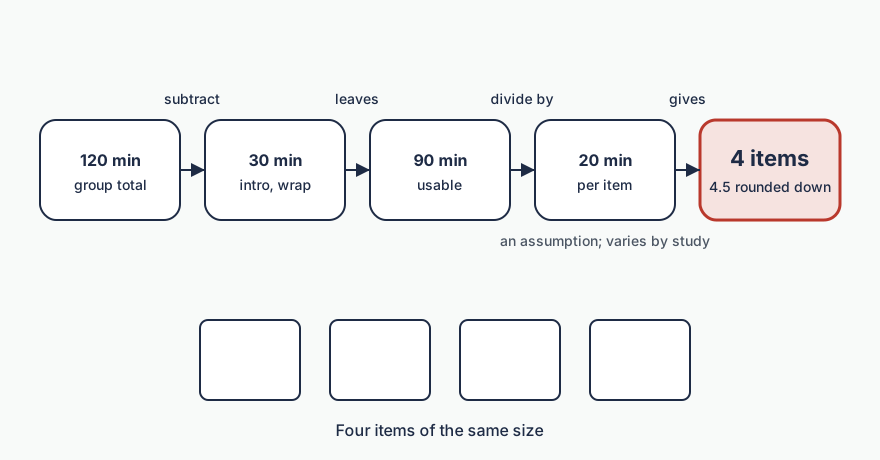
For load, the model is usable minutes divided by minutes per item. A 120-minute group with 30 minutes for introductions and wrap-up leaves 90. At 20 minutes per concept that is four items, rounded down from 4.5. The 20 minutes is an assumption and varies by study.
- Check
- Purpose
- Pass
- Each item is tied to a written discussion question
- Fail
- You can only say it "gives context"
- Check
- Parity
- Pass
- Items share size, finish and length
- Fail
- One is visibly more finished
- Check
- Load
- Pass
- Usable minutes ÷ planned minutes per item gives at least the number of items you plan to show
- Fail
- Fewer whole slots than items
- Check
- Order
- Pass
- A written plan puts each item first at least once
- Fail
- Same order in every session
- Check
- Language
- Pass
- Read aloud in the session language by someone from the audience, who does not ask what a line means
- Fail
- They paraphrase or stumble
- Check
- Framing
- Pass
- Questions are neutral ("what do you notice?")
- Fail
- Questions praise ("how convenient is this?")
- Check
- Delivery
- Pass
- Legible from the furthest seat, or on a typical phone screen
- Fail
- Text unreadable on the device used
- Check
- Handling
- Pass
- Any unreleased item has written rules saying who may hold it, where it is stored and when it is returned
- Fail
- Rules are left to the day
How Qualfacto handles it
Qualfacto recruits participants in Indian cities and fields the sessions where your stimulus is shown. You bring the stimulus; the team does not produce it. It targets by household and demographic profile and checks participant identity before invitation. The formats include focus groups, in-depth interviews, online bulletin boards, in-home use tests, shop-alongs, diary studies and usability testing. Sessions can run in languages other than English. Studies are run by its own team, by research partners or by your own moderator, depending on the project.
For ad stimulus, see advertising pre-testing. Pricing is set per project. Send your research brief to support@qualfacto.io and ask for the free pilot. The team answers Monday to Friday, 10:00 to 18:00 IST (Indian Standard Time), and aims to reply within one business day.
Example
A snack brand tests three pack designs in six focus groups of two hours each (illustrative, not a real client study). Each design is shown on a printed card in the same size and finish, and the question for each is "what would you expect to find inside?" With six groups and three designs, each design opens two groups.
Frequently asked
Sources
- 1.AQR glossary: Stimulus material, Association for Qualitative Research
- 2.AQR glossary: Order effect, Association for Qualitative Research
- 3.Quirk's glossary: External stimuli, Quirk's
- 4.A Qualitative Approach to Consumer-Based Concept Development, Quirk's, 1 December 2005
- 5."Please speak in Hindi": cognitive interviews in North India, PLOS ONE, 28 July 2026