Rural Market Research in India: A Scoping Sheet and Method Guide
Rural market research in India works when the study treats rural as several markets, matches method to who can be reached, and samples villages by size, checked against an eight-point brief.
By Jitendra Kumar Nirala, Founder · Updated 10 Oct 2026
Key takeaways
- 01Split rural India by state, village size, gender and role (buyer, user or influencer) before choosing a method. A single "rural" sample hides the differences that decide the result.
- 02Phone and online recruitment suits rural youth and many rural men, but misses many rural women. Add in-person, in-home sessions for them (see the reach table below).
- 03
About 80% of India's inhabited villages had fewer than 2,000 people in the 2011 Census (our calculation, shown below), so plan village selection by size band.
- 04Write the brief before fieldwork and check it against eight tests: the decision, the people, the places, the languages, the method per audience, the dates, consent and data, and the incentive and deliverable.
In this article
- 1Why is rural market research in India not one market?
- 2Who can you actually reach by phone or online in rural India?
- 3Which method fits which rural audience?
- 4How many villages and interviews does a rural qualitative study need?
- 5What drives the cost of rural market research?
- 6What should a rural research brief contain?
- 7How does Qualfacto run rural market research?
- 8Frequently asked questions
Phone-based recruitment skews a rural sample towards men. In rural India, 80.7% of men aged 15 and above own a mobile phone, against 48.4% of women, according to the Ministry of Statistics and Programme Implementation's 2025 telecom survey.
That gap is one reason a rural study can look complete and still be wrong. The sample fills with whoever answers the phone, and the person who decides what the household buys never speaks. Household spending also differs sharply between states, and village sizes range from tiny hamlets to villages of several thousand people.
Rural market research is the work of finding out what people outside cities buy, why, and from whom, so that a product, price or message fits them. It starts with deciding which rural people matter to your decision, not with choosing a survey tool.
Why is rural market research in India not one market?
Rural India is not uniform. In the Household Consumption Expenditure Survey 2023-24, which covered 154,357 rural households, average monthly per capita consumption expenditure (MPCE, what each person in a household spends in a month) was ₹4,122 in rural India and ₹6,996 in urban India. Within rural India:
- The poorest 5% of rural people averaged ₹1,677 a month and the richest 5% averaged ₹10,137, about six times as much.
- Among states, rural MPCE ran from ₹2,739 in Chhattisgarh to ₹9,377 in Sikkim. Uttar Pradesh was ₹3,481, Bihar ₹3,670, Tamil Nadu ₹5,701 and Kerala ₹6,611.
A concept tested in rural Tamil Nadu, where average spending is about 64% higher than in rural Uttar Pradesh (₹5,701 against ₹3,481, our calculation), tells you little about Uttar Pradesh.
Village size matters too. The 2011 Census table of villages by population size class gives these counts for inhabited villages. The shares and the 5,000-and-above row are our calculation from 597,608 inhabited villages, rounded to one decimal place.
| Village population | Villages | Share |
|---|---|---|
| Under 200 | 82,151 | 13.7% |
| 200 to 499 | 114,732 | 19.2% |
| 500 to 999 | 141,800 | 23.7% |
| 1,000 to 1,999 | 139,164 | 23.3% |
| 2,000 to 4,999 | 96,428 | 16.1% |
| 5,000 and above | 23,333 | 3.9% |
Adding the first four rows gives 477,847 villages, or 80.0%, under 2,000 people. Village sizes have shifted since 2011, so treat this as the shape of the distribution, not today's exact count. For a study, the practical point is that "a village" can mean 150 people or 8,000, and the shops, media and trust networks differ with it.
Who can you actually reach by phone or online in rural India?
You can reach rural youth and many rural men; you will miss many rural women. The MoSPI telecom survey (January to March 2025) interviewed 19,071 rural households. Its rural results for people aged 15 and above:
| Rural, aged 15 and above | Men | Women |
|---|---|---|
| Own a mobile phone | 80.7% | 48.4% |
| Used the internet in the last 3 months | 72.1% | 57.6% |
| Sent a message with an attached file | 67.2% | 50.9% |
Younger people are easier to reach. Among rural people aged 15 to 24, 95.7% of men and 91.1% of women used the internet in the last three months. In the same age group, 74.8% of men but only 51.7% of women own a phone.
Households are better connected than individuals. In rural India, 82.1% of households have a smartphone and 83.3% have internet access at home, against 91.3% and 91.6% in urban India.
Two cautions. The survey recorded what people said they could do and did not test them. Where several people share one phone, the survey assigns ownership to the person who uses it most.
Our inference: where young women use the internet but rarely own a phone, a call to a listed number may reach someone else in the household. Recruit through the household, ask who is speaking, and do not treat a completed phone screener as proof that the right person answered. Our guide to how to recruit participants for a study in India covers recruitment routes in more detail.
Which method fits which rural audience?
Choose the method per audience, not per study. This table is our recommendation, built on the figures above. Rows marked as our judgement go beyond the survey.
| Audience | Reachability | Method we would use |
|---|---|---|
| Rural men and women aged 15 to 24 | High internet use (95.7% of men, 91.1% of women) | Remote in-depth interviews (one-to-one conversations) or phone-based diaries, after checking who holds the phone |
| Rural men aged 15 and above | 72.1% used the internet | Remote for connected respondents; in-person for the rest |
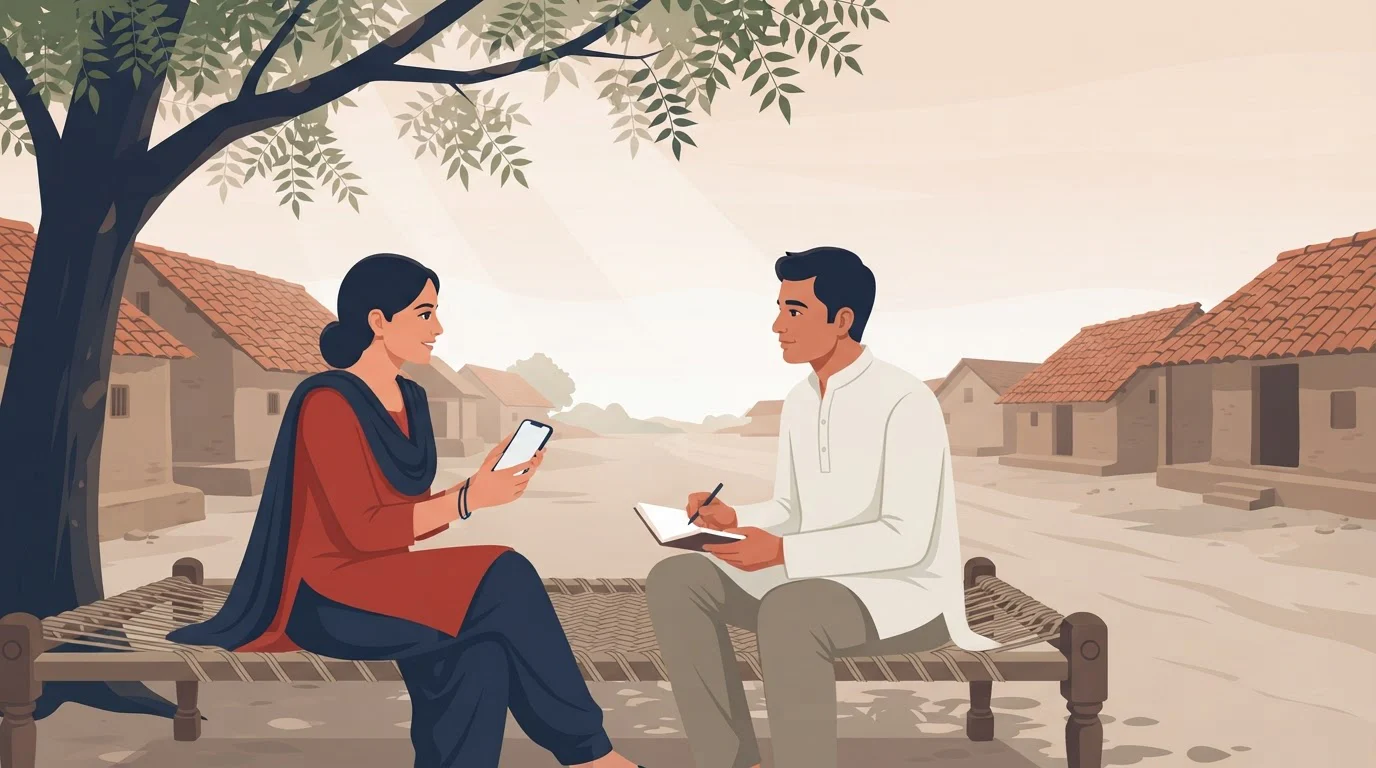
| Rural women aged 15 and above | 57.6% used the internet; 48.4% own a phone | In-person, in-home sessions with a woman moderator (the person who runs the session), recruited through the household |
| Older or low-literacy respondents (our judgement) | Not measured here | Face-to-face, in the local language, with show cards (printed cards of answer options or images) and a three-point or five-point scale |
| Shopkeepers, farmers, local influencers (our judgement) | Usually reachable by phone for first contact | A visit to the shop or field, scheduled away from market days and harvest |
In our view, in-home sessions show things an interview cannot, such as where a product is stored and who is present when it is used. The trade-off is time and cost, which is why the next section sizes a study before you commit.
How many villages and interviews does a rural qualitative study need?
Plan by cells, not by a single total. A cell is one state and village-size band, with gender planned inside it. Our worked example below is a model and a starting point, not an official figure; adjust it to your category. For the reasoning behind numbers like these, see our guide to sample size in qualitative research.
The brief: test a low-priced packaged-food concept in rural Uttar Pradesh and Tamil Nadu.
The working:
- Two states, because rural MPCE differs by ₹2,220 a month (₹5,701 minus ₹3,481).
- Two village-size bands per state: 500 to 1,999 people and 2,000 to 4,999 people. Together they hold 377,392 inhabited villages, about 63% of the 597,608 in the 2011 Census. We omit the smallest villages here because a first test is usually clearer in places with a market and a few shops. Add them if your product is sold through very small outlets.
- That gives 2 × 2 = 4 cells. Each cell has three villages: 4 × 3 = 12 villages.
- Four in-home interviews per village, two with women and two with men: 12 × 4 = 48 interviews, 24 with women and 24 with men.
- Each cell then holds 3 × 4 = 12 interviews, six with women and six with men.
Our assumption, not an official figure: about 12 interviews per cell, half women and half men, is a starting point for themes to repeat. Adjust after the pilot. If a cell is still producing new themes at the end, add villages to it. If it repeats early, stop early.
Pilot first. Run one village per state, 2 × 4 = 8 interviews, before committing to the other ten. A pilot finds a poor screener (the qualifying questions that decide who takes part), an unclear show card or a language mismatch while it is cheap to fix. Build the screening questions with our research screener template.
Fieldwork practice we recommend:
- Ask the village head for permission before fieldwork starts, and say what the study is for.
- Avoid harvest weeks and major festival weeks in the chosen state.
- Write consent wording in the interview language, saying what you collect and how long you keep it. The Digital Personal Data Protection Act 2023 and its Rules, notified in November 2025, set the consent and notice duties for personal data. As of October 2026 those duties are being phased in, with the main obligations applying from 13 May 2027, so write consent wording to that standard now. Our informed consent guide has a form to adapt.
What drives the cost of rural market research?
Several factors move the price of a rural study, and the brief fixes most of them:
- Distance from the nearest town. Villages far from a feeder town add travel time and cost.
- Gender and role quotas. A quota is a fixed number of respondents required from a group, such as women, or the household's main buyer. Filling one in person takes more screening contacts per completed interview.
- Language. Each language needs fluent moderators and translated materials.
- Village-size mix. Spreading 48 interviews over many small villages takes more travel than concentrating them in fewer larger ones.
- Recruitment difficulty. A narrow usership (how recently and how often someone buys or uses the product), such as buyers of one brand in the last month, takes more screening than a broad category.
- Participant incentive. It is set per study and should reflect the time asked.
We price rural studies per project from these inputs.
What should a rural research brief contain?
A rural brief should pass eight tests, each of which you can check before you send it. Use the list below as the brief itself.
Does the brief name the decision?
Pass: you can finish "If we find X, we will do Y". Fail: the aim is "understand rural consumers".
Does the brief define the people?
Pass: the audience is defined by state, village-size band, gender and role. Fail: it says "rural India".
Does the brief name the places?
Pass: states are named and there is a distance limit from the nearest town. Fail: it says "pan-India rural".
Does the brief name the languages?
Pass: each interview language is named and the moderator is fluent in it. Fail: it says "regional languages".
Is there a method for each audience?
Pass: every audience maps to a method with a reason, and any phone method for women names how you will confirm who answered. Fail: one method for everyone.
Are the fieldwork dates checked?
Pass: fieldwork avoids harvest and festival weeks in each chosen state. Fail: dates are set without checking the local calendar.
Are consent and data handling written down?
Pass: consent wording is in the interview language and states what is collected and for how long. Fail: the form is in English only.
Are the incentive and deliverable stated?
Pass: the incentive is stated to participants before they take part, and the deliverable format is named. Fail: either is missing.
How does Qualfacto run rural market research?
We run it from your brief. You share the objective, audience, geography, languages, sample and timeline; we check feasibility and send a tailored proposal and quote. Once scope, commercials and timelines are agreed, we recruit and screen participants, schedule the sessions and process participant incentives after validation. You then receive the agreed output.
Qualfacto is a qualitative research participant panel in India, operated by Think Design Research Services. We recruit across metros, Tier 1 and Tier 2 cities (India's larger city groupings), and urban, semi-urban and rural locations, and we assess language requirements project by project. We support interviews, group discussions, product tests, surveys and other qualitative formats.
We do not publish a rate card; every study is priced from the brief, and we are open to a pilot or introductory first project, depending on scope. A small pilot is a good way to test a rural brief before you scale. Send your brief to us at qualfacto.io and we will tell you what is feasible for your states, languages and audience.
Scope your rural study with Qualfacto
Frequently asked questions
Yes for rural youth and many rural men, but not for many rural women. Most rural people aged 15 to 24 are online (MoSPI, 2025), while rural women aged 15 and above are reached less by phone or internet, so add in-person sessions for them.
Start with official household data: the Household Consumption Expenditure Survey 2023-24 for spending, the MoSPI telecom survey for phone and internet use, and the Census village size tables for village counts. Then add primary fieldwork for your own category.
Sources
- 1.Results of Comprehensive Modular Survey: Telecom, 2025 (press note), Ministry of Statistics and Programme Implementation
- 2.Household Consumption Expenditure Survey 2023-24 fact sheet, Ministry of Statistics and Programme Implementation
- 3.Census of India 2011, A-03: Villages by population size class
- 4.Digital Personal Data Protection Rules, 2025 notification, Press Information Bureau