Contextual Inquiry in India: Recruit, Access and Field Days
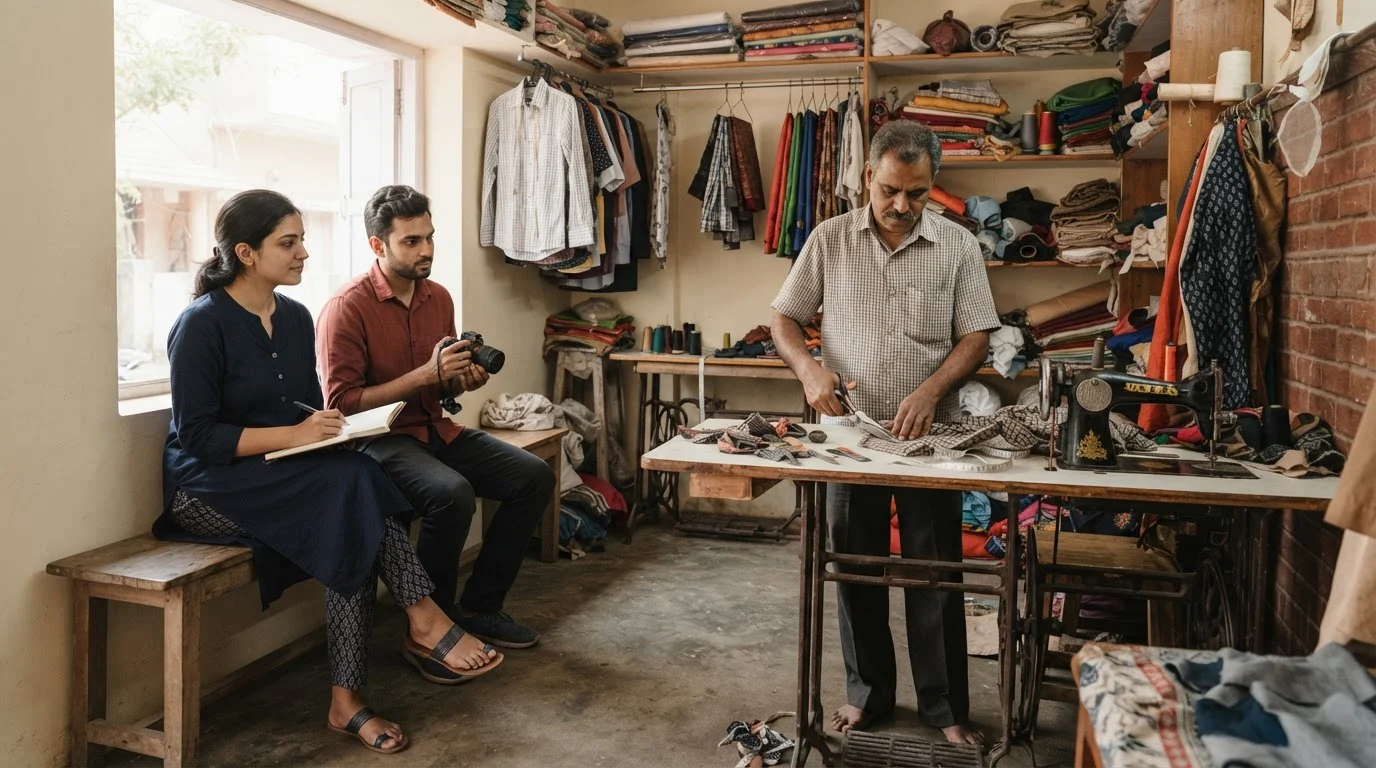
Contextual inquiry means watching people do a real task where they do it, then asking questions as they go. Sessions run one to three hours, so plan field days before you recruit.

By Jitendra Kumar Nirala, Founder · Updated 2 Nov 2026
Key takeaways
- A contextual inquiry is observation plus questions at the participant's real place, during a real task. Plan 1 to 3 hour sessions and follow GOV.UK's limit of two three-hour or four one-hour visits in a day, which we apply per pair of researchers.
- Our starting point is 4 to 6 households per segment. Two segments means 8 to 12 sessions, which is 4 to 6 field days for one pair on three-hour visits, before travel.
- A session moved to a meeting room, or turned into a group, is no longer a contextual inquiry.
- Get consent from everyone in the room, including people who join late. Remote sessions work mainly for desk-bound, single-screen tasks.
In this article
- 1What is a contextual inquiry, and how is it different from ethnography?
- 2How many contextual inquiry sessions fit in a field day?
- 3Why do contextual inquiries lose the context they were meant to capture?
- 4What goes on a contextual inquiry setup sheet?
- 5How do you get access and consent for a contextual inquiry in India?
- 6When can a contextual inquiry run remotely?
- 7How does Qualfacto run in-context studies in India?
- 8Frequently asked questions
A contextual inquiry usually goes wrong before the first session. The client moves it to a meeting room because that is easier to book. Or three participants are invited at once so the day is not wasted. Either way, the thing you came to watch is gone: a person doing real work in a real place.
The method is simple to describe and hard to schedule. Each visit is long, careful teams go in pairs, and one pair can only do so many visits in a day. In India, the total also depends on which cities your households or workplaces are in.
In India the gap widens: homes are often shared with extended family, gated societies control entry, and travel between cities can take a day. Plan access and consent before you plan the questions.
What is a contextual inquiry, and how is it different from ethnography?
A contextual inquiry combines in-depth observation and interviews with a small sample of users, in their own setting, to understand how they really work. Ethnography needs complete immersion in a person's or group's setting for a sustained period. It looks at social situations and at how people think a thing works (mental models) too. "Field study" is the umbrella term for both (Nielsen Norman Group, January 2024).
It is not an interview that happens to be held in someone's home. You watch the task first. You interrupt with an open question when an action is unclear. At the end you summarise what you think you saw, so the participant can correct you (Nielsen Norman Group, December 2020).
How many contextual inquiry sessions fit in a field day?
GOV.UK says not to plan more than two three-hour or four one-hour visits in a day. We assume that limit applies to one pair of researchers. Sessions run between 1 and 3 hours, and the work goes better in pairs. One person leads the visit and the other takes notes, photos and recordings (GOV.UK Service Manual, 2017). Sessions on long processes can run from an hour to several days (Office for Health Improvement and Disparities, GOV.UK, 2021).
Our recommendation for sample size is 4 to 6 households per segment, where a segment is a group of participants who share the task and setting you study. Add more when contexts differ by city, household or income. Treat that as a starting point and read how it fits with other methods in our UX research methods guide.
Here is the arithmetic for a two-segment study. This is our model, not an official figure.
- Sessions: 2 segments × 4 to 6 households = 8 to 12 completed sessions.
- Recruits: completions × 1.25, the 25% margin we use to cover no-shows. That means 10 to 15 people.
- Field days for one pair: sessions ÷ visits per day.
| Session length | Visits per day (GOV.UK limit, applied per pair by us) | Field days for 8 sessions | Field days for 12 sessions |
|---|---|---|---|
| 3 hours | 2 | 4 | 6 |
| 1 hour | 4 | 2 | 3 |
A pair means two people, so 4 to 6 field days is 8 to 12 person-days on three-hour visits. The model assumes one city. If your segments sit in different cities, count field days for each city and add travel days. A single pair covering Delhi and Chennai has made two trips.
Why do contextual inquiries lose the context they were meant to capture?
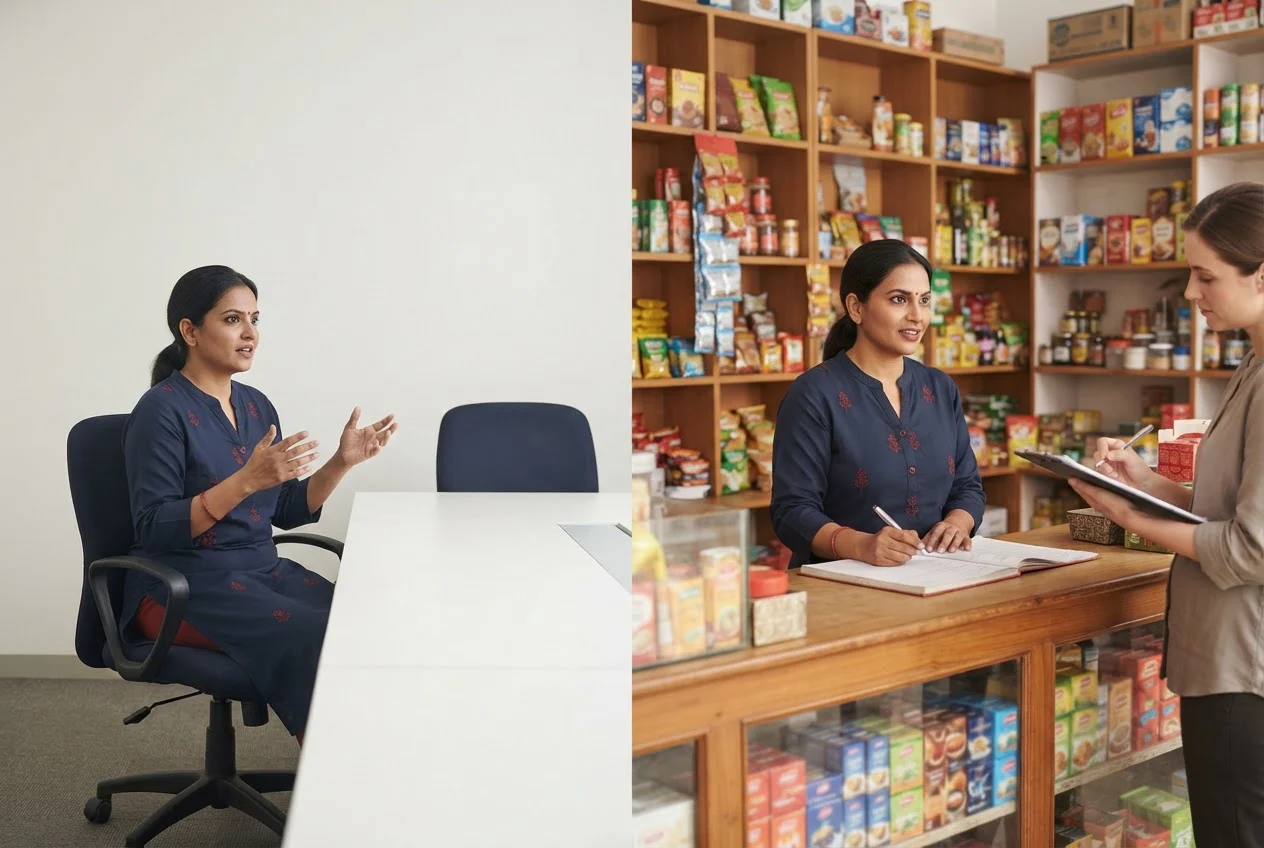
Because someone swaps the place or the task for something more convenient. Clients book a conference room. Visits turn into group sessions. Participants describe their routine instead of doing it. Once the setting or the task is replaced, you are running an ordinary interview (UXmatters, 2012). Our advice: move the session to the real setting. If that is impossible, call it a user interview, as UXmatters suggests, not a contextual inquiry.
What goes on a contextual inquiry setup sheet?
Fill in the sheet below before you recruit. Each row has a pass test, and any "fail" means the study will probably lose its context.
| Field | What to write | Pass if | Fail if |
|---|---|---|---|
| Focus | One sentence: the task, the setting, the decision it informs | Someone outside the team can say what you will watch | It says only "understand users" |
| Segments | City, household or workplace type, task, one row each | Each row has its own session count (we start at 4 to 6) | Different cities or income levels share one row |
| Visit length | 1 to 3 hours | Within the GOV.UK daily limit, applied per pair | More than two 3-hour or four 1-hour visits a day |
| Recruits | Completions × 1.25 | 8 sessions → 10 recruits, 12 → 15 | Recruits equal completions |
| Place | The real home, shop or workplace | The task happens where it normally happens | The venue is a meeting room or café |
| Live task | When the task naturally occurs | The participant does it during the visit | The brief says "tell me about" |
| People present | Names and roles of everyone who may be in the room | Consent is recorded for each person | A manager or relative joins unrecorded |
| Recording | What you record, why, where it is stored | Participant agrees before you start | You decide on the day |
| Roles | One lead, one note-taker | Two people attend | One researcher goes alone |
| Wrap-up | Five minutes to read back your reading | Participant corrects at least one point or confirms all | The session ends when the task ends |
| Analysis | Time booked before fieldwork starts | Analysis days are booked in the calendar before the first visit, at a stated number of days per field day (state your own ratio) | No analysis days are booked |
Use this alongside a one-page market research brief so the sheet and the brief agree.
How do you get access and consent for a contextual inquiry in India?
Get informed consent from everyone who will be in the room, including people who join later. Ask again before recording any new activity (GOV.UK Service Manual, 2017). For a workplace visit, we recommend written permission from the employer as well as the participant, because the participant cannot grant access to a shop floor or an office.
Recordings and household details are personal data under the Digital Personal Data Protection (DPDP) Act 2023 (DPDP Act 2023). The Market Research Society of India (MRSI) and ESOMAR codes ask for informed, voluntary consent (ESOMAR code of conduct). Our recommendation: before you enter a home, agree the visit with the adult household member who owns or rents it, and for a gated society, tell the society office or security in advance.
Plan for the people who are always there in a home or shop: a spouse, a parent, a colleague. Decide before the visit whether they may stay, and record their consent if they do. Our informed consent guide has a form you can adapt and the Indian rules.
GOV.UK also asks you to plan for emergencies and to avoid excluding disabled people or those who need support. Going in pairs is described as easier and safer.
When can a contextual inquiry run remotely?
Remote sessions suit computer-based, desk-bound work that fits on one shareable screen. The researcher is not in the room, so you lose the physical surroundings and anything off screen. Sessions of 2 to 3 hours work. Turn your camera off during observation to reduce distraction, and invite participants to follow-up sessions to see full workflows (Nielsen Norman Group, November 2022).
Remote is a poor fit when the task is cooking, caring, repairing or buying. If the task is a purchase, a shop-along is a better format.

How does Qualfacto run in-context studies in India?
Our ethnography service, home visits or virtual sessions, is the format closest to a contextual inquiry. We do not sell a package with that name. You share the task, setting and segments in your brief, and we assess feasibility and send a tailored proposal and commercial quote. Once you agree, we recruit.
- Recruitment by city: we target by household and demographic profile and run participant identity checks before invitation.
- Languages and moderators: we can run sessions in languages other than English and supply moderators.
- Deliverables: recruitment, fieldwork materials, recordings, transcripts, structured data exports and research reports, depending on the scope we agree before the study begins.
- Invitations: participants are invited according to each project's requirements and their profile. They receive incentives only after the stated participation requirements are completed and validated.
We price each project individually and offer a free pilot. Send your brief to support@qualfacto.io. We aim to reply within one business day, Monday to Friday, 10:00 to 18:00 Indian Standard Time (IST), though detailed briefs may take longer.
If you live in India and would like to take part in studies like this, see how to join and get invited. Registration is only an expression of interest and does not guarantee selection or invitations; invitations depend on each project's requirements and your profile, and rewards depend on the specific study's terms.
Plan your in-context study in India with Qualfacto
Frequently asked questions
The principles are context, partnership, interpretation and focus. Context means watching work in its real setting. Partnership means you and the participant work it out together. Interpretation means confirming what you think you saw. Focus means a clear research purpose steers what you watch. A session has four parts: a primer to build rapport, a transition into observation, the contextual interview, and a wrap-up (Nielsen Norman Group, 2020).
Schedule the visit for when the task naturally happens, ask them to start it, and ask to see every step. Participants drift into interview mode, describe their routine, and skip steps that seem obvious to them (UXmatters, 2012).
Use a contextual inquiry when the task unfolds at home or at work. Use a shop-along when the task is a purchase in a store or app. A shop-along (shop-along research) has three parts: a short interview before the trip, the trip itself with as little interruption as possible, and an interview afterwards.
Sources
- 1.Nielsen Norman Group, "Contextual Inquiry: Inspire Design by Observing and Interviewing Users in Their Context", Kim Flaherty, 6 December 2020
- 2.Nielsen Norman Group, "UX Research Cheat Sheet: Field Studies", Susan Farrell and Therese Fessenden, 12 January 2024
- 3.Nielsen Norman Group, "Remote Contextual Inquiry: Lessons Learned", Kate Kaplan, 13 November 2022
- 4.GOV.UK Service Manual, "Contextual research and observation", published 1 September 2017
- 5.Office for Health Improvement and Disparities, GOV.UK, "Contextual inquiry", 19 October 2021
- 6.UXmatters, "Why Are Contextual Inquiries So Difficult?", Jim Ross, June 2012