
Glossary
Dyad Interview
A dyad interview is a moderated conversation with two participants at once, used when the answer sits between two people, such as a shared purchase, rather than inside one person's head.

By Jitendra Kumar Nirala, Founder · Updated 24 Oct 2026
Also called Paired depth interview, Joint interview or Dyadic interview
On this page
- 01Definition
- 02Quick facts
- 03Introduction
- 04What a dyad interview is and what it is called
- 05Dyad vs in-depth interview, triad and focus group
- 06Why dyad interviews go wrong, and what people confuse them with
- 07How to book pairs for a dyad interview in India
- 08Terms related to a dyad interview
- 09How Qualfacto handles it
- 10Example
- 11Related terms
- 12Frequently asked
What is a dyad interview?
A dyad interview is a qualitative interview in which one moderator talks with two participants at once. It is also called a paired depth interview, and it suits topics that two people share.
Key takeaways
- Use it when the subject is something two people share, such as a household purchase or a joint routine.
- Each person gets at most half the airtime of a one-to-one interview of the same length. In a 60-minute dyad that is 30 minutes each.
- Do not pair people with a power gap on topics the junior person would hold back on, and do not pair people on topics either would hide from the other. Interview them separately.
- Book more pairs than the sessions you need, because a pair only sits if both people turn up. If each person has a 90% chance of attending, only 81% of pairs will sit, so book 10 pairs for 8 sessions.
Quick facts
- Participants
- One moderator and two participants
- Planned length
- 60 to 90 minutes, with margin for overrun
- Who it suits
- Two relatively equal partners deciding something together
- Main risks
- One person dominating, the pair drifting into talking to each other, or one person holding back
Introduction
A 2024 review of 471 journal articles that used dyadic interviews found that more than 40% interviewed married couples or equivalents and about 30% other family pairs (Morgan, Field Methods). Roughly 70% of the interviews were with family pairs, so most published dyad research studies something two people do or decide together. That is where the method fits best.
Research teams often book a pair hoping for a cheaper interview or a smaller focus group. A dyad is neither. The second person changes what the first says, which is both the value of the method and its main risk, and the moderator (the person who runs the session) has to manage it.
This entry defines the term, sets a dyad against a one-to-one interview, a triad (an interview with three participants) and a focus group, and ends with a booking sheet for recruiting pairs in India, where a session only runs if both people turn up. Each check can be run before you pay for fieldwork.
What a dyad interview is and what it is called
Paired depth interview, joint interview and dyadic interview name the same method. The Association for Qualitative Research (AQR) defines it as "an interview conducted with two people" that lets the researcher probe each person's experience and use similarities and differences between them to go deeper.
Pairs are either people who know each other (family, friends, partners in a purchase) or people who have never met (Quirk's). A conflict pair is two screened strangers chosen because they differ, for example loyal users of rival brands.
Dyad vs in-depth interview, triad and focus group
Quirk's glossary notes dyads suit purchase decisions between two relatively equal partners.
Airtime per person in a 60-minute session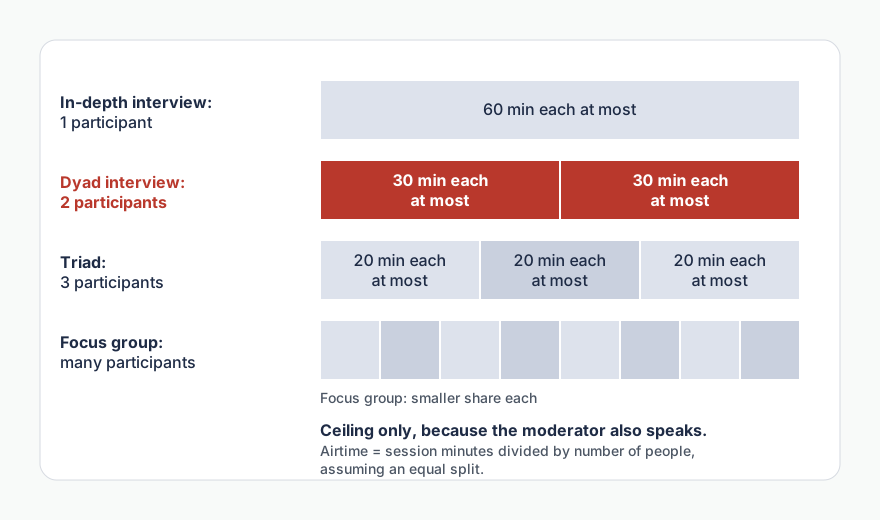
The airtime column is session minutes divided by number of people, assuming an equal split. It is a ceiling, because the moderator also speaks. For how to run the one-to-one and group formats, see the guides to the in-depth interview method and the focus group discussion guide.
- Format
- In-depth interview
- People
- 1
- Best when
- Answer is private, sensitive or individual
- Most airtime per person in a 60-minute session
- 60 minutes
- Format
- Dyad, known pair
- People
- 2
- Best when
- Decision or routine is shared
- Most airtime per person in a 60-minute session
- 30 minutes
- Format
- Dyad, conflict pair
- People
- 2 strangers
- Best when
- You want opposing views side by side
- Most airtime per person in a 60-minute session
- 30 minutes
- Format
- Triad
- People
- 3
- Best when
- Three people influence the outcome
- Most airtime per person in a 60-minute session
- 20 minutes
- Format
- Focus group of 8
- People
- 8
- Best when
- You need group opinion and interaction
- Most airtime per person in a 60-minute session
- 7.5 minutes
Why dyad interviews go wrong, and what people confuse them with
Dyad interviews go wrong when one person dominates, when the pair drifts into talking to each other, or when one person holds back because the other is listening. A study of 47 dyadic interviews with 94 employees found dominance across status or personality gaps, long digressions between close pairs, and discomfort on sensitive topics (Szulc and King, 2022). The same paper found that participants cannot be anonymous to each other.
One doctoral researcher on an Edinburgh University blog reported recruitment resistance: "Not everyone is in a position to take part in a dyadic interview, while some individuals would much prefer to take part in research by themselves." That is an anecdote, not a finding.
Two distinctions:
- A dyad is not a family member sitting in on someone's interview. There, one person is a bystander. In a dyad both are participants.
- A dyad is not a focus group with two seats. Two people cannot supply the range of views a group does.
How to book pairs for a dyad interview in India
Book pairs by running seven checks before recruitment starts, then book more pairs than sessions, because a pair only sits if both people arrive.
Have you named the pair rule?
Pass: one sentence gives the relationship and the shared decision ("married couples who chose their last two-wheeler together"). Fail: "two people from the target group", which gives no reason to pair them.
Is there a power gap?
Pass: equal standing, such as spouses or two friends. Fail: manager and report, or elder and junior, on a topic where the junior would hold back. Interview them separately.
Would either person be embarrassed if the other heard an answer?
Ask this of each question. Pass: no, every time. Fail: any yes. Move that question to a separate interview with each person; some reviewed studies use both formats (7% in Morgan's review).
Is each person screened separately?
Use the same questions for both, in a research screener. Pass: both screened individually, both comfortable in the session language, and both able to reach the same city or join the same online session. Fail: the second person added by name only.
Has each person given consent?
Pass: each signs a consent form saying they are not anonymous to each other and agree to keep each other's answers confidential. Fail: one signs for the pair. For personal data duties in India, see the Digital Personal Data Protection Act, 2023 (DPDP Act).
Does the guide fit the time?
Plan 60 to 90 minutes, with margin for overrun. Pass: the guide covers each topic in under 30 minutes per person at 60 minutes, or 45 at 90 minutes. Fail: more questions than that.
Have you set the number of pairs?
Set the number of sessions using a guide to sample size in qualitative research. Pass: sessions needed is written down with the attendance model applied. Fail: sessions needed without the model.
Attendance model: pairs to book = sessions needed ÷ (show rate squared), rounded up. Show rates are assumptions; replace them with your own.
The model assumes the two people decide independently. Couples who travel together are likelier to arrive together, so the loss is smaller for them.
- Chance each person attends
- 90%
- Chance the pair sits
- 81% (0.9 × 0.9)
- Pairs to book for 8 sessions
- 10 (8 ÷ 0.81 = 9.9)
- Chance each person attends
- 80%
- Chance the pair sits
- 64% (0.8 × 0.8)
- Pairs to book for 8 sessions
- 13 (8 ÷ 0.64 = 12.5)
How Qualfacto handles it
Qualfacto reviews every brief for feasibility and sends a tailored proposal, so put the pairing rule, the shared decision and the joint-or-separate split in your market research brief. A dyad is not one of its listed formats. Its named formats are in-depth interviews of 30 to 120 minutes and focus groups of 1 to 3 hours.
For the recruitment side it offers city-level recruitment, identity checks before invitation, targeting by household and demographic profile, and sessions in languages other than English. You can bring your own moderator. Pricing is set per project, and a free pilot is available.
Email your research brief to support@qualfacto.io (or message on WhatsApp for quick queries). Qualfacto aims to reply within one business day, Monday to Friday, 10:00 to 18:00 India Standard Time (IST). Detailed briefs may take longer.
Example
A bank testing a joint-account journey would interview a married couple together. What it needs to see is how they divide the decision, and an individual interview can only report that second-hand.
Frequently asked
Sources
- 1.AQR glossary: paired depth interview, Association for Qualitative Research
- 2.Quirk's glossary: dyad, Quirk's
- 3.Morgan (2024), Collecting Data through Dyadic Interviews: A Systematic Review, Field Methods, 2024
- 4.Szulc and King (2022), The Practice of Dyadic Interviewing, Forum: Qualitative Social Research 23(2), 2022
- 5.University of Edinburgh blog: Tell us about your methodology, dyadic semi-structured interviews, University of Edinburgh
- 6.Digital Personal Data Protection Act, 2023, Ministry of Electronics and Information Technology, 2023