Glossary
Gen Z Market Research
Gen Z market research studies people born 1997 to 2012, aged 14 to 29 in 2026. In India that range spans minors and adults, so recruit by age band, not label.

By Jitendra Kumar Nirala, Founder · Updated 24 Oct 2026
On this page
- 01Definition
- 02Quick facts
- 03Introduction
- 04What is Gen Z market research?
- 05How many Gen Z are there in India, and how many can you research?
- 06Why is "Gen Z" a weak brief on its own?
- 07How do you turn "Gen Z" into a brief a recruiter can screen against?
- 08What changes when Gen Z participants are under 18?
- 09How Qualfacto handles it
- 10Example
- 11Related terms
- 12Frequently asked
What is Gen Z market research?
Gen Z market research is research with people born between 1997 and 2012, who are aged 14 to 29 in 2026. The term describes the audience, not a method.
Key takeaways
- The label names who you study, not how, so state exact ages in every brief.
- About 407 million people in India fall in the range: roughly three quarters are 18 or over and about a quarter are under 18.
- Replace the label with five fields: age band, life stage, place and class, session language, and a qualifying behaviour.
- From 13 May 2027, India's Digital Personal Data Protection (DPDP) Act requires verifiable parental or guardian consent for anyone under 18.
Quick facts
- Birth years
- 1997 to 2012
- Age in 2026
- 14 to 29
- Range set by
- Convention among research bodies; Pew Research Center uses 1997 to 2012
- Size in India
- About 407 million people, 27.6% of the population
- Adult share
- About 75% aged 18 or over
Introduction
Two vendors quoting on "Gen Z snack buyers" can recruit 15-year-olds in one city and 28-year-olds in another. In India the law treats those two ends of the range differently.
A brief that says only "Gen Z" leaves the recruiter to guess which people you meant. The result is a sample that matches the label and misses your audience.
This entry defines the term, sizes each slice of the cohort for India, and gives you a five-field brief a recruiter can screen against. It is written for buyers commissioning qualitative work: interviews, group discussions and diaries (participants record their day in photos and videos over several days), where one mismatched participant wastes a full session.
What is Gen Z market research?
Interviews, group discussions, diaries and surveys can all count as Gen Z research if the participants fall in that range.
The range is a convention set by research bodies, not a measurement. Pew Research Center uses 1997 to 2012 (Where Millennials end and Generation Z begins). If your brief says "Gen Z" without ages, two vendors can quote on different people.
How many Gen Z are there in India, and how many can you research?
India has about 407 million Gen Z, 27.6% of the population, and roughly three quarters of them are adults. PopulationPyramids' arrangement of United Nations data, which groups people born 1997 to 2012 as Gen Z, gives 406,921,316 people for 2026 (PopulationPyramids; underlying data: UN World Population Prospects 2024).
The table shows the estimated split by age, worked out from the UN's 2026 age bands for India as arranged by PopulationPyramids.
How it is worked out: the bands are 10 to 14 (122,038,950), 15 to 19 (126,213,668), 20 to 24 (128,964,063) and 25 to 29 (126,579,855). One fifth of the first band is taken for age 14, three fifths of the second for ages 15 to 17, and two fifths for ages 18 and 19, assuming people are spread evenly within each band. The slices total 406 million, about 0.2% below PopulationPyramids' generation count. These are estimates, not census figures.
- Age in 2026
- 14 to 17
- People (approx.)
- 100 million
- Share of Gen Z
- 25%
- Age in 2026
- 18 to 24
- People (approx.)
- 179 million
- Share of Gen Z
- 44%
- Age in 2026
- 25 to 29
- People (approx.)
- 127 million
- Share of Gen Z
- 31%
Why is "Gen Z" a weak brief on its own?
Birth year does not tell you what someone buys or how they live. A 15-year-old at school and a 28-year-old with a job and a household share a label and little else. Life stage, city, socio-economic class and language explain far more, and India varies on all four (Ipsos, 2025; Open Magazine, 2026; MxMIndia, 2026).
Terms often confused with Gen Z:
- Millennials, or Gen Y: the same group under two names, born 1981 to 1996 and aged 30 to 45 in 2026, 361,777,610 people (PopulationPyramids).
- Gen Alpha: usually born from 2013 onward (definitions vary).
- Life stage: where someone is in life, such as student, first job or parent. It usually separates buyers better than birth year.
- Psychographics: values, attitudes and interests, which interviews and diaries reveal better than age.
How do you turn "Gen Z" into a brief a recruiter can screen against?
Write five fields, each of which can become a screener question with a clear pass or fail. If a field cannot be checked with a number or a yes or no, it is not yet a criterion.
From the Gen Z label to five screening fields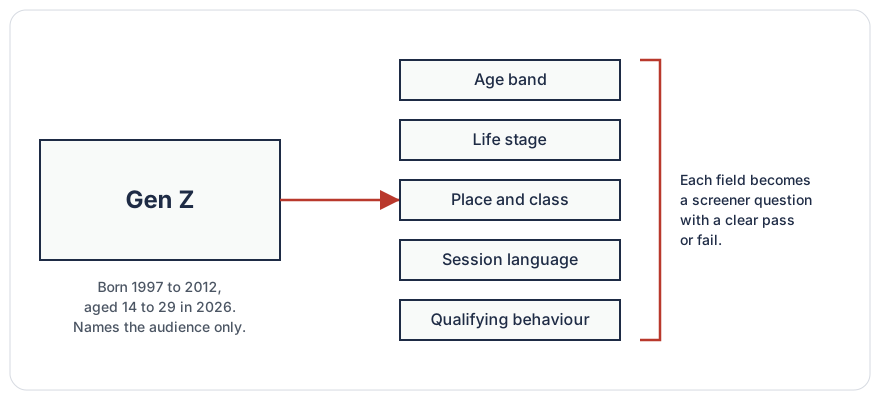
Put this into a one-page research brief and a research screener. For numbers per group, see sample size in qualitative research. The place and class field can use a socio-economic class.
- Field
- Age band
- Passes when
- Exact years, such as 18 to 24
- Fails when
- "Young" or "Gen Z"
- Field
- Life stage
- Passes when
- One option per person: student, first job, working with dependants
- Fails when
- Several overlapping options
- Field
- Place and class
- Passes when
- Named city type and socio-economic class
- Fails when
- "Urban"
- Field
- Session language
- Passes when
- The language spoken at home and in the session
- Fails when
- "Local"
- Field
- Qualifying behaviour
- Passes when
- A past action in a period, such as bought twice in the past month
- Fails when
- "Interested in snacks"
What changes when Gen Z participants are under 18?
Under-18 participants need a parent's or guardian's verifiable consent. The DPDP Act, 2023 defines a child as anyone under 18 (Section 2(f)) and Section 9 requires that consent. Section 9 also bars tracking, behavioural monitoring and targeted advertising aimed at children (Ministry of Electronics and Information Technology; EY India).
The Digital Personal Data Protection Rules, 2025 were notified on 13 November 2025 (G.S.R. 846(E)). The duties on children's data, including verifiable parental consent under Rule 10, apply from 13 May 2027. As of 23 October 2026, they are not yet in force (Ministry of Electronics and Information Technology). Confirm the current text with your legal adviser before planning. About a quarter of Gen Z sits under 18, so treat that work as a separate study with its own informed consent design.
How Qualfacto handles it
Qualfacto recruits adult Gen Z, aged 18 to 29, from its panel of adults aged 18 to 55, by city and by household and demographic profile. It runs qualitative studies: in-depth interviews of 30 to 120 minutes, focus groups of one to three hours, diary studies, online bulletin boards (written discussions that participants join at different times), shop-alongs (a researcher accompanies a shopper in store or online), ethnography (home visits or virtual sessions), product tests and usability tests.
For a Gen Z brief it also checks participant identity before invitation and runs sessions in languages other than English. Pricing is quoted per project, and a free pilot is offered. Send your research brief to support@qualfacto.io. Qualfacto aims to reply within one business day, Monday to Friday, 10:00 to 18:00 Indian Standard Time.
Example
"Gen Z snack buyers" becomes ages 18 to 24, college students living away from home, mid-size cities, sessions in Hindi, bought a packaged snack at least twice in the past month.
Frequently asked
Sources
- 1.UN World Population Prospects 2024, UN Population Division
- 2.India generations, 2026 projection: PopulationPyramids' arrangement of UN data, PopulationPyramids
- 3.India population by age, 2026: PopulationPyramids' arrangement of UN data, PopulationPyramids
- 4.Where Millennials end and Generation Z begins, Pew Research Center, 2019
- 5.Digital Personal Data Protection Act, 2023 and Rules, 2025, Ministry of Electronics and Information Technology
- 6.Transforming data privacy: DPDP Act, 2023 and DPDP Rules, 2025, EY India
- 7.Generational Marketing: Breaking free from stereotypes, Ipsos, March 2025
- 8.Dear Indian brands, Gen Z is not a marketing strategy, Open Magazine, April 2026
- 9.Gen Z is an age bracket, India is the brief, MxMIndia, September 2026