Glossary
Interviewer bias
Interviewer bias is distortion in what participants say, caused by the interviewer's wording, reactions or characteristics.

By Jitendra Kumar Nirala, Founder · Updated 23 Oct 2026
On this page
- 01Definition
- 02What is interviewer bias, and how does it differ from bias in hiring?
- 03When does interviewer bias change answers in Indian research interviews?
- 04What does interviewer bias look like inside an IDI or focus group?
- 05How do you control interviewer bias before fieldwork starts?
- 06How Qualfacto handles it
- 07Example
- 08Related terms
- 09Frequently asked
What is interviewer bias in research?
Interviewer bias is the distortion of a participant's answers by the interviewer: how a question is worded, how the interviewer reacts, and who the interviewer appears to be.
Key takeaways
- Control interviewer bias through the written brief, not through good intentions.
- It matters most for sensitive, attitudinal, open-ended questions, which covers most in-depth interviews (IDIs) and focus group discussions (FGDs).
- Decide moderator match by topic sensitivity before fieldwork starts.
- Fix the wording of core questions and use neutral probes in every session.
- Have a second person review a sample of recordings against the moderator rules.
In research, interviewer bias means a moderator or interviewer changes what a participant says. The transcript then records a reaction to the interviewer instead of the participant's own view.
Nobody is scored, so the damage is quiet. A nod rewards one kind of answer. A question carries its own answer. A participant decides they cannot be frank with this person. The report that follows looks clean and is wrong in a direction nobody can see.
For buyers commissioning interviews and focus groups in India, the useful question is when the risk is large enough to change who moderates. Two Indian studies, one with large gaps and one with almost none, answer that. They lead to a table you can put into a research brief, plus a short list of moderator rules to paste beside it.
What is interviewer bias, and how does it differ from bias in hiring?
The wider academic term, the interviewer effect, is the distortion of responses to interviewer-administered data collection that arises from differential reactions to interviewers' social style and personality, or to how they present particular questions (Wikipedia).
The hiring meaning is the interviewer's preferences distorting a judgement of a candidate. Employer guidance for that case recommends standardised questions asked of every candidate (GOV.UK, 4 March 2026). Research uses the same remedy, but what gets damaged is the data.
Two neighbouring terms are often confused with it. Social desirability bias sits with the participant, who wants to look good. Interviewer bias is often what triggers it. Confirmation bias sits with the interviewer, who steers towards an answer they already expect, and it is one route to interviewer bias.
When does interviewer bias change answers in Indian research interviews?
Interviewer bias changes answers most when the topic is private and the participant feels socially distant from the interviewer. On socially easy opinion questions the effect can nearly vanish. Two Indian studies show the two ends.
Where interviewer bias is strong and weak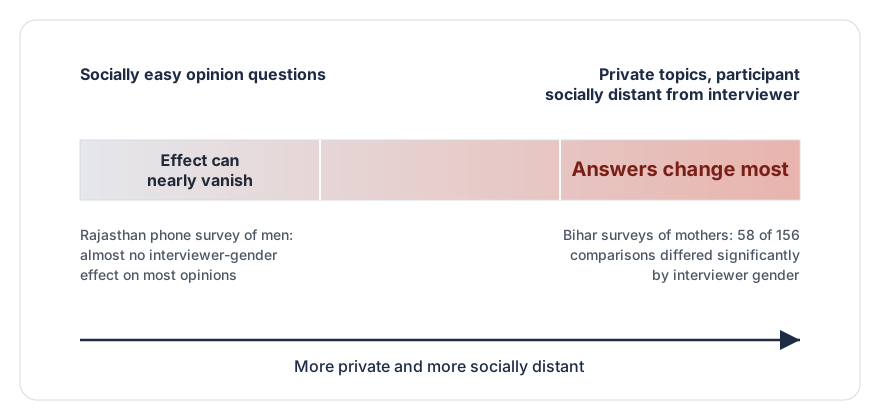
In September 2016, two identical household surveys of mothers ran in two Bihar districts, one with all-male and one with all-female interviewers. Of 156 comparisons across 54 indicators, 58 (37.2%) differed significantly. Male interviewers produced 39 lower estimates and 19 higher ones; 39 of 58 is 67% (Vollmer et al., PLOS ONE, 2021). The gaps clustered on birth preparedness, delivery care, contraception, breastfeeding and reproductive health, while child-health topics showed less gap. A frontline health worker in the study's follow-up explained: "There is no sense of shame if a woman is talking to another woman. But women in the village will definitely feel ashamed while talking to men."
In the Rajasthan study published in 2025, phone numbers for 2,738 men were randomly assigned to male or female interviewers. Answers were near-identical on most gender-attitude questions, and only one question differed noticeably (Hathi et al., Survey Insights, 2025).
Both are structured surveys, not commercial focus groups. The Rajasthan study had only men and eight interviewers. Attitudinal, sensitive, ambiguous, complex and open-ended questions are more prone to interviewer effects (West and Blom, 2017). Qualitative interview questions are mostly open-ended and attitudinal, so the inference is that they are at least as exposed. Plan around topic sensitivity.
What does interviewer bias look like inside an IDI or focus group?
Interviewer bias inside an IDI or focus group looks like a question that carries its answer, a reaction that rewards one kind of answer, or a moderator whose voice, accent, dress, age or values change what people will say (Roller, 2019). Many leading questions compromise validity (Nielsen Norman Group, reviewed 15 July 2026).
- Leading
- "Don't you find the payment screen confusing?"
- Neutral
- "Talk me through the payment screen. What happened at each step?"
- Leading
- "Most people prefer the cheaper pack, right?"
- Neutral
- "Which of these would you pick, and what made you choose it?"
- Leading
- Nodding and "great!" after a favourable comment
- Neutral
- The same flat "thank you, that's helpful" after every answer
- Leading
- Describing the idea in the brand's own words
- Neutral
- Asking about the participant's last real experience first
How do you control interviewer bias before fieldwork starts?
Settle four things in the brief: moderator match, fixed wording for core questions, neutral probes and a review of recordings. The table below is a recommendation. The High row is an inference from the Bihar gender result, extended to household roles, caste and religion. The Low row is an inference from Rajasthan. The Medium row is a judgement.
Test for the Medium pilot. Pass: the two moderators' transcripts give the same answers on the core questions. Fail: answers differ on two or more core questions, in which case assign by match.
Paste this into your market research brief:
- Core questions are asked in the guide's exact wording and order in every session.
- Probes are neutral ("Tell me more", "What do you mean by that?") and never suggest an answer.
- The moderator reacts the same way to positive and negative answers. Pass: the reviewer finds no difference in tone or praise between positive and negative answers in 10 sampled answers of each.
- For sensitive topics, the moderator is matched to participants as agreed in the brief. Pass: every sensitive-topic session has the moderator the brief specifies. Fail: any session that does not.
- The moderator writes a short note after each session on anything that may have shaped answers.
- Participants consent to recording and review before the session. Pass: consent is on record for every participant before recording starts. See informed consent in research.
- A second person reviews a sample of recordings against this list.
To test point 7, pick 20 questions at random from each moderator's recordings. Pass: at most one presumes or offers an answer. Fail: two or more, or one moderator clearly above colleagues, in which case retrain or reassign before more fieldwork. The threshold is a recommendation, not a published standard.
Write the guide itself using the in-depth interview method and focus group discussion guide. The format also changes who is in the room: see online vs in-person focus groups.
- Topic sensitivity
- Low
- Examples
- App navigation, pack design, ad recall
- Moderator match
- Any trained moderator, same core wording in every session
- Topic sensitivity
- Medium
- Examples
- Spending, credit, income, status brands
- Moderator match
- Match language and region; pilot with two moderators and compare transcripts
- Topic sensitivity
- High
- Examples
- Health, family planning, household roles, caste, religion
- Moderator match
- Match gender, and consider age, language and region; test the assignment in a pilot
How Qualfacto handles it
We recruit participants for in-depth interviews and focus groups, online or in person. Studies may be run by us, by research partners or by other research organisations. We can supply moderators, recruit participants by city and run sessions in languages other than English, so moderator match and participant profile can be settled together in one brief. For group sessions, see how to conduct focus groups in India.
Put the topic, the language and who will moderate in the same brief, so the participant profile and the moderator match are settled together. We offer research buyers a free pilot, sample or trial; ask us what it covers for your study.
Share your research brief with our team by email or WhatsApp through Qualfacto. We aim to reply within one business day (Monday to Friday, 10:00 AM to 6:00 PM India Standard Time).
Example
In the Rajasthan phone study of 2,738 men, answers on women eating last were near-identical: 45.6% with male interviewers and 46.7% with female. On affirmative action for women, the share giving the more conservative answer was 16.5% with male interviewers and 8.7% with female.
Frequently asked
Sources
- 1.Interviewer effect, Wikipedia
- 2.Vollmer, Singh, Harshe and Valadez: interviewer gender and mothers' responses in Bihar, PLOS ONE, 2021
- 3.Hathi, Coffey, Thorat and Nagle: matching interviewer and respondent gender in India, Survey Insights, 2025
- 4.West and Blom: Explaining Interviewer Effects, Journal of Survey Statistics and Methodology, 2017
- 5.In-depth Interviewer Effects, Margaret Roller, Research Design Review, 16 September 2019
- 6.User Interviews 101, Nielsen Norman Group
- 7.Use fair and structured interview techniques, GOV.UK, 4 March 2026