
Glossary
Market Research
Market research is the process of finding out what people think, feel and do, so that businesses and organisations can make better decisions.

By Jitendra Kumar Nirala, Founder · Updated 29 Oct 2026
On this page
- 01Definition
- 02Quick facts
- 03Introduction
- 04What marks market research out from opinion
- 05Why research in India must account for language, city and household
- 06Primary vs secondary, qualitative vs quantitative research
- 07Which qualitative format answers which business question
- 08What should you know before you take part in market research?
- 09How consent and participant data are handled in research
- 10How Qualfacto fits in
- 11Example
- 12Related terms
- 13Frequently asked
What is market research?
Primary research collects new information; secondary research uses information that already exists. Qualitative research explains why people act; quantitative research counts how many. In India, what people say in one city, language or household type may not hold in another, which is why researchers ask about your background when you register.
Key takeaways
- Market research turns a business question into evidence you can trace: who was asked, how, and what it changed.
- Researchers decide who to hear from before they choose a method, because a finding from one Indian city, language or household type may not hold in another.
- If you take part in a study, you should know the topic, format, time needed and applicable reward details before you decide.
Quick facts
- Set by
- ICC/ESOMAR Code (2025 edition), 13 articles
- In force since
- 1 April 2026 for MRSI members in India
- Global industry size
- US$142 billion in 2023, up 8% (ESOMAR)
- Main types
- Primary or secondary; qualitative or quantitative
Introduction
Many people who look up market research expect a survey. The industry behind it is far larger than that. ESOMAR's Global Market Research 2024 report says the global insights industry grew 8% in 2023, from almost US$130 billion to US$142 billion. ESOMAR is the global association for research and insights professionals.
A typical study runs like this: someone in Lucknow or Coimbatore is asked about a snack, a bank app or a phone, and a decision is made elsewhere on the strength of the answer. Whether that decision is sound depends on who was asked, in which language, and on what terms.
This page explains what market research means, the main types, which research format answers which question, and what it can mean for you if you take part in a study.
What marks market research out from opinion
What marks research out is a method you can describe and repeat. A relative's view on your packaging is an opinion. Recorded interviews with the buyers you want to reach, asked the same questions and compared, are research.
The 2025 code is the profession's rulebook, with 13 articles on how participants, clients and the public must be treated. The Market Research Society of India (MRSI) announced its adoption in December 2025, and its members have been bound by it since 1 April 2026.
Why research in India must account for language, city and household
Research most often helps you decide four things: what to build, what to charge, what to say and how the customer experience should work. It matters because each is costly to reverse once money is spent. Product teams use it before building, brands before launching or repricing, and agencies and consultancies commission it for clients.
Language, city and household each change what people say and do, so a finding from one place may not hold in another. As of the 2011 Census, the Language Atlas of India covers 121 languages: 22 scheduled in the Constitution and 99 not.
This is why researchers ask about your city, language and household when you create a participant profile. It helps match you to studies where your background is relevant. It does not mean everyone who registers will be invited to a study.
Primary vs secondary, qualitative vs quantitative research
Primary research collects new information directly from people for your question. Secondary research uses information others have already collected, such as government data, published reports or your own sales records. Start with secondary because it is quick to check, then use primary for what it cannot answer.
Four kinds of research on two scales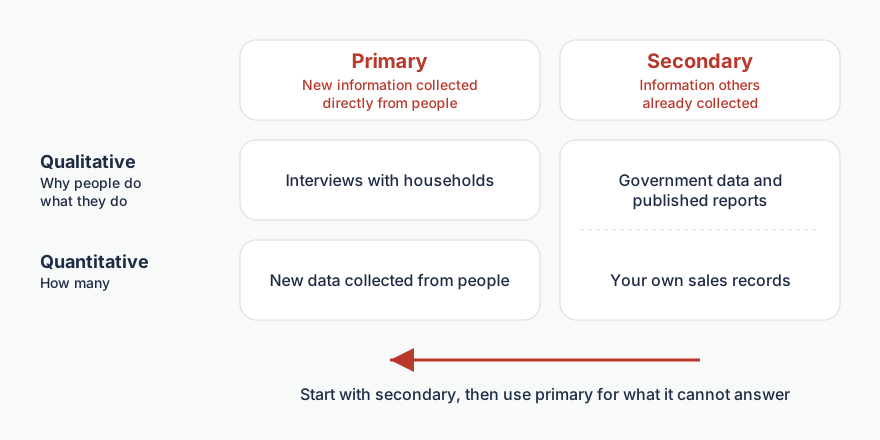
Data is also qualitative or quantitative. Qualitative research uncovers why people do what they do, through descriptive insight into their perceptions, opinions, beliefs and attitudes. It usually involves fewer people than quantitative research, which collects numbers from many people to measure how many, how much or how often.
- Aspect
- Examples
- Primary research
- Interviews, focus groups, diary studies
- Secondary research
- Census tables, trade reports, your sales records
- Aspect
- Good for
- Primary research
- Why people act; your own question
- Secondary research
- Background and context
- Aspect
- Limit
- Primary research
- Needs recruitment and consent
- Secondary research
- May not fit your city or customer
Which qualitative format answers which business question
Choose the format from the question. Interviews suit personal reasons, focus groups suit group reactions, diaries suit what happens over days, shop-alongs and ethnography suit behaviour in context, and usability tests suit whether a task works.
- Your question
- Why did this buyer choose or drop us?
- Format
- In-depth interview (IDI)
- What it is
- A one-to-one conversation about personal reasons
- Your question
- How does a group react to this idea, pack or advert?
- Format
- Focus group discussion (FGD)
- What it is
- A moderated group discussion of reactions and disagreements
- Your question
- What happens over a week, not an hour?
- Format
- Diary study
- What it is
- Participants log photos and videos in their own routine
- Your question
- What do people do at the shelf or at home?
- Format
- Shop-along and ethnography
- What it is
- A shop-along follows a buyer through a store or app; ethnography is watching people in their homes or normal routines
- Your question
- Can people finish this task on our app or site?
- Format
- Usability test
- What it is
- Watching where people hesitate or fail while using a product
What should you know before you take part in market research?
Before you take part in a study, you should know what you are agreeing to. With Qualfacto, an invitation includes key details such as the study topic, format, expected time commitment and applicable reward, so you can decide whether the study suits you. Here is what to check:
- Topic. What is the study about?
- Format. Is it an interview, a group discussion, a diary activity or a product or app test, and is it online or in person?
- Time. How long will it take, and when?
- Reward. Rewards depend on the specific study and its participation terms. Check the applicable reward details before you agree.
- Consent and data. Will the session be recorded, and how will your information be used? Read the Privacy Policy before you decide.
Once you take part, share honestly. There is no right answer, and you do not need to give the answer you think someone wants to hear.
How consent and participant data are handled in research
Participation must be voluntary and based on clear information, and participants can withdraw at any time. Personal data goes to a client only if the participant agreed to that purpose and transfer, and researchers keep client communications and results confidential unless agreed otherwise. These duties sit in Articles 4, 6 and 8 of the ICC/ESOMAR Code.
As of 23 October 2026, the DPDP Rules, 2025, made under India's Digital Personal Data Protection (DPDP) Act, 2023, apply in phases. The provisions setting up the Data Protection Board took effect on 13 November 2025. The notice, consent and data principal rights rules take effect on 13 May 2027, and a data principal is the person whose data is collected.
You can read how Qualfacto handles participant information in its Privacy Policy. To ask for your data to be deleted, see Data Deletion.
How Qualfacto fits in
Qualfacto connects people in India with opportunities to share their experiences and opinions through qualitative market research. Depending on the study, you might take part in an in-depth interview, a focus group discussion, a diary study, an online bulletin board (a written discussion over several days), ethnography, a shop-along, a product test, or an app or website usability test, online or in person.
Studies may be conducted by Qualfacto, research partners or other research organisations, depending on the project. Study invitations depend on each project’s requirements and your participant profile. Registering is an expression of interest and does not guarantee selection or immediate study invitations. Rewards, eligibility and timelines depend on the specific study and its participation terms, and these details are shared before you take part. You can read the Terms of Participation on our website.
Joining Qualfacto is free. You should never be asked to pay to register or to access a research opportunity. To be considered for suitable studies, register with Qualfacto.
Example
Illustrative example: A snack brand plans to launch a small pack in a second city. Its sales data, which is secondary research, shows what sold. Interviews with households, which are primary qualitative research, show who decides the purchase and why a pack is skipped, which sales figures cannot. People who take part in such interviews help the brand understand real choices, not guess at them.
Frequently asked
Sources
- 1.ICC/ESOMAR International Code on Market, Opinion and Social Research and Data Analytics, 2025, ESOMAR
- 2.MRSI adopts global ICC/ESOMAR 2025 Code, Market Research Society of India, December 2025
- 3.Global Market Research 2024 report, ESOMAR
- 4.Language Atlas of India, Census of India 2011
- 5.About Qualitative Research, QRCA
- 6.Definition of Marketing, American Marketing Association
- 7.Digital Personal Data Protection Rules, 2025, G.S.R. 846(E), Gazette of India