Glossary
Response Bias
Response bias is a general term for tendencies to answer inaccurately.

By Jitendra Kumar Nirala, Founder · Updated 23 Oct 2026
On this page
- 01Definition
- 02Introduction
- 03What is response bias in interviews and focus groups?
- 04Which response biases hit interviews and groups hardest?
- 05How can you check a transcript for dominant voices?
- 06What should a brief specify to reduce response bias?
- 07How Qualfacto handles it
- 08Example
- 09Related terms
- 10Frequently asked
What is response bias in interviews and focus groups?
Response bias is a general term for tendencies for participants to respond inaccurately or falsely to questions. In interviews and groups, much of it is triggered by the setup, such as who speaks first and how the guide is ordered.
Key takeaways
- Interviews and groups can reduce response bias but not remove it.
- Five forms matter most in qualitative work: dominant voices, conformity (changing your answer to match the group), recall error, question order and leading probes (a probe is a follow-up question that asks the participant to say more).
- Each form leaves a trace you can check, such as the share of words per participant or whether an answer describes a specific occasion.
- Put the controls in the brief before fieldwork: a guide that puts open questions before named options, with stimulus (the concept, advert or product you show) order rotated across groups, and a moderator who redirects dominant speakers.
Introduction
In interviews and groups it appears as dominant voices, conformity, recall error, question order and leading probes, reduced by design.
A focus group transcript can look like eight opinions and be one. Whoever speaks first and most sets the frame, and the others adjust to it. In the transcript, a dominant voice appears as one person's wording repeated back, in slightly different forms, by everyone else.
One-to-one interviews have quieter versions of the same problem. Memory fills gaps, so a participant describes what usually happens rather than what happened last week. An earlier question changes how the next one is read, so the order of your guide shapes the answers. Each error is quiet: the transcript reads smoothly and nothing flags that the setup shaped what was said.
What is response bias in interviews and focus groups?
Response bias has several types, including acquiescence bias, agreeing regardless of your view, and social desirability bias, answering to look good in front of others. Social desirability bias is a main driver of conformity in groups. Non-response bias and undercoverage bias are different: they concern who is missing from a survey sample, not how the people present answer.
Question order shows the mechanism. In a 1950 survey experiment, support for letting reporters from the other side into the US rose by 37 points, and the reverse item by 24 points, depending on which question came first (Hyman and Sheatsley, as reported on Wikipedia). An interview guide is likely to work the same way, because each question changes what the next one means.
Which response biases hit interviews and groups hardest?
Five forms matter most: dominant voices, conformity, recall error, question order and leading probes. The table gives the trace each leaves in a session or transcript and the evidence behind it.
Five response biases and the trace each leaves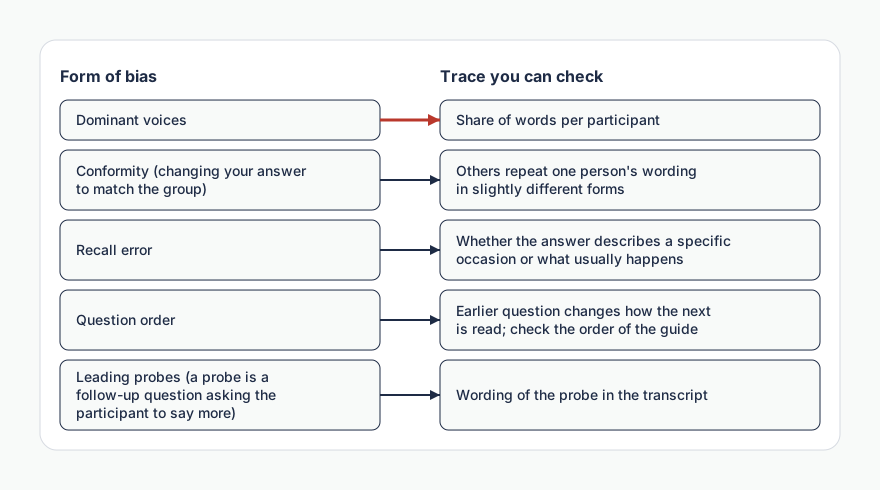
Format changes the mix. In a study of five groups (21 participants), online groups had fewer direct exchanges between participants, and the facilitator held more control (de Souza et al., 2024). That is a small sample, so treat it as a lead. See online versus in-person focus groups for the trade-off.
In a 2025 test with 13 participants, seating participants on a floor-sized rating scale before they explained their position reduced dominance and conformity effects (Alimoradi et al.).
- Form
- Dominant voice
- What you see
- One or two people supply most quotes on a theme, because without active moderation a transcript over-represents the most vocal (CASRAI). A badly moderated group of nine can carry the views of about three people (Nielsen Norman Group).
- Form
- Conformity
- What you see
- Later speakers echo the first and agreement arrives fast. In a 2003 experiment, consumers' attitudes and purchase intentions moved toward more moderate positions after focus-group discussion, more than after answering alone on a survey or in a nominal group (Bristol and Fern). Shifting views do not prove conformity; some of the shift may be deference to the group.
- Form
- Recall error
- What you see
- Answers start with "usually", or events are dated closer to the present than they were. Survey research shows the error grows with longer reference periods (Bradburn, US Bureau of Labor Statistics); applying this to interviews is an inference. Specific events jog memory better than general processes (Nielsen Norman Group).
- Form
- Question order
- What you see
- A named brand or option colours later answers, as the 1950 reporters experiment above shows.
- Form
- Leading probe
- What you see
- Participants say yes to the interviewer's wording, and many leading questions compromise the validity of the data (Nielsen Norman Group).
How can you check a transcript for dominant voices?
Count each participant's words and divide by the participant total. The method is to code every statement by participant, then see how much of any theme comes from one member (Kidd and Parshall, 2000).
A suggested threshold, not a published standard, is twice an equal share (2 × 100 ÷ n, so 25% for 8 people). It is a simple flag for review, not a proven cut-off.
Tally sheet: participant code | words | share of total | themes introduced | themes only echoed.
What should a brief specify to reduce response bias?
A brief should specify five tests, one per form. Each has a pass and a fail. These are recommendations, to be added to your market research brief.
How do you test for a dominant voice?
Pass: no participant above twice an equal share of words (25% in a group of 8). Fail: any participant above that share. Flag for review: if that participant introduced themes that three or more others then echoed, treat those themes as unverified and re-probe them in the next group.
How do you test for conformity?
Pass: on each key question, participants write or record an answer before anyone speaks aloud, and the moderator asks for a different view when agreement arrives within minutes (CASRAI). Fail: the first speaker answers aloud, or the moderator moves on after quick agreement.
How do you test the recall window?
Pass: every past-behaviour question names the last occasion within the past 7 days (30 days for infrequent behaviour). Fail: any question starting "usually" or "in general", or naming an older occasion.
How do you test guide order?
Pass: no brand or option is named until all open questions are done, and stimulus order is rotated across groups. Fail: any named option in the first third of the guide, or the same stimulus order in every group. The focus group discussion guide and in-depth interview method show the structure.
How Qualfacto handles it
We choose the format to fit the bias. We run In-Depth Interviews, Focus Groups, Online Bulletin Boards and Digital Diary Studies. A diary captures behaviour in the moment, so recall error is smaller. In our view, an asynchronous board reduces the contest for airtime that a room creates.
Recruitment is the other lever. We recruit by city, check identity before invitation, and target by household and demographic profile. This lets you keep groups apart where deference is likely, for instance by gender or age (our recommendation). Sessions can run in languages other than English.
We can supply the moderator, or the study can be run by research partners, depending on the project.
Example
A group of 8 produces 6,400 participant words, and participant 3 accounts for 1,920. That is 1,920 ÷ 6,400 = 30%, against an equal share of 12.5% (100 ÷ 8). The numbers are invented for illustration. The next check is whether participant 3 introduced the themes the rest echoed.
Frequently asked
Sources
- 1.Response bias, Wikipedia (reports Hyman and Sheatsley, 1950)
- 2.Bradburn, Recall Period in Consumer Expenditure Surveys, US Bureau of Labor Statistics
- 3.Kidd and Parshall (2000), Getting the Focus and the Group, Qualitative Health Research
- 4.Bristol and Fern (2003), The effects of interaction on consumers' attitudes in focus groups, Psychology & Marketing
- 5.de Souza et al. (2024), Changes in participant interactions, International Journal of Qualitative Methods
- 6.Alimoradi et al. (2025), Rethinking Focus Groups, Human Factors and Ergonomics Society proceedings
- 7.CASRAI, Focus Groups: Design, Moderation, Analysis
- 8.Nielsen Norman Group, User interviews 101
- 9.Nielsen Norman Group, Focus groups 101