Glossary
Unmet needs
Unmet needs are things people value that current products or services serve poorly. A complaint becomes one only when behaviour, such as a workaround or a payment, proves it.

By Jitendra Kumar Nirala, Founder · Updated 23 Oct 2026
On this page
- 01Definition
- 02What are unmet needs in customer research?
- 03Why is a complaint not yet an unmet need?
- 04Which three tests separate a real unmet need from noise?
- 05Which research method shows an unmet need?
- 06How do you rank candidate needs once you have found them?
- 07What do related terms and other fields mean by unmet need?
- 08How Qualfacto handles it
- 09Example
- 10Related terms
- 11Frequently asked
What are unmet needs in customer research?
An unmet need is something a person cares about that the available options serve poorly. It is about the job the person is trying to do, not about any one product, and it differs from a want or a feature request.
Key takeaways
- Three tests separate a real unmet need from noise: you saw a workaround, it has a stated cost, and people paid or switched.
- Interviews report behaviour and observation shows it, so use diary studies, home visits, shop-alongs or in-home use tests for the proof.
- Rank candidates only after the qualitative work, and treat the score as an ordering aid, not a pass mark.
Someone can complain about a delivery app every week and never change how they order. People complain about things they will never pay to fix. What users say and what they do are often quite different, so interview answers alone need checking against behaviour (Nielsen Norman Group).
What are unmet needs in customer research?
Strategyn frames the aim as finding which desired outcomes customers feel are underserved or overserved (Strategyn). The product-discovery view groups "customer needs, pain points, and desires that are not currently being satisfied" under the term (Product Talk).
Two things follow:
- The person may never have said it aloud.
- It is about the job they are trying to do, not about your product.
Why is a complaint not yet an unmet need?
A complaint costs the speaker nothing, so it is a hypothesis, not a finding. A pile of complaints only shows what annoys people.
Three look-alikes are often confused with a need:
- A want: a preference with no cost attached.
- A feature request: one customer's guess at a solution. The need sits underneath it.
- A pain point: often real, and part of an unmet need, but on its own it does not show that anyone acts on it.
The gap between talk and action is well documented. What users say and what they do are often quite different, and the mismatch is a rich source of insight (Nielsen Norman Group, 1 March 2024). Interviews collect reported behaviour, not observed behaviour (Nielsen Norman Group).
Which three tests separate a real unmet need from noise?
A candidate need is real when you have seen a workaround, the participant can put a cost on it, and someone paid or switched because of it. Run all three on every candidate. All three must pass for a candidate to count as an unmet need. These pass thresholds are a practitioner recommendation, not an industry standard.
Three tests a candidate need must pass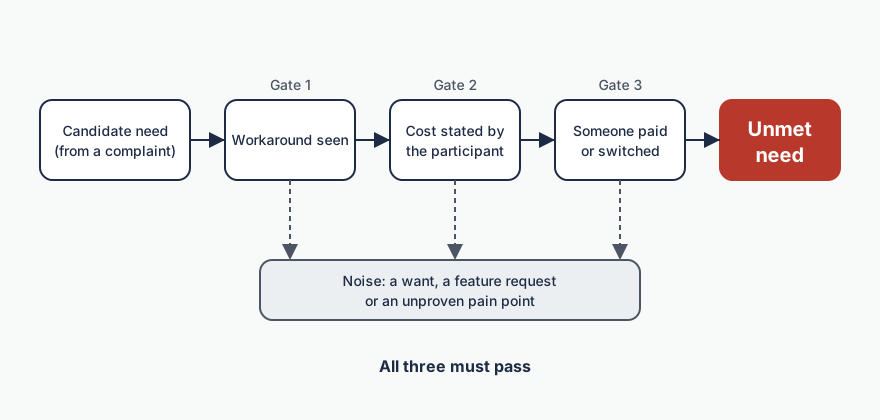
Half of a small qualitative sample is a signal, not a measure of how common the need is.
Record each candidate on an evidence card with these fields:
- The situation or job, in the participant's words.
- The current workaround.
- Its cost.
- Evidence type: said, shown or paid for.
- How many of how many participants, by segment.
- What they tried and dropped.
- Verdict: complaint only, unmet need, or overserved (the options already satisfy a need better than the customer needs).
- Test
- Workaround seen
- Pass
- You have it as evidence: a diary entry, a screen recording or a home visit
- Fail
- It was only described in an interview
- Test
- Cost stated
- Pass
- The participant names the cost in minutes, rupees or steps, and at least half the participants in that segment show the same cost
- Fail
- Fewer than half of the participants in the segment show the same cost
- Test
- Paid or switched
- Pass
- A receipt, an account or subscription record, or a diary entry shows the payment or switch
- Fail
- A spoken claim alone
Which research method shows an unmet need?
The method that shows an unmet need is the one that lets you see the workaround, not just hear about it. Choose by what you suspect.
Start with in-depth interviews to find candidates. Then use a method that shows behaviour before you call anything a need.
- What you suspect
- A complaint, no detail yet
- Method
- In-depth interview
- What the method is
- A one-to-one conversation of 30 to 120 minutes
- What it gives you
- Stories of the last time it happened
- What you suspect
- A hidden workaround
- Method
- Diary study or digital ethnography
- What the method is
- A diary study is multi-day photo and video tasks on a mobile app or the web. Digital ethnography is observing people in their everyday setting through virtual sessions
- What it gives you
- The workaround in the moment, over days
- What you suspect
- Friction while buying
- Method
- Shop-along
- What the method is
- Walking through a shopping journey, in store or online, while the participant shares what they notice and choose
- What it gives you
- What people do in the aisle or app
- What you suspect
- A gap in using a product
- Method
- In-home use test
- What the method is
- Trying a product at home and sharing the experience
- What it gives you
- Real use at home
How do you rank candidate needs once you have found them?
Rank them with a survey of importance and satisfaction, after the qualitative work has produced the candidate list. The common formula is opportunity = importance + max(0, importance − satisfaction) (Strategyn). Respondents rate on a 5 to 7 point scale. The share giving the top two points is converted to a 0 to 10 score, and the formula uses those scores (Buchanan, an unverified practitioner critique).
The scores below are illustrative, worked with the formula above. Importance alone puts B first. The gap puts A first, because A matters almost as much and is served far worse.
Because the formula adds importance twice, check whether the ranking changes when you sort by the importance-satisfaction gap alone before relying on the order. Use the score to order candidates, not as a pass mark. This step needs a far larger sample than interviews.
- Need
- A
- Importance
- 9
- Satisfaction
- 3
- Opportunity
- 9 + 6 = 15
- Need
- B
- Importance
- 10
- Satisfaction
- 8
- Opportunity
- 10 + 2 = 12
- Need
- C
- Importance
- 5
- Satisfaction
- 6
- Opportunity
- 5 + 0 = 5
How Qualfacto handles it
Qualfacto recruits and runs the qualitative step in India, matched to the test you need to pass. Its formats include in-depth interviews (30 to 120 minutes), digital diary studies (multi-day photo and video tasks on a mobile app or the web), ethnography (home visits or virtual), shop-alongs, in-home use tests and online bulletin boards.
It recruits by city, runs sessions in languages other than English, checks participant identities before invitation, and targets by household and demographic profile. You can bring your own moderators. Deliverables depend on scope and are agreed before the study starts. They can include recordings, transcripts, structured data exports and reports.
Pricing is set per project, based on method, audience and sample, and a free pilot is offered. Email your brief to support@qualfacto.io, Monday to Friday, 10:00 to 18:00 Indian Standard Time (IST). Qualfacto aims to reply within one business day.
Example
A founder hears ten complaints, calls them an unmet need, and builds. The complaints were real, but the need was never tested.
Frequently asked
Sources
- 1.Customer Needs Definition, Strategyn
- 2.Market opportunity and the opportunity algorithm, Strategyn
- 3.Unmet Needs, Product Talk
- 4.What People Say vs. What They Do, Nielsen Norman Group, 1 March 2024
- 5.User Interviews 101, Nielsen Norman Group
- 6.Unmet need, Health United States, CDC
- 7.Unmet need, Think Local Act Personal
- 8.Outcome Driven Innovation: A Critique on the Quantification Process, Braden Buchanan (unverified practitioner critique)