Laddering Technique in India: Script, Sample, Cut-Off Maths
The laddering technique climbs from a product feature to a personal value by asking why it matters. Plan interviews and cut-off together: a rule built for 125 ladders breaks at 10.

By Jitendra Kumar Nirala, Founder · Updated 3 Nov 2026

Key takeaways
- A laddering study depends on three numbers that must agree: interviews, ladders per interview and cut-off. A 2020 review reports 30 to 50 interviews for a hierarchical value map. Our recommendation, based on one six-interview study, is 6 to 10 interviews for a hand-drawn sketch, where you draw and group each respondent's ladders by hand.
- A 60-minute interview works from the respondent's last real choice. It covers up to three attributes and uses rotating probes. Follow every fork, and stop climbing when the answer becomes about the person.
- In our 10-ladder worked example, a cut-off of 4 keeps 7% of all relations and a cut-off of 2 keeps 82%.
- Below about 30 interviews, show each respondent's ladder and report how many people sit behind each link instead of using a cut-off.
In this article
- 1What is the laddering technique and when does it fit?
- 2How do you run a laddering interview in 60 minutes?
- 3How many interviews does a laddering study need?
- 4Why does the usual cut-off of 3 to 5 fail on a small study?
- 5What goes wrong in ladder interviews, and how do you stop it?
- 6How do you recruit and field laddering interviews in India?
- 7Frequently asked questions
A laddering interview takes one line to write and a long time to analyse. The question "why does that matter to you?" is the easy part. What shapes the study is how many answer chains you collect and where you cut the final map.
Laddering is a one-to-one interview technique. It starts from something a person chose, such as a feature of a grocery app. It keeps asking why it matters until the answers stop being about the product and start being about the person. Each chain of answers is a ladder.
The analysis rules were written for large samples, and a smaller study needs different handling. A hierarchical value map is a diagram of the most frequent links from features to values, and the cut-off is the minimum number of links needed to draw a line on it. This page gives a 60-minute script, a table for planning interviews and hours, and a worked example that shows where the usual cut-off fails. It is written for researchers fielding interviews in India.
What is the laddering technique and when does it fit?
The laddering technique is a one-to-one interview that moves from a feature a person chose, to what it does for them, to why that matters in their life. The three levels are attributes, consequences and values. It fits past or current choices, not hypothetical ones.
The idea behind it is means-end theory: people choose things because features lead to consequences that serve their values. Reynolds and Gutman set out the interview and analysis method in the Journal of Advertising Research, 1988. One ladder reads: free delivery, then saves money, then budget control, then security.
This page covers soft laddering, the conversational interview. It needs a trained interviewer who follows the respondent. Hard laddering forces respondents to build ladders step by step, often through a questionnaire.
Start from the last real choice. The attribute you begin with shapes every ladder that follows, and different ways of eliciting attributes produce different sets, according to Grunert, Grunert and Sørensen (1995, working paper). A remembered purchase gives you attributes that were actually used in a decision.
How do you run a laddering interview in 60 minutes?
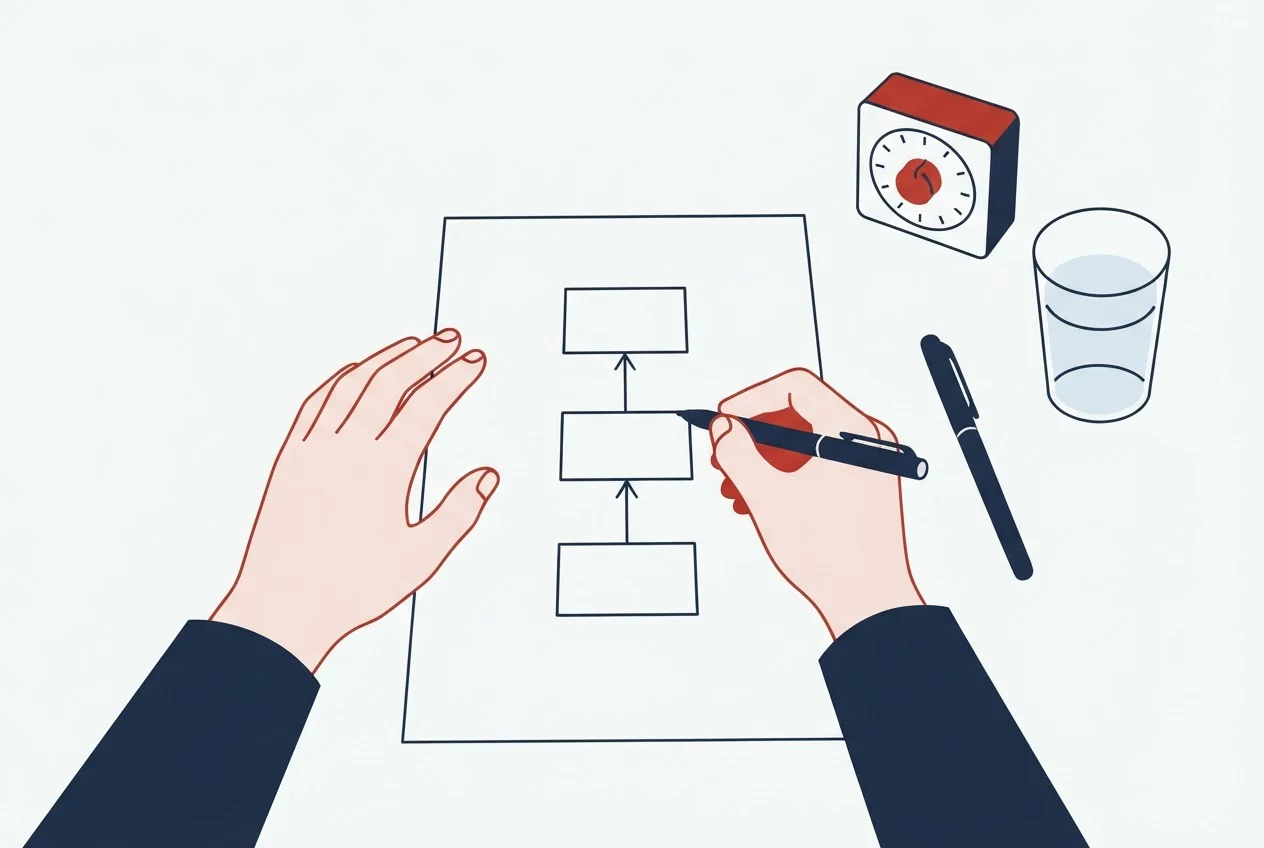
Spend five minutes on warm-up, ten on picking attributes, thirty-five on climbing, and the rest on negatives and close. In a published laddering study, sessions ran 90 minutes with 45 or more spent laddering. Sixty minutes holds up to three attributes.
| Minutes | Stage | What you say or do |
|---|---|---|
| 0 to 5 | Warm-up | State the length. Say: "Some of my questions will sound repetitive. I am trying to understand you, not test you." Add that later questions are more about the person than the product. Get consent to record. |
| 5 to 15 | Pick attributes | Ask: "Think of the last time you chose [category]. What made you pick it over the others?" List up to three attributes in the respondent's own words. |
| 15 to 50 | Climb | Take one attribute at a time. Ask one probe, wait, then ask the next, rotating the wording. |
| 50 to 55 | Negatives | Ask: "What is one thing about it that put you off, or that you would change?" Ladder it the same way. |
| 55 to 60 | Close | Recap the main chain. Thank them and explain how the recording will be used. |
Rotate these probes so the interview does not sound like a loop:
- "Why does that matter to you?"
- "What does that let you do?"
- "What would it mean if you could not?"
- "What does that give you?"
Our recommendation if the respondent stalls: ask for an example from their own week, or ask what a friend would say.
Follow forks. One "why" can bring back several reasons. In an example from Grunert, Grunert and Sørensen (1995, p. 9), asking why "good taste" is important produced "it makes me feel relaxed and joyful", "my family will be pleased" and "it shows that I am a good housekeeper". Write all of them down and climb each in turn. Do not pick one for the respondent.
Stop climbing when the answer is about the person ("it makes me feel…", "my family comes first") or when the respondent repeats an earlier answer. This is our working rule. The method itself gives no fixed number of rungs.
How many interviews does a laddering study need?
Plan 30 to 50 interviews for a hierarchical value map, the range reported by a 2020 systematic review in the Journal of Patient Experience. For a hand-drawn sketch, our recommendation is 6 to 10 interviews, based on one 2023 library study that drew useful value hierarchies from six interviews.
Our planning model sets ladders at 2.5 per interview. That is our own planning assumption, from dividing the 125 ladders and 50 respondents in one example set-up in Reynolds and Gutman (1988). It is not a measured average. Forks add ladders.
| Study type | Interviews | Minutes each | Interview hours | Ladders expected (planning assumption) |
|---|---|---|---|---|
| Hand-drawn sketch | 6 to 10 | 60 | 6 to 10 | 15 to 25 |
| Value map, short sessions | 30 to 50 | 45 | 22.5 to 37.5 | 75 to 125 |
| Value map, 60-minute script | 30 to 50 | 60 | 30 to 50 | 75 to 125 |
| Value map, long sessions | 30 to 50 | 90 | 45 to 75 | 75 to 125 |
Interview hours are interviews times minutes divided by 60. The session lengths are assumptions. Published studies range widely: one study in the 2020 review ran 15 to 78 minutes, another about 50 minutes, and the 90-minute sessions come from the study cited above. Recruiting, transcription and coding come on top. For wider guidance on numbers, see our sample size in qualitative research guide.
Why does the usual cut-off of 3 to 5 fail on a small study?
A cut-off is the minimum number of links between two elements that earns a line on the value map. Reynolds and Gutman (1988) report that a cut-off of 4 with 50 respondents and 125 ladders can account for as many as two-thirds of all relations, and recommend 3 to 5 for 50 to 60 respondents. In the 10-ladder example below, a cut-off of 4 keeps only 7% of relations.
To read the table below, you need two terms. An implication matrix counts how often one element leads to another. A direct link joins neighbouring rungs in a ladder. An indirect link joins elements further apart in the same ladder.
We built a small example. These 10 ladders are illustrative and invented for the method demo. They are not participant data.
- free delivery, saves money, budget control, security
- free delivery, saves money, family comes first, security
- free delivery, saves money, budget control, security
- fast delivery, saves time, more time with family, family comes first
- fast delivery, saves time, less stress, peace of mind
- fast delivery, saves time, more time with family, family comes first
- fresh produce, no waste, budget control, security
- fresh produce, healthy meals, family comes first
- fast delivery, saves time, less stress, peace of mind
- fresh produce, healthy meals, more time with family, family comes first
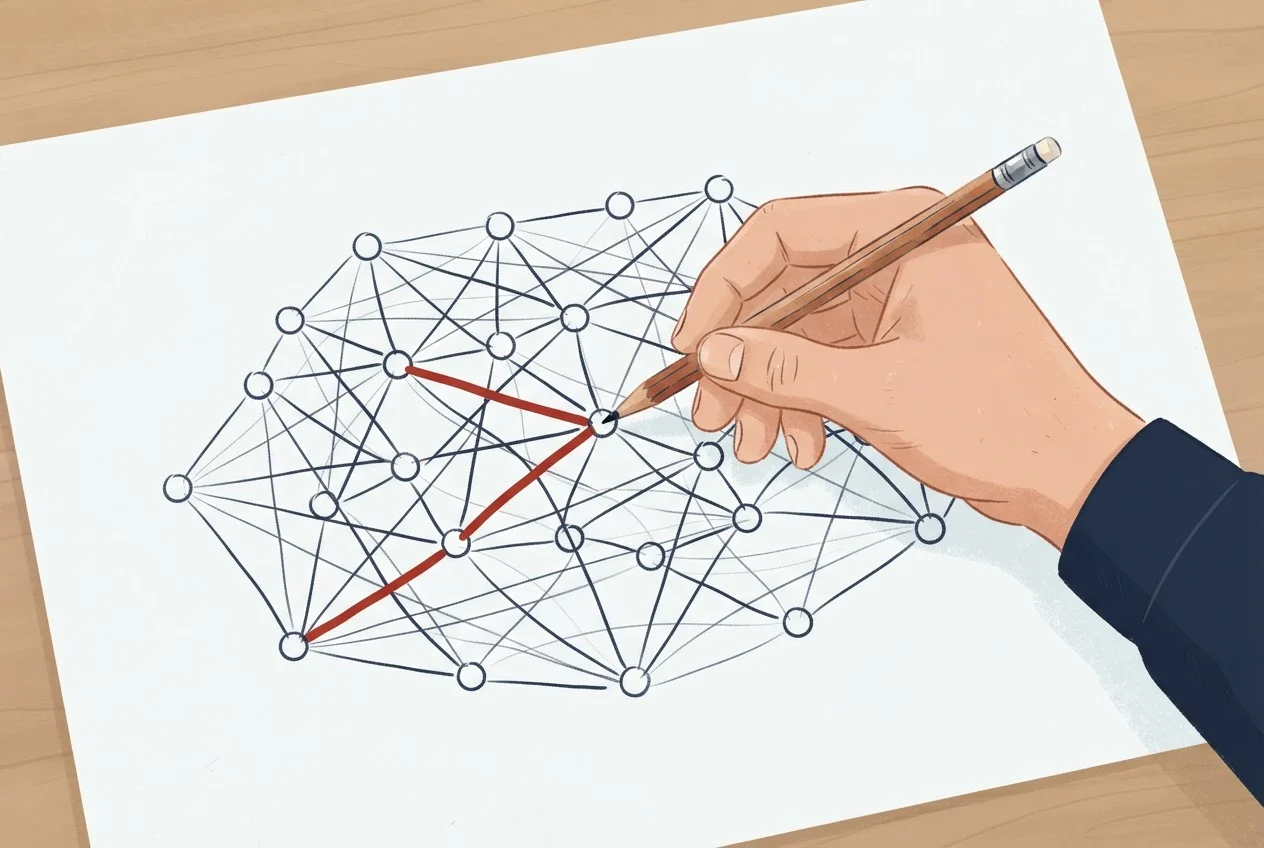
We counted every direct link (29) and indirect link (28), 57 relations in all. For each pair of elements we added direct and indirect counts, then applied the cut-off.
| Cut-off | Links kept on the map | Share of all 57 relations |
|---|---|---|
| 2 | 20 | 82% (47 of 57) |
| 3 | 6 | 33% (19 of 57) |
| 4 | 1 | 7% (4 of 57) |
At a cut-off of 4, one line survives: fast delivery to saves time. A cut-off of 3 leaves six lines, and 2 leaves 20. The result comes from an invented example and will vary with real data.
Draw each respondent's ladder, group them by shared attribute, and report how many respondents sit behind each link.
What goes wrong in ladder interviews, and how do you stop it?
Four problems recur: the interview feels like an interrogation, respondents give tidy answers, forks distort the map, and the ladders are all positive. Veludo-de-Oliveira, Ikeda and Campomar name four barriers to laddering in practice: "time-consuming and expensive interviews; artificial set of answers; researcher biases; and simplistic analysis of the results" (Qualitative Market Research, 2006).
Repetition feels like interrogation. Questions get more personal as they climb. We recommend you state the length and the repetition at the start, rotate the probes, and ask for examples. Do not force an answer. If someone cannot answer, note the question and return to it later.
Respondents give tidy answers. Some want to appear intelligent and respectable, and some answer to meet what they think the interviewer expects. We recommend asking for examples and analogies, leaving silences, using the third-person probe and promising confidentiality.
Forks distort the aggregate. In an illustration in Grunert, Grunert and Sørensen (1995, pp. 16 to 17), a sample of 30 respondents includes 25 with the ladder "good taste, then well-being" and 5 with "good taste, then function better, then well-being". The aggregate map then describes the whole group by the longer chain. Check any map against individual ladders before you report it.
Ladders skew positive. The technique usually asks about positive features and misses the negatives. The 50-to-55-minute slot in the script above fixes this. We recommend a second person code a sample of transcripts independently and compare, so one researcher's reading does not decide the map.
How do you recruit and field laddering interviews in India?
Recruit people who made the relevant choice recently, then interview them one to one. At Qualfacto we recruit by city and by household and demographic profile, and we check each participant's identity before inviting them. We run in-depth interviews of 30 to 120 minutes, online or in person, so the 60-minute script fits comfortably.
Write the screener around the starting choice: a purchase or use of the category within a window you set, and the ability to name what they chose. Our research screener template gives a fill-in structure. Our in-depth interview method guide covers planning and briefing.
We run sessions in languages other than English. Draft the probes in the language the respondent will use, and have a native speaker check each one. We recommend this because a literal translation of "why does that matter?" can sound blunt.
You can bring your own moderators. Deliverables depend on the scope agreed before the study starts: recordings, transcripts, structured data exports or a research report. Coding ladders needs transcripts, so agree that up front. Record only with consent, and see informed consent in research for a form and the Indian rules.
We do not work from a fixed rate card. Each project is priced from your brief, and we offer a free pilot. Email your brief to support@qualfacto.io with the research objective, target audience, city, number of interviews, language and timeline. We aim to reply within one business day (Monday to Friday, 10:00 to 18:00 Indian Standard Time).
If you would like to take part in studies as a participant, see how to join and get invited. Registration does not guarantee selection, and invitations depend on each project's requirements and your profile. Rewards, eligibility and requirements depend on each study's terms.
Field your laddering study with Qualfacto
Email your brief to support@qualfacto.io and we will price it for you, with a free pilot on offer.
Frequently asked questions
A questionnaire can run hard laddering, but it does not reliably replace interviews. The 2006 review by Veludo-de-Oliveira and colleagues reports that hard laddering's advantage is efficiency in data collection, while little is known about its validity and reliability or its match with interview results. Interviews are the safer choice when ladders will drive a decision.
Sources
- 1.Laddering Theory, Method, Analysis, and Interpretation, Journal of Advertising Research 28(1), 11 to 31, 1988
- 2.Laddering in the practice of marketing research: barriers and solutions, Qualitative Market Research: An International Journal 9(3), 297 to 306, 2006
- 3.Means-end chains and laddering: an inventory of problems and an agenda for research, Working paper 34, Aarhus School of Business, 1995
- 4.Using Laddering Interviews and Hierarchical Value Mapping to Gain Insights Into Improving Patient Experience in the Hospital: A Systematic Literature Review, Journal of Patient Experience 7(6), 1740 to 1747, 2020
- 5.Discovering what patrons value in a consumer health library service using laddering interviews, Journal of the Medical Library Association 111(1 to 2), 612 to 617, 2023
- 6.Laddering: A Research Interview Technique for Uncovering Core Values, UXmatters, 6 July 2009
- 7.The worked example and planning table are Qualfacto's own calculations, shown in full on this page.